Essayer OR - Gratuit
Star power
Down To Earth
|April 16, 2022
The world is close to cracking nuclear fusion energy code, a source of virtually endless clean energy

CALL IT a bold vision or the desperation for carbon-free energy, nuclear fusion research is finally gathering momentum and the world's dream of virtual limitless energy is closer to reality than ever before.
On December 21 last year, the world moved a step closer to mastering this energy process that powers our sun and stars. A laboratory in the UK generated 12 MW over five seconds through fusion, more than doubling its own record of 1997. The energy is enough to power 35 homes for five seconds.
But the reason this source of energy, despite being known for some 70 years, has never become viable is that nuclear fusion happens at extremely high temperatures, when nuclei of atoms fuse to form new elements and release huge amounts of energy in the process. In the sun, massive gravitational pressure enables nuclear fusion at around 10 million degrees Celsius. On Earth, where the pressure is much lower, the temperature required is above 100 million degrees Celsius. No material can survive such heat.
To enable fusion in a laboratory, scientists at the Culham Centre for Fusion Energy in Oxfordshire heated a 0.17 mg mixture of deuterium and tritium—two variants of hydrogen—to temperatures 10 times hotter than the sun, converting the gases into plasma, the fourth state of matter. They then held it in place using superconductor electromagnets as it spun around in the doughnut-shaped Joint European Torus (JET) reactor, fusing and releasing vast amounts of energy as heat. If done for more than five seconds, the copper wire electromagnets would have become overheated.

In comparison [to fusion), fossil fuels would have required 10 million times more fuel to generate the same amount of energy
ATHINA KAPPATOU, physicist, Max Planck Institute of Plasma Physics, Germany
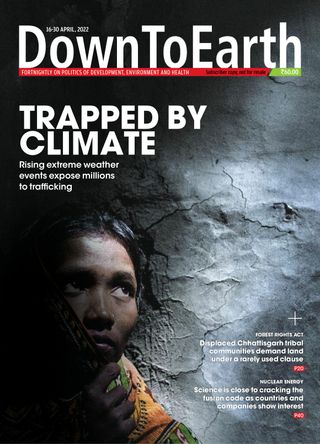

Cette histoire est tirée de l'édition April 16, 2022 de Down To Earth.
Abonnez-vous à Magzter GOLD pour accéder à des milliers d'histoires premium sélectionnées et à plus de 9 000 magazines et journaux.
Déjà abonné ? Se connecter
PLUS D'HISTOIRES DE Down To Earth

Down To Earth
GREAT NICOBAR DILEMMA
In the fragile ecosystem of Nicobar, strategic development must align with constitutional commitment to protect environment, indigenous dignity

3 mins
March 16, 2026

Down To Earth
CATCH BY THE ROOTS
Sabai grass could be a game-changer for the marginalised economies of West Bengal's dry uplands. All it needs is an efficient market strategy
4 mins
March 16, 2026

Down To Earth
POWERING TRANSITION
India's renewable ambitions are rising rapidly, with half of its installed power capacity now coming from non-fossil sources. Yet the gap between capacity and generation remains wide. The experiences of two pioneering states, Karnataka and Tamil Nadu, which together generate over a fifth of the country's renewable energy, offer crucial lessons for accelerating the transition, reports PUJA DAS from Bengaluru, Chennai, Mumbai and New Delhi
16 mins
March 16, 2026

Down To Earth
At core of survival
Water scarcity defines life in a village inside Sariska Tiger Reserve's critical habitat, as debates over its relocation drag on
5 mins
March 16, 2026

Down To Earth
What's on your plate
An upcoming digital tool can help people learn about the origin of their meals and make climate-positive food choices
2 mins
March 16, 2026

Down To Earth
'Bad environment can never be good economics'
The Supreme Court of India and even the high courts were once very active and took a proactive role in protecting the environment; unfortunately, that is no longer true
4 mins
March 16, 2026
Down To Earth
Things fall apart
IN THE past year, the world has counted more missiles and bombs than hours.
2 mins
March 16, 2026

Down To Earth
Universities in crisis, innovation is stifled
Political control and skewed policies have led to unrest in academia, stifling creativity and meaningful research
4 mins
March 16, 2026

Down To Earth
SPARK IN THE GAME
The Reserve Bank of India's restored recognition of Default Loss Guarantees re-enables credit flow into last-mile electric mobility
3 mins
March 16, 2026

Down To Earth
Ushering in new eras
An appraisal of the state of biodiversity conservation, pollution reduction and climate adaptation regimes in India
3 mins
March 16, 2026
Translate
Change font size