Prøve GULL - Gratis
Cormac McCarthy Has Never Been Better
The Atlantic
|January - February 2023
His two new novels are the pinnacle of a controversial career.

The Passenger and Stella Maris, Cormac McCarthy’s new novels, are his first in many years in which no horses are harmed and no humans scalped, shot, eaten, or brained with farm equipment. But you would be wrong to assume that the world depicted in these paired works of fiction, published a month and a half apart, is a cheerier place. "There are mornings when I wake and see a grayness to the world I think was not in evidence before,” The Passenger’s most jovial character, John Sheddan, says to one of several other characters who are suicidally depressed. "The horrors of the past lose their edge, and in the doing they blind us to a world careening toward a darkness beyond the bitterest speculation.”
McCarthy throws the reader an anchor of this sort every few pages, the kind of burdensome existential pronouncement that might weigh a lesser book down and make one long for the good old-fashioned Western equicide of McCarthy’s earlier work. At least when a horse dies, it doesn’t spend a week beforehand in the French Quarter musing about existence. For that matter, neither do most of McCarthy’s previous human victims, who were too busy getting hacked or shot to death to see the darkness coming and philosophize about their condition. To twist a line from the poet Vachel Lindsay: They were lucky not because they died, but because they died so dreamlessly.
McCarthy’s fervent admirers are bound to come to these novels with impossible expectations. The late critic Harold Bloom, who spoke for superfans of the writer everywhere, wrote that "no other living American novelist has given us a book as strong and memorable as
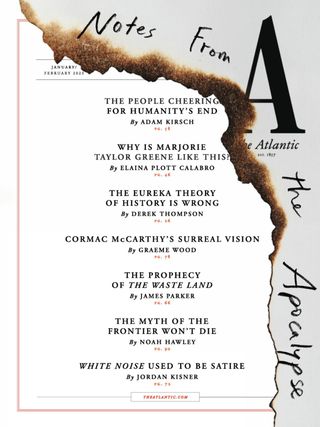

Denne historien er fra January - February 2023-utgaven av The Atlantic.
Abonner på Magzter GOLD for å få tilgang til tusenvis av kuraterte premiumhistorier og over 9000 magasiner og aviser.
Allerede abonnent? Logg på
FLERE HISTORIER FRA The Atlantic
The Atlantic
You Had to Be There
An emerging field of history asks if we can ever really understand how our forebears experienced love, anger, fear, and sorrow.

23 mins
January 2026

The Atlantic
By the Horns
The week before the biggest bullfight of her career, in Cádiz, Spain, this past July, 24-year-old Miriam Cabas posted a carefully produced video on Instagram.
1 mins
January 2026

The Atlantic
The New German War Machine
After World War II, Germany embraced pacifism as a form of atonement. Now the country is arming itself again.
18 mins
January 2026
The Atlantic
The Eloquence
The prime minister was watching a disaster movie when we found him.
4 mins
January 2026

The Atlantic
What's for Dinner, Mom?
The women who want to change the way America eats
12 mins
January 2026

The Atlantic
How Terror Works
A 1947 German novel explores the sometimes corrosive, sometimes energizing nature of fear.
8 mins
January 2026

The Atlantic
Yesterday's Idea of a Modern Man
Sam Shepard, a self-made cowboy, was also a poet of masculine angst.
7 mins
January 2026

The Atlantic
ACCOMMODATION NATION
America's colleges have an extra-time-on-tests problem.
11 mins
January 2026

The Atlantic
Respect the Drummer
A new history of rock, told through its overlooked heroes
5 mins
January 2026

The Atlantic
THE MOST POWERFUL MAN IN SCIENCE
WHY IS ROBERT F. KENNEDY JR. SO CONVINCED HE'S RIGHT?
42 mins
January 2026
Translate
Change font size