試す 金 - 無料
The Mother of Depressions
Scientific American
|December 2025
Postpartum depression is a leading cause of death among new mothers. A new type of drug offers better, faster treatment

Kristina Leos (left), who went through severe depression after the birth of her daughter Victoria, leans in to kiss her child.
POSTPARTUM DEPRESSION DESCENDED on Kristina Leos like a heavy fog that separated her from everyone she loved. She could see her newborn baby girl, her two older kids and her husband, but she felt like a ghost passing through their world. “I was going through the motions, but it was like I was looking down on my family,” she recalls.
Leos, 40, a nurse who lives in Midlothian, Tex., tried several different antidepressants and doses. None helped. She messaged a friend, anxious that she was unfit to be a mother. She even asked if they would take her new baby, Victoria. Although Leos never considered hurting her kids, there were times when she was driving home from work and wondered what it would be like to drive off a bridge. “I just had no fear of dying,” she says. “I didn’t care what happened.”
In December 2023, nine months after Leos gave birth to Victoria, her doctor told her they were running out of options. She was down to serious choices, including infusions of ketamine (a drug that alters the anatomy and activity of brain cells), electroconvulsive therapy or admission to a psychiatric hospital.
Then Leos remembered seeing something on social media about a new drug specifically for postpartum depression. Unlike older antidepressants such as Prozac, this medication worked on brain chemicals that are particularly affected by pregnancy. She asked her doctor about it, and they decided to give it a try. Leos began the medication on New Year’s Day 2024. Three days later her world shifted. “I was driving on the highway, and I could literally feel this huge cloud lifting over me,” she says. “And every day I got better and better.” The drug, called zuranolone and approved by the U.S. Food and Drug Administration in 2023, has since relieved depression in thousands of women.
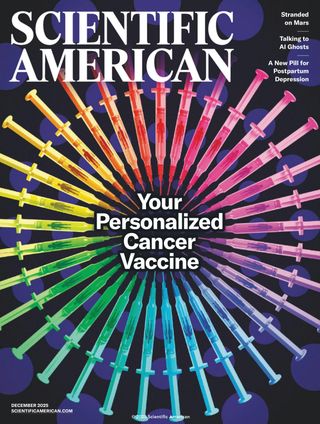

このストーリーは、Scientific American の December 2025 版からのものです。
Magzter GOLD を購読すると、厳選された何千ものプレミアム記事や、10,000 以上の雑誌や新聞にアクセスできます。
すでに購読者ですか? サインイン
Scientific American からのその他のストーリー
Scientific American
Flashes in the Night
Celestial transients shine furiously and briefly. Astronomers are just beginning to understand them.

13 mins
January 2026

Scientific American
The Imperiled Orcas of the Salish Sea
The southern resident killer whales are on the brink. Now the scientists who study them are, too
17 mins
January 2026

Scientific American
The Reptile Sexpocalypse
The sex of many turtles, crocodilians, and other reptiles is determined by the temperature at which their eggs incubate. Global warming could doom them
11 mins
January 2026

Scientific American
A Suite of Killers
Heart ailments, kidney diseases and type 2 diabetes actually may be part of just one condition. It's called CKM syndrome
10 mins
January 2026
Scientific American
A Good Night's Sleep
Psychological data and brain scans show all the ways sleep can improve our lives, our bodies and our relationships
1 mins
January 2026
Scientific American
Behind the Nobel
A 2025 winner reflects on the mysterious T cells that won him the prize
5 mins
January 2026
Scientific American
Cable Quakes
Fiber optics that connect the world can detect its earthquakes, too
2 mins
January 2026

Scientific American
Inside Asteroid Family Trees
Asteroid origins can be hard to trace
4 mins
January 2026

Scientific American
Think Again
Chimpanzees can weigh evidence and update their beliefs like humans do.
3 mins
January 2026

Scientific American
Cracking the World's Most Famous Code
Solving the CIA's Kryptos puzzle took three parts math and one part sleuthing
6 mins
January 2026
Listen
Translate
Change font size