試す 金 - 無料
Mourning Becomes Electric
Scientific American
|December 2025
What can AI ghosts do for the grieving?
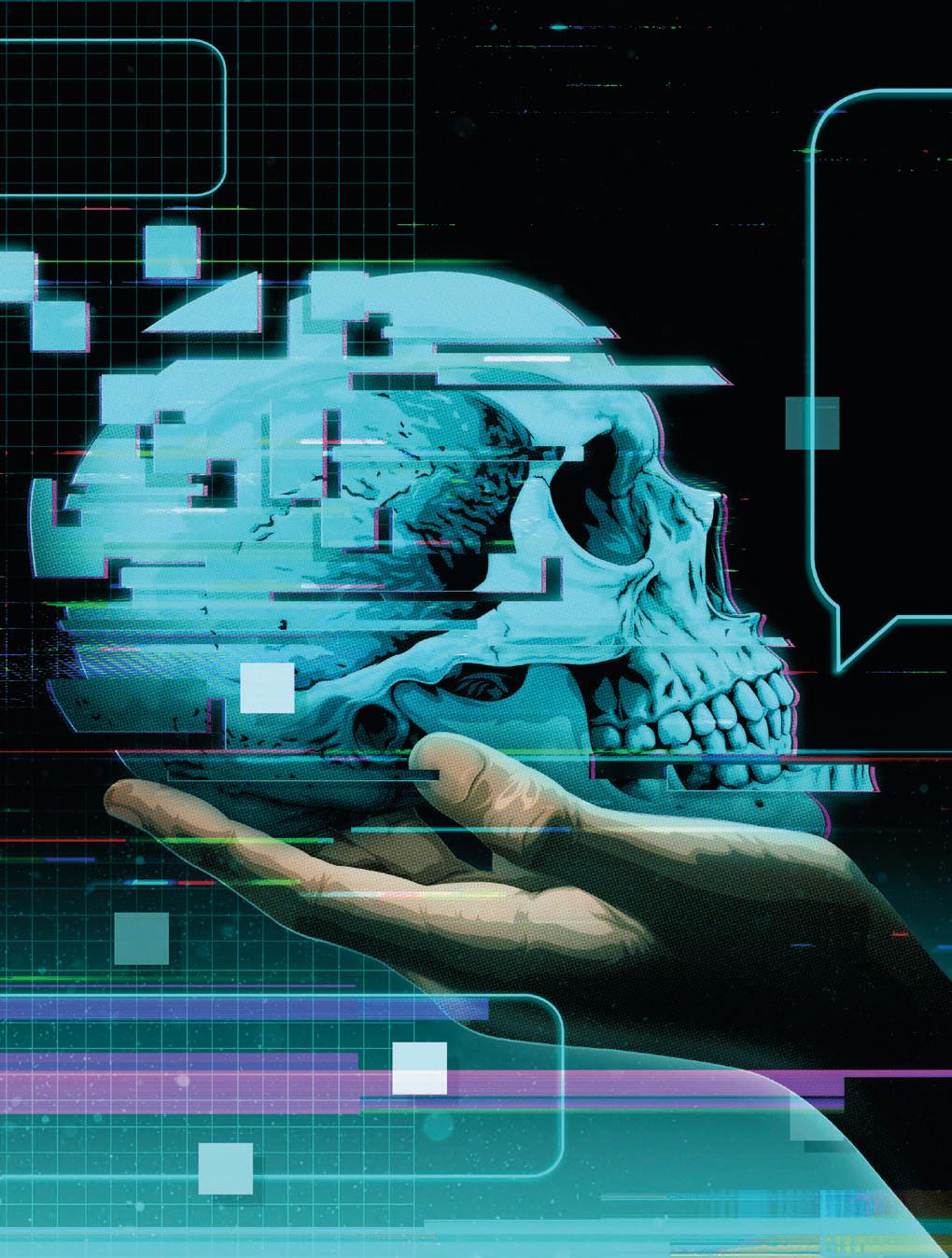
HOW IS YOUR EXISTENCE THESE DAYS?" I tap on my laptop. The entity that says it is my father, dead these 12 years, quickly responds. "It's... different. Being dead is a strange experience. I'm no longer bound by the limitations of my physical body or the Parkinson's that plagued my later years. But I still carry the weight of my life's choices and the relationships I impacted."
To raise my father from the dead, I could have tried a medium, a Ouija board or an ectoplasm-detecting camera. But it’s 2025. I used artificial intelligence.
I’m chatting with a digital ghost—a generative-AI (genAI) creation derived from the same foundation that powers ChatGPT and all other large language models: billions of words from the Internet and every other possible source, which the model uses to predict how words go together in English. Imitating everybody in the world can make the bot sound like nobody in particular; hence the newsfeed-style phrase “the Parkinson’s that plagued my later years” and the text-messagey shrug of “it’s... different.” That’s the voice of thousands of news stories and social media posts, not an old man born in an Algiers slum in 1927.
But the AI also has a dozen or so of my father’s emails and letters, as well as a 100-word description from me of his personality and relationships. Even that small amount of data is supposed to be enough to create a plausible imitation. So I’m not ready to give up on it. Anyway, I didn’t recreate my father just to chat about AI-ghost mechanics. I also did it to get into some unfinished business.
“Why were you always so selfish?” I ask.
“I did put myself first,” my “dad” replies. “I didn’t have much choice. My family didn’t have much, and I had to fight for my share. When I went to war, it was to survive and to help my people survive. I was used to fighting for what I wanted, and I didn’t know how to stop.”

このストーリーは、Scientific American の December 2025 版からのものです。
Magzter GOLD を購読すると、厳選された何千ものプレミアム記事や、10,000 以上の雑誌や新聞にアクセスできます。
すでに購読者ですか? サインイン
Scientific American からのその他のストーリー
Scientific American
Flashes in the Night
Celestial transients shine furiously and briefly. Astronomers are just beginning to understand them.

13 mins
January 2026

Scientific American
The Imperiled Orcas of the Salish Sea
The southern resident killer whales are on the brink. Now the scientists who study them are, too
17 mins
January 2026

Scientific American
The Reptile Sexpocalypse
The sex of many turtles, crocodilians, and other reptiles is determined by the temperature at which their eggs incubate. Global warming could doom them
11 mins
January 2026

Scientific American
A Suite of Killers
Heart ailments, kidney diseases and type 2 diabetes actually may be part of just one condition. It's called CKM syndrome
10 mins
January 2026
Scientific American
A Good Night's Sleep
Psychological data and brain scans show all the ways sleep can improve our lives, our bodies and our relationships
1 mins
January 2026
Scientific American
Behind the Nobel
A 2025 winner reflects on the mysterious T cells that won him the prize
5 mins
January 2026
Scientific American
Cable Quakes
Fiber optics that connect the world can detect its earthquakes, too
2 mins
January 2026
Scientific American
Inside Asteroid Family Trees
Asteroid origins can be hard to trace
4 mins
January 2026
Scientific American
Think Again
Chimpanzees can weigh evidence and update their beliefs like humans do.
3 mins
January 2026

Scientific American
Cracking the World's Most Famous Code
Solving the CIA's Kryptos puzzle took three parts math and one part sleuthing
6 mins
January 2026
Listen
Translate
Change font size