
Magzter GOLDで無制限に
10,000以上の雑誌、新聞、プレミアム記事に無制限にアクセスできます。
Nancy Grace Roman
BBC Sky at Night Magazine
|July 2023
Ezzy Pearson celebrates a scientist whose legacy can be felt across all astronomy

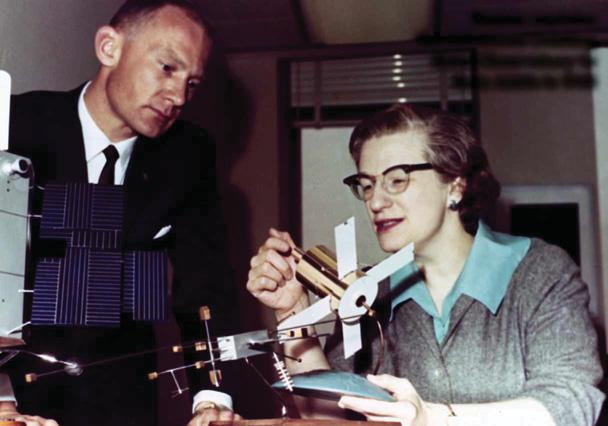
Nancy Grace Roman (16 May 1925 -25 December 2018) not only laid the groundwork for our understanding of how galaxies grow but also founded NASA's space astronomy programme, becoming 'the mother of Hubble'.
Roman's love of the stars was evident from an early age, and she set up an astronomy club for her friends when she was just 10. However, when she told her guidance counsellor she wanted to be a professional astronomer, she was asked, "What lady would take mathematics instead of Latin?".
Ignoring this discouragement, she went on to attain her degree from Swarthmore University before moving to the University of Chicago's Yerkes Observatory for her PhD. Here she studied the motions of stars which formed in the same cluster as the Plough, but which had drifted apart over time.
Later, Roman expanded this research to all Sun-like stars visible to the naked eye and soon noticed that where stars orbited in the Milky Way was connected to their metallicity. Metals (meaning anything heavier than helium in astronomy) are only formed inside stars, so if a star contains a lot of metal it must have been born after several generations of previous stars had already produced them. Younger, metal-rich stars tended to move in circular orbits near our Galaxy's centre, while older, metal-poor stars were further out.
This connection was the first clue towards understanding how the Milky Way grows over time, providing the foundation for modern studies of galactic evolution. Her work also developed a method of gauging stellar metallicities by comparing their brightness at blue and ultraviolet wavelengths, which is still used today.


このストーリーは、BBC Sky at Night Magazine の July 2023 版からのものです。
Magzter GOLD を購読すると、厳選された何千ものプレミアム記事や、10,000 以上の雑誌や新聞にアクセスできます。
すでに購読者ですか? サインイン
BBC Sky at Night Magazine からのその他のストーリー
BBC Sky at Night Magazine
MOONWATCH
January's top lunar feature to observe

2 mins
January 2026
BBC Sky at Night Magazine
Speed up your processing workflow
How to use Photoshop's Actions tool to drastically cut your processing time
3 mins
January 2026
BBC Sky at Night Magazine
Chasing Canada's polar lights
With solar maximum peaking and a new Moon promising dark skies, Jamie Carter travels to Churchill, Manitoba to hunt the Northern Lights - and dodge polar bears – in Canada's far north
7 mins
January 2026
BBC Sky at Night Magazine
Beyond Pluto: The search for the hidden planets
Could one – or even two - undiscovered planets lurk at the edges of our Solar System? Nicky Jenner explores how close we are to finding the elusive 'Planet 9'
6 mins
January 2026
BBC Sky at Night Magazine
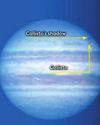
Jupiter moon events
Jupiter is a magnificent planet to observe.
2 mins
January 2026
BBC Sky at Night Magazine
What samples from space have taught us
Alastair Gunn explains what scientists have learnt in the 20 years since the first unmanned mission brought materials back from alien worlds
3 mins
January 2026
BBC Sky at Night Magazine
The Milky Way as you've never seen it before
This is the largest low-frequency radio colour image of our Galaxy ever assembled
1 min
January 2026
BBC Sky at Night Magazine
Merger of ‘impossibly' massive black holes explained
Scientists discover how enormous, fast-spinning black holes can exist after all
1 mins
January 2026
BBC Sky at Night Magazine
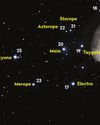
Lunar occultation of the Pleiades
BEST TIME TO SEE: 27 January from 20:30 UT
1 min
January 2026
BBC Sky at Night Magazine
The Universe's expansion may be slowing down
New study suggests current theories of dark energy could be wrong
1 mins
January 2026
Translate
Change font size