Intentar ORO - Gratis
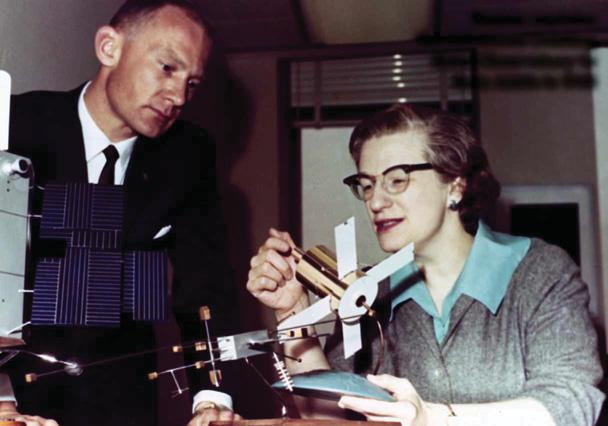
Nancy Grace Roman
BBC Sky at Night Magazine
|July 2023
Ezzy Pearson celebrates a scientist whose legacy can be felt across all astronomy

Nancy Grace Roman (16 May 1925 -25 December 2018) not only laid the groundwork for our understanding of how galaxies grow but also founded NASA's space astronomy programme, becoming 'the mother of Hubble'.
Roman's love of the stars was evident from an early age, and she set up an astronomy club for her friends when she was just 10. However, when she told her guidance counsellor she wanted to be a professional astronomer, she was asked, "What lady would take mathematics instead of Latin?".
Ignoring this discouragement, she went on to attain her degree from Swarthmore University before moving to the University of Chicago's Yerkes Observatory for her PhD. Here she studied the motions of stars which formed in the same cluster as the Plough, but which had drifted apart over time.
Later, Roman expanded this research to all Sun-like stars visible to the naked eye and soon noticed that where stars orbited in the Milky Way was connected to their metallicity. Metals (meaning anything heavier than helium in astronomy) are only formed inside stars, so if a star contains a lot of metal it must have been born after several generations of previous stars had already produced them. Younger, metal-rich stars tended to move in circular orbits near our Galaxy's centre, while older, metal-poor stars were further out.
This connection was the first clue towards understanding how the Milky Way grows over time, providing the foundation for modern studies of galactic evolution. Her work also developed a method of gauging stellar metallicities by comparing their brightness at blue and ultraviolet wavelengths, which is still used today.


Esta historia es de la edición July 2023 de BBC Sky at Night Magazine.
Suscríbete a Magzter GOLD para acceder a miles de historias premium seleccionadas y a más de 9000 revistas y periódicos.
¿Ya eres suscriptor? Iniciar sesión
MÁS HISTORIAS DE BBC Sky at Night Magazine
BBC Sky at Night Magazine
Crush: Close Encounters with Gravity
Gravity is something that we're all innately familiar with. It keeps our feet on the ground, fights against a rocket trying to leave Earth and governs the movement of the planets and stars.

1 mins
April 2026
BBC Sky at Night Magazine
Exploring the Universe
There's no shortage of children's books about astronomy.
2 mins
April 2026
BBC Sky at Night Magazine
Make your Milky Way images pop
Simple, free processing techniques using FastStone Image Viewer
3 mins
April 2026
BBC Sky at Night Magazine
Nightfaring: In Search of the Disappearing Darkness
This book is a manifesto for dark skies, written as a travel memoir.
1 mins
April 2026
BBC Sky at Night Magazine
Flying saucers- The making of a modern myth
Our obsession with UFOs goes back further than you might think. Robert Pateman traces how early science fiction, dubious sightings and an alien-mad media led to the 1950s saucer fever
9 mins
April 2026
BBC Sky at Night Magazine
STAR OF THE MONTH
Alphecca, the brightest jewel in the Crown
1 min
April 2026
BBC Sky at Night Magazine
How to use a planisphere
Navigate the sky with the original stargazer's tool. No batteries, apps or Wi-Fi required!
3 mins
April 2026
BBC Sky at Night Magazine
Why rockets don't launch straight up
For a rocket to get its payload into space, it has to follow a curved path. But what would happen if it didn't?
2 mins
April 2026
BBC Sky at Night Magazine
Q&A WITH A DARK MATTER SPECIALIST
Dark matter makes up 27 per cent of all matter in the Universe. So why is it so hard to find? Meet one of the people making a map that leads us to it
3 mins
April 2026

BBC Sky at Night Magazine
Why I want to put a hotel on the Moon
Bored of the beach? Sick of city breaks? Step this way. Space entrepreneur Skyler Chan explains how he'll build a holiday destination on the Moon by 2030
2 mins
April 2026
Translate
Change font size