試す 金 - 無料
Authentic Memory
Outlook
|September 11, 2025
The growing silence between father and son becomes almost a theme in its own right in Jey Sushil's Dukh Ki Duniya Bhitar Hai
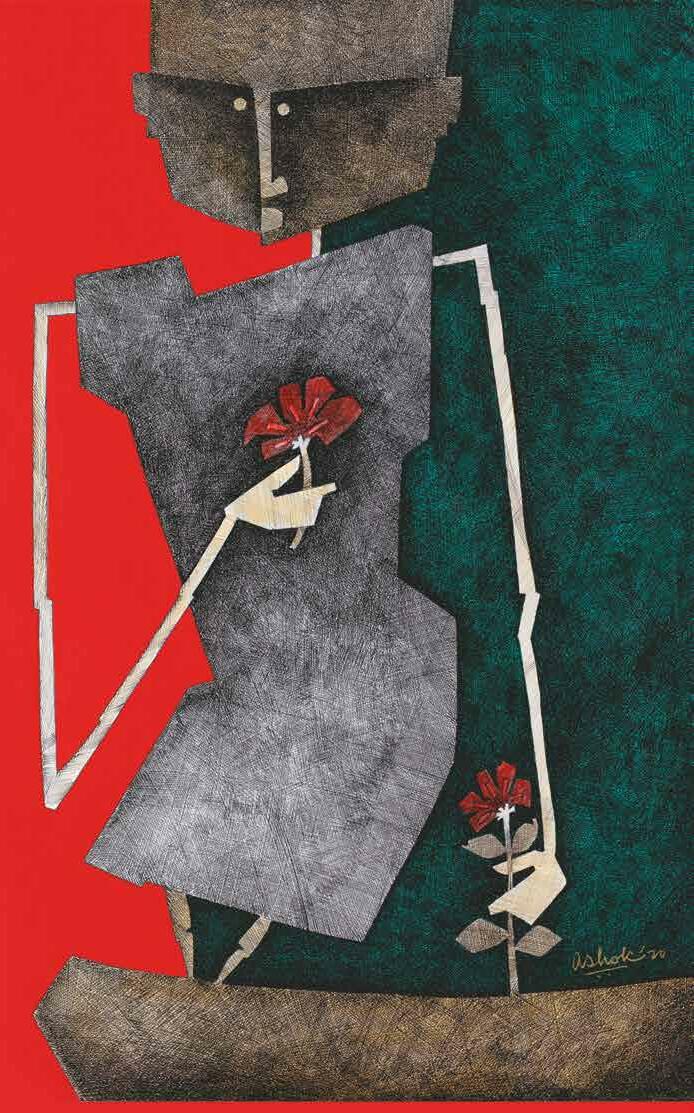
JEY Sushil’s Dukh Ki Duniya Bhitar Hai is a profoundly moving memoir that begins as a son’s attempt to grapple with the grief and memories that follow the death of his father and gradually expands into a rich social portrait of postcolonial India. It is about remembrance—of a father’s presence and absence, of sweetness and bitterness, closeness and distance—and about a son’s effort to draw, through his own family’s story, a larger sketch of a newly independent nation, its dreams, aspirations, and transformations.
At its core, the memoir is the story of Sushil’s father, a man born in a small village in Bihar, who spent his life working in the uranium mines of Jadugoda, Jharkhand. His was a life shaped by the ideals of industrial India—the “temples of modern India”— where one could hope to build a secure livelihood and a better future for one’s children. But by the end of his life, those hopes had given way to the quiet despair that has touched so many workers in liberalised India. Written from the son’s perspective, the memoir opens with the shock of loss and slowly threads together fragments of memory to recount the life of his father and the larger family journey.
The book begins with the father’s return to his ancestral village after retirement, carrying the hope that he would spend the latter years of his life in the place where he was born. But the village refused to accept a man who had, in many ways, become an outsider. Petty self-interest, property disputes, family quarrels, and the relentless financial demands of relatives created a climate of alienation. The same village the father had left in his youth in search of work now offered only estrangement in his old age.

このストーリーは、Outlook の September 11, 2025 版からのものです。
Magzter GOLD を購読すると、厳選された何千ものプレミアム記事や、10,000 以上の雑誌や新聞にアクセスできます。
すでに購読者ですか? サインイン
Outlook からのその他のストーリー

Outlook
'Why GDP Growth Doesn't Always Translate Into Votes'
The recent election results have once again shown that economic growth alone does not guarantee electoral victory.

3 mins
June 06, 2026

Outlook
Lights, Camera, Othering
The establishment of Israel has been accompanied by a national cinema devoted to negating and erasing the Palestinian Other
5 mins
June 06, 2026

Outlook
Goodbye to All That
Booker-winning British author Julian Barnes' Departure(s) is a unique hybrid work: playful, philosophical, whimsical
4 mins
June 06, 2026

Outlook
Collapse of Trust
As the NEET-UG 2026 paper leak forced the cancellation of India’s biggest medical entrance exam, more than 22 lakh aspirants find themselves trapped in uncertainty
11 mins
June 06, 2026

Outlook
NO LONGER A TWELFTH MAN
Bihar cricket, which has languished in the shadows for long, is all set to improve its strike rate, thanks to Vaibhav Sooryavanshi, the new Bihari kid on the block
5 mins
June 06, 2026

Outlook
BLAZE OF GLORY
The challenges of being a celebrity cricketer at a young age can be tough to handle
5 mins
June 06, 2026

Outlook
THE SWASHBUCKLERS
A new generation of fearless stars is emerging and finding its feet at the very top of an extremely competitive cricketing environment
5 mins
June 06, 2026

Outlook
THE TEEN TORNAD
At the age of 15, Vaibhav Sooryavanshi is already a cricketing legend
10 mins
June 06, 2026
Outlook
A Journey to Remember
The prerecorded message crackled over the din in the compartment: ‘Welcome to the Shatabdi Express.
4 mins
June 06, 2026

Outlook
Crossing Borders
Ruth Martin is the translator of German-Iranian author Shida Bazyar’s novel The Nights are Quiet in Tehran (originally written in German), which has been shortlisted for the 2026 International Booker Prize.
4 mins
June 06, 2026
Listen
Translate
Change font size