試す 金 - 無料
Khadi Fabric: A Legacy of Sustainability and Freedom
Textile Value Chain
|September 2025
Khadi stands as a prime example of ethical textile production - hand spun and handwoven from natural fibres like cotton and silk, making both the fabric and its production process ethical and sustainable.
-
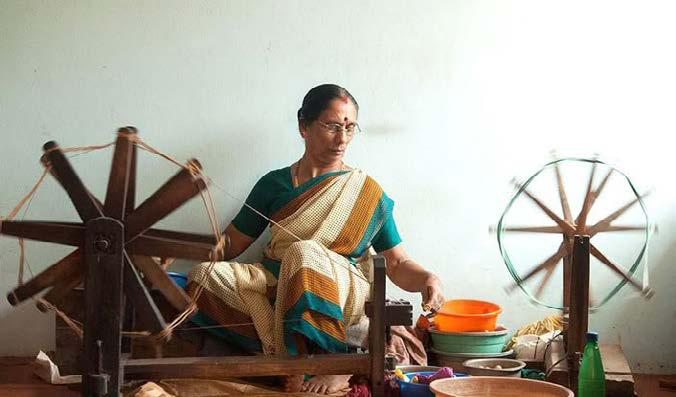
This textile, synonymous with India's freedom struggle, was revived in Gujarat by Mahatma Gandhi, who said, "The Khadi spirit means also infinite patience."
History and Origin
Khadi dates back to ancient Vedic times (5000 BC), with detailed accounts of cotton and natural fibres being handwoven with gold thread. The word 'Khadi' derives from 'Khaddar', meaning hand-spun fabric in India. The weaving of Khadi represents the oldest method of fabric production, practised on the Indian subcontinent for over 5,000 years.
The term originates from the Hindi word 'khad' and denotes a hand-weaving technique rather than a specific material. Hand-spun using a wooden spinning wheel (charkha) and then handwoven, Khadi is typically cotton-based but can also be crafted from silk, wool, and other fibres.
During colonial times, the British took Indian cotton to England, processed it in British mills, and sold it back as cloth at exorbitant prices. Gandhi urged Indians to spin and weave their own yarn to break British monopolies and achieve self-reliance. The fabric symbolises freedom, resistance, self-reliance, and equality.
Manufacturing Process
The traditional Khadi production involves several steps:
1. Ginning: Separating fibres from cotton seeds using sharp comb-like tools
2. Spinning: Converting slivers into yarn on a spinning wheel, stretching them to become thinner
3. Warping: Preparing cotton for weaving by threading yarns through heddles and securing to the loom's beam
4. Weaving: Arranging the loom with warp yarns affixed horizontally to the beam
5. Dyeing: Adding colours using predominantly natural dyes, either before or after weaving
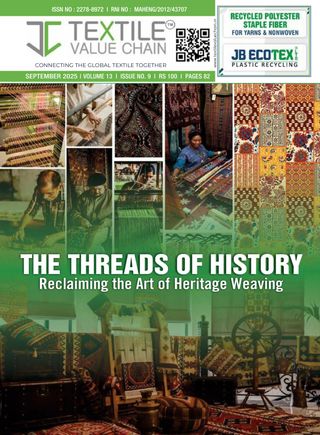

このストーリーは、Textile Value Chain の September 2025 版からのものです。
Magzter GOLD を購読すると、厳選された何千ものプレミアム記事や、10,000 以上の雑誌や新聞にアクセスできます。
すでに購読者ですか? サインイン
Textile Value Chain からのその他のストーリー
Textile Value Chain
EPR in Textiles: Turning Compliance into Opportunity
When the EU Comes to Panipat, It Means One Thing — The World Is Watching

3 mins
November 2025

Textile Value Chain
European Parliament Delegation Visits Panipat Recycling Cluster to Strengthen India-EU Collaboration on Circular Textiles
A high-level delegation from the European Parliament's Committee on International Trade (INTA) visited the Panipat Textile Recycling Cluster — India's largest hub for recycled textiles and circular manufacturing — during their official visit to India.
1 mins
November 2025

Textile Value Chain
Paramount Instruments: Where Innovation Turns Testing into Joy
At Paramount Instruments, innovation isn't just a Pursuit- it's in our DNA.
2 mins
November 2025
Textile Value Chain
Crafting the Future: LMW & Hami Weavelon pioneer Compact Spinning in Polyester
Manmade fibres today form the backbone of the global textile industry, driven by their versatility, performance, and ability to meet the rising demand for both everyday and specialised applications.
3 mins
November 2025

Textile Value Chain
Data is the New Thread: Weaving India's Textile Sector into a Circular Powerhouse
On November 13, 2025, at the 12th Edition of the India and Sustainability Standards (ISS) International Dialogue and Conference held at Bharat Mandapam in New Delhi, representatives from the Home Exporters Welfare Association of India (HEWA) joined industry leaders, policymakers, and international organizations to address a pressing question: How can India's textile sector meet emerging global data requirements while supporting its MSME backbone?
3 mins
November 2025

Textile Value Chain
Rieter Winding Suction Nozzle Upgrade: More Yarn, Less Energy Use
After upgrading the suction nozzles on their 32 winding machines, Sanyang Textile Co., Ltd., China, saw an increase in yarn production of 3% and a reduction of 13% in energy use. The flow-optimised, aerodynamically designed suction nozzle enables efficient upper yarn search and pickup from the package. This results in a 55% reduction in red light percentage and a significant reduction in the operator's workload.
1 mins
November 2025
Textile Value Chain
EU's Extended Producer Responsibility (EPR) Law and Its Implications for India's Textile Industry
The European Union (EU) has approved a new Extended Producer Responsibility (EPR) framework for textiles. This is a major regulatory shift that makes fashion brands and producers accountable for their products' entire lifecycle, from design and production through collection, sorting, recycling and disposal.
9 mins
November 2025

Textile Value Chain
GTE Ahmedabad 2025 Concludes Day 3 with a Huge Footfall
The 38th Garment Technology Expo (GTE) Ahmedabad 2025, co-located with the Lace & Trims Show, wrapped up its third day on an impressive note, recording around 9,700 B2B visitors. The strong industry turnout reaffirmed the expo's role as one of the most influential and business-driven platforms for garment and apparel technology in the western region.
2 mins
November 2025

Textile Value Chain
Reinterpreting Korean Street Fashion through Sustainable Design Practices
A Path through Eco-conscious Urban Fashion
7 mins
November 2025
Textile Value Chain
3D Printing in Textiles Manufacturing: A Game-Changer in Design, Sustainability, and Efficiency
The global textile and apparel industry is undergoing a radical transformation due to the convergence of digital design, advanced material technology, and next-generation manufacturing. Of the latter, few have greater potential to change how textiles are made today than additive manufacturing, better known as 3D printing.
5 mins
November 2025
Listen
Translate
Change font size