
Passez à l'illimité avec Magzter GOLD
Obtenez un accès illimité à plus de 9 000 magazines, journaux et articles Premium pour seulement
Essayer OR - Gratuit
Khadi Fabric: A Legacy of Sustainability and Freedom
Textile Value Chain
|September 2025
Khadi stands as a prime example of ethical textile production - hand spun and handwoven from natural fibres like cotton and silk, making both the fabric and its production process ethical and sustainable.
-
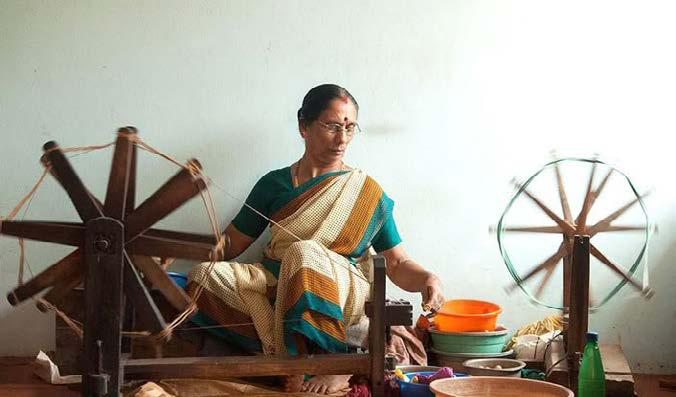
This textile, synonymous with India's freedom struggle, was revived in Gujarat by Mahatma Gandhi, who said, "The Khadi spirit means also infinite patience."
History and Origin
Khadi dates back to ancient Vedic times (5000 BC), with detailed accounts of cotton and natural fibres being handwoven with gold thread. The word 'Khadi' derives from 'Khaddar', meaning hand-spun fabric in India. The weaving of Khadi represents the oldest method of fabric production, practised on the Indian subcontinent for over 5,000 years.
The term originates from the Hindi word 'khad' and denotes a hand-weaving technique rather than a specific material. Hand-spun using a wooden spinning wheel (charkha) and then handwoven, Khadi is typically cotton-based but can also be crafted from silk, wool, and other fibres.
During colonial times, the British took Indian cotton to England, processed it in British mills, and sold it back as cloth at exorbitant prices. Gandhi urged Indians to spin and weave their own yarn to break British monopolies and achieve self-reliance. The fabric symbolises freedom, resistance, self-reliance, and equality.
Manufacturing Process
The traditional Khadi production involves several steps:
1. Ginning: Separating fibres from cotton seeds using sharp comb-like tools
2. Spinning: Converting slivers into yarn on a spinning wheel, stretching them to become thinner
3. Warping: Preparing cotton for weaving by threading yarns through heddles and securing to the loom's beam
4. Weaving: Arranging the loom with warp yarns affixed horizontally to the beam
5. Dyeing: Adding colours using predominantly natural dyes, either before or after weaving

Cette histoire est tirée de l'édition September 2025 de Textile Value Chain.
Abonnez-vous à Magzter GOLD pour accéder à des milliers d'histoires premium sélectionnées et à plus de 9 000 magazines et journaux.
Déjà abonné ? Se connecter
PLUS D'HISTOIRES DE Textile Value Chain

Textile Value Chain
The New Age of Men's Tailoring: From Bespoke to Hybrid Models
Part 1 of the Series: The Evolving World of Men's Tailored Wear

4 mins
January 2026

Textile Value Chain
The Textile Landscape of 2025: A Year of Transformation
Navigating Policy Reforms, Trade Agreements, and Global Events
5 mins
January 2026

Textile Value Chain
Recycled Fibres vs Virgin Fibres: The Real Cost, Footprint & Business Opportunity
For decades, the textile industry asked only one question when choosing raw material:
3 mins
January 2026

Textile Value Chain
2025 in Perspective: A Stronger, Cleaner, Smarter Future for Textiles
The year 2025 reminded the textile and apparel sector that resilience now matters more than pace.
5 mins
January 2026
Textile Value Chain
Heimtextil as a Working lab for Sutlej and its Customers
When the global home textiles industry gathers in Frankfurt this January, Sutlej Textiles is approaching Heimtextil with a clear intent: to treat the fair less as a product parade and more as a live development lab with its buyers and partners.
4 mins
January 2026

Textile Value Chain
Weaving Heritage into Future: A Conversation with Ms Roop Rashi Mahapatra
In an era where fast fashion dominates the global textile landscape, Khadi stands as a timeless symbol of India's heritage, sustainability, and self-reliance.
11 mins
January 2026

Textile Value Chain
Home Textiles: Ever-growing Market to Evergreen Product Source
Indian Home textiles have always enjoyed a special market position, and demand continues to increase, capturing a premium to the budgeted market across different markets, but with one constant hunger for extraordinary design, a super comfortable feel, and the appeal of sophistication, along with changing market dynamics.
4 mins
January 2026

Textile Value Chain
The Velvet Revolution: How This Timeless Fabric is Redefining Modern Textiles
When you run your hand across velvet, something happens.
3 mins
January 2026

Textile Value Chain
SPGPrints Achieves Landmark Success at ITMA ASIA 2025 With Transformative Textile Printing Technology and Key Order Closures
SPGPrints, the global leader in innovative textile printing solutions, announced an overwhelmingly successful participation in ITMA ASIA 2025 at the Singapore Expo.
2 mins
January 2026
Textile Value Chain
Development of Home Textile Products from Post-Consumer Textile Waste
With the growing concern over textile waste and its environmental impact, sustainable approaches for fabric reuse are urgently needed.
5 mins
January 2026
Listen
Translate
Change font size