試す 金 - 無料
Use Open Source for Safer Generative AI Experiments
MIT Sloan Management Review
|Winter 2024
Commercial Al services can put proprietary data at risk but there are alternatives.

Integrating artificial intelligence into the daily workflow of employees across organizations, from upper management to front-line workers, holds the promise of increasing productivity in tasks such as writing memos, developing software, and creating marketing campaigns. However, companies are rightly worried about the risks of sharing data with third-party AI services, as in the well-publicized case of a Samsung employee exposing proprietary company information by uploading it to ChatGPT.
These concerns echo those heard in the early days of cloud computing, when users were worried about the security and ownership of data sent to remote servers. Managers now confidently use mature cloud computing services that comply with a litany of regulatory and business requirements regarding the security, privacy, and ownership of their data. AI services, particularly generative AI, are much less mature in this regard — partly because it is still early days, but also because these systems have a nearly inexhaustible appetite for training data.
Large language models (LLMs) like OpenAI’s ChatGPT have been trained on an enormous corpus of written content accessed via the internet, without regard for the ownership of that data. The company now faces a lawsuit from a group of bestselling authors, including George R.R.
Martin, for having used their copyrighted works without permission, enabling the LLM to generate copycats. Proactively seeking to protect their data, traditional media outlets have engaged in licensing discussions with AI developers; negotiations between OpenAI and The New York Times, however, broke down over the summer.
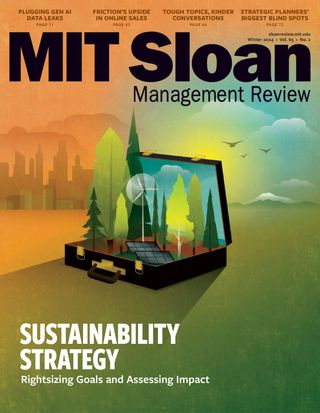

このストーリーは、MIT Sloan Management Review の Winter 2024 版からのものです。
Magzter GOLD を購読すると、厳選された何千ものプレミアム記事や、10,000 以上の雑誌や新聞にアクセスできます。
すでに購読者ですか? サインイン
MIT Sloan Management Review からのその他のストーリー

MIT Sloan Management Review
Assess What Is Certain in a Sea of Unknowns
Understanding what won't change clarifies what might — and strengthens decision-making in volatile times.

13 mins
winter 2026

MIT Sloan Management Review
Ask Sanyin: Why Is It So Hard to Pull the Plug on a Project?
We're finding it difficult to wind down projects that no longer serve our priorities.
2 mins
winter 2026

MIT Sloan Management Review
Integrate Sustainability and Innovation to Find New Opportunities
Five common innovation practices can help leaders pursue sustainability as a growth strategy.
12 mins
winter 2026

MIT Sloan Management Review
The Case for Quiet Corporate Activism
Leaders concerned that they will be penalized for championing sustainability and diversity can still sustain their commitments.
11 mins
winter 2026

MIT Sloan Management Review
The Perils of Algorithmic Pricing
Some revenue management systems based on algorithms may lead to unintended collusion and antitrust violations.
9 mins
winter 2026

MIT Sloan Management Review
Broadening Future Perspectives at the Bank of England
Leaders at the U.K’s central bank sought to broaden their thinking about future risks and opportunities. Here’s how they built longer-term horizon-scanning capabilities and what they learned along the way.
9 mins
winter 2026

MIT Sloan Management Review
How Nesting Changes Platform Strategy
Should your platform host another platform — or be hosted by one? Here's how to think through the choices.
14 mins
winter 2026
MIT Sloan Management Review
Are You an Authentic Leader or an Authentic Jerk?
Leaders who are true to their values can inspire trust and respect, but not if \"being yourself\" becomes the problem.
13 mins
winter 2026

MIT Sloan Management Review
How to Make Scenario Planning Stick
Developing future scenarios can deepen leaders’ strategic insights. Establishing scenario planning as an ongoing capability and reaping its full benefits require linking it to other processes.
16 mins
winter 2026

MIT Sloan Management Review
A Faster Way to Build Future Scenarios
This streamlined approach to scenario planning incorporates AI and helps managers navigate future uncertainties more efficiently.
13 mins
winter 2026
Translate
Change font size