試す 金 - 無料
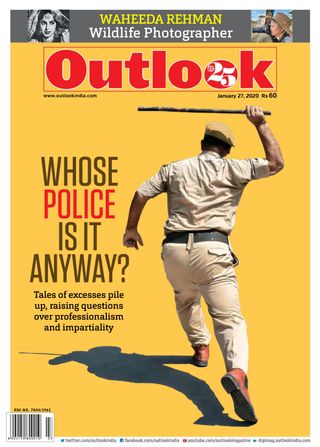
Whose Police Is It Anyway?
Outlook
|January 27, 2020
On January 14, the Delhi Police got a few admonitory lessons from Tis Hazari judge Kamini Lau.

“Have you read the Constitution?” Lau asked, as she tore into them for arresting Bhim Army chief Chandrashekhar Azad in connection with anti-CAA protests, and for behaving as if “Jama Masjid is in Pakistan”. (She granted him bail the next day—although clouding the trail a bit by telling him to stay off Delhi and not “interfere” in its elections.) The focus here, however, is not Azad. It’s how the police—as an institution, as the most visible instrument of law—seem all too often to occupy a space far away from the ideal. Which is, working for the citizenry, securing their pursuit of legal freedoms in a hugely unequal, violent society. Something else Judge Lau said—that Section 144 of the CrPC cannot be used as an instrument of repression—offers a clue. The structure of power in which the police are embedded is still that of the colonial era, where the people are seen as the enemy.
Scan, in your mind, the images of brute police force in Jamia Millia Islamia, including inside its library. (That this helped ‘nationalise’ the anti-CAA protests only showed what Indians thought of it.) Contrast that with its mute inaction as a masked mob ran amok in JnU. And later, a transparent lack of impartiality as DCP Joy Tirkey listed the accused at a press conference—naming Left-affiliated students (who bore enough signs of being victims in that episode), and a conspicuous silence on the ABVP. Fan out to Lucknow, where the arrest and torture of Sadaf Zafar only crowned charges of a reign of communally motivated brutalities across mofussil UP. Mangalore police in Karnataka invited charges of a similarly violent partisanship.

このストーリーは、Outlook の January 27, 2020 版からのものです。
Magzter GOLD を購読すると、厳選された何千ものプレミアム記事や、10,000 以上の雑誌や新聞にアクセスできます。
すでに購読者ですか? サインイン
Outlook からのその他のストーリー
Outlook
Goapocalypse
THE mortal remains of an arterial road skims my home on its way to downtown Anjuna, once a quiet beach village 'discovered' by the hippies, explored by backpackers, only to be jackbooted by mass tourism and finally consumed by real estate sharks.

2 mins
January 21, 2026

Outlook
A Country Penned by Writers
TO enter the country of writers, one does not need any visa or passport; one can cross the borders anywhere at any time to land themselves in the country of writers.
8 mins
January 21, 2026
Outlook
Visualising Fictional Landscapes
The moment is suspended in the silence before the first mark is made.
1 mins
January 21, 2026
Outlook
Only the Upper, No Lower Caste in MALGUDI
EVERY English teacher would recognise the pleasures, the guilt and the conflict that is the world of teaching literature in a university.
5 mins
January 21, 2026
Outlook
The Labour of Historical Fiction
I don’t know if I can pinpoint when the idea to write fiction took root in my mind, but five years into working as an oral historian of the 1947 Partition, the landscape of what would become my first novel had grown too insistent to ignore.
6 mins
January 21, 2026
Outlook
Conjuring a Landscape
A novel rarely begins with a plot.
6 mins
January 21, 2026
Outlook
The City that Remembered Us...
IN the After-Nation, the greatest crime was remembering.
1 min
January 21, 2026
Outlook
Imagined Spaces
I was talking with the Kudiyattam artist Kapila Venu recently about the magic of eyes.
5 mins
January 21, 2026
Outlook
Known and Unknown
IN an era where the gaze upon landscape has commodified into picture postcards with pristine beauty—rolling hills, serene rivers, untouched forests—the true essence of the earth demands a radical shift.
2 mins
January 21, 2026

Outlook
A Dot in Soot
A splinter in the mouth. Like a dream. A forgotten dream.
2 mins
January 21, 2026
Translate
Change font size