
Mit Magzter GOLD unbegrenztes Potenzial nutzen
Erhalten Sie unbegrenzten Zugriff auf über 9.000 Zeitschriften, Zeitungen und Premium-Artikel für nur
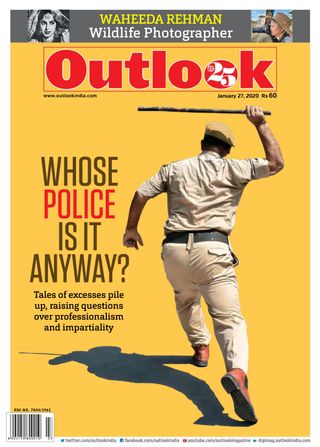
Whose Police Is It Anyway?
Outlook
|January 27, 2020
On January 14, the Delhi Police got a few admonitory lessons from Tis Hazari judge Kamini Lau.

“Have you read the Constitution?” Lau asked, as she tore into them for arresting Bhim Army chief Chandrashekhar Azad in connection with anti-CAA protests, and for behaving as if “Jama Masjid is in Pakistan”. (She granted him bail the next day—although clouding the trail a bit by telling him to stay off Delhi and not “interfere” in its elections.) The focus here, however, is not Azad. It’s how the police—as an institution, as the most visible instrument of law—seem all too often to occupy a space far away from the ideal. Which is, working for the citizenry, securing their pursuit of legal freedoms in a hugely unequal, violent society. Something else Judge Lau said—that Section 144 of the CrPC cannot be used as an instrument of repression—offers a clue. The structure of power in which the police are embedded is still that of the colonial era, where the people are seen as the enemy.
Scan, in your mind, the images of brute police force in Jamia Millia Islamia, including inside its library. (That this helped ‘nationalise’ the anti-CAA protests only showed what Indians thought of it.) Contrast that with its mute inaction as a masked mob ran amok in JnU. And later, a transparent lack of impartiality as DCP Joy Tirkey listed the accused at a press conference—naming Left-affiliated students (who bore enough signs of being victims in that episode), and a conspicuous silence on the ABVP. Fan out to Lucknow, where the arrest and torture of Sadaf Zafar only crowned charges of a reign of communally motivated brutalities across mofussil UP. Mangalore police in Karnataka invited charges of a similarly violent partisanship.

Diese Geschichte stammt aus der January 27, 2020-Ausgabe von Outlook.
Abonnieren Sie Magzter GOLD, um auf Tausende kuratierter Premium-Geschichten und über 9.000 Zeitschriften und Zeitungen zuzugreifen.
Sie sind bereits Abonnent? Anmelden
WEITERE GESCHICHTEN VON Outlook

Outlook
The Big Blind Spot
Caste boundaries still shape social relations in Tamil Nadu-a state long rooted in self-respect politics

8 mins
December 11, 2025
Outlook
Jat Yamla Pagla Deewana
Dharmendra's tenderness revealed itself without any threats to his masculinity. He adapted himself throughout his 65-year-long career as both a product and creature of the times he lived through
5 mins
December 11, 2025

Outlook
Fairytale of a Fallow Land
Hope Bihar can once again be that impossibly noisy village in Phanishwar Nath Renu's Parti Parikatha-divided, yes, but still capable of insisting that rights are not favours and development is more than a slogan shouted from a stage
14 mins
December 11, 2025

Outlook
The Lesser Daughters of the Goddess
The Dravidian movement waged an ideological war against the devadasi system. As former devadasis lead a new wave of resistance, the practice is quietly sustained by caste, poverty, superstition and inherited ritual
2 mins
December 11, 2025
Outlook
The Meaning of Mariadhai
After a hundred years, what has happened to the idea of self-respect in contemporary Tamil society?
5 mins
December 11, 2025

Outlook
When the State is the Killer
The war on drugs continues to be a war on the poor
5 mins
December 11, 2025

Outlook
We Are Intellectuals
A senior law officer argued in the Supreme Court that \"intellectuals\" could be more dangerous than \"ground-level terrorists\"
5 mins
December 11, 2025
Outlook
An Equal Stage
The Dravidian Movement used novels, plays, films and even politics to spread its ideology
12 mins
December 11, 2025
Outlook
The Dignity in Self-Respect
How Periyar and the Self-Respect Movement took shape in Tamil Nadu and why the state has done better than the rest of the country on many social, civil and public parameters
5 mins
December 11, 2025

Outlook
When Sukumaar Met Elakkiya
Self-respect marriage remains a force of socio-political change even a century later
7 mins
December 11, 2025
Translate
Change font size