
मैगज़्टर गोल्ड के साथ असीमित हो जाओ
10,000 से अधिक पत्रिकाओं, समाचार पत्रों और प्रीमियम कहानियों तक असीमित पहुंच प्राप्त करें सिर्फ
कोशिश गोल्ड - मुक्त
GREENLAND'S FROZEN SECRET
Scientific American
|July/August 2025
The collapse of the world's second-largest ice sheet would drown cities worldwide. Is that ice more vulnerable than we know?
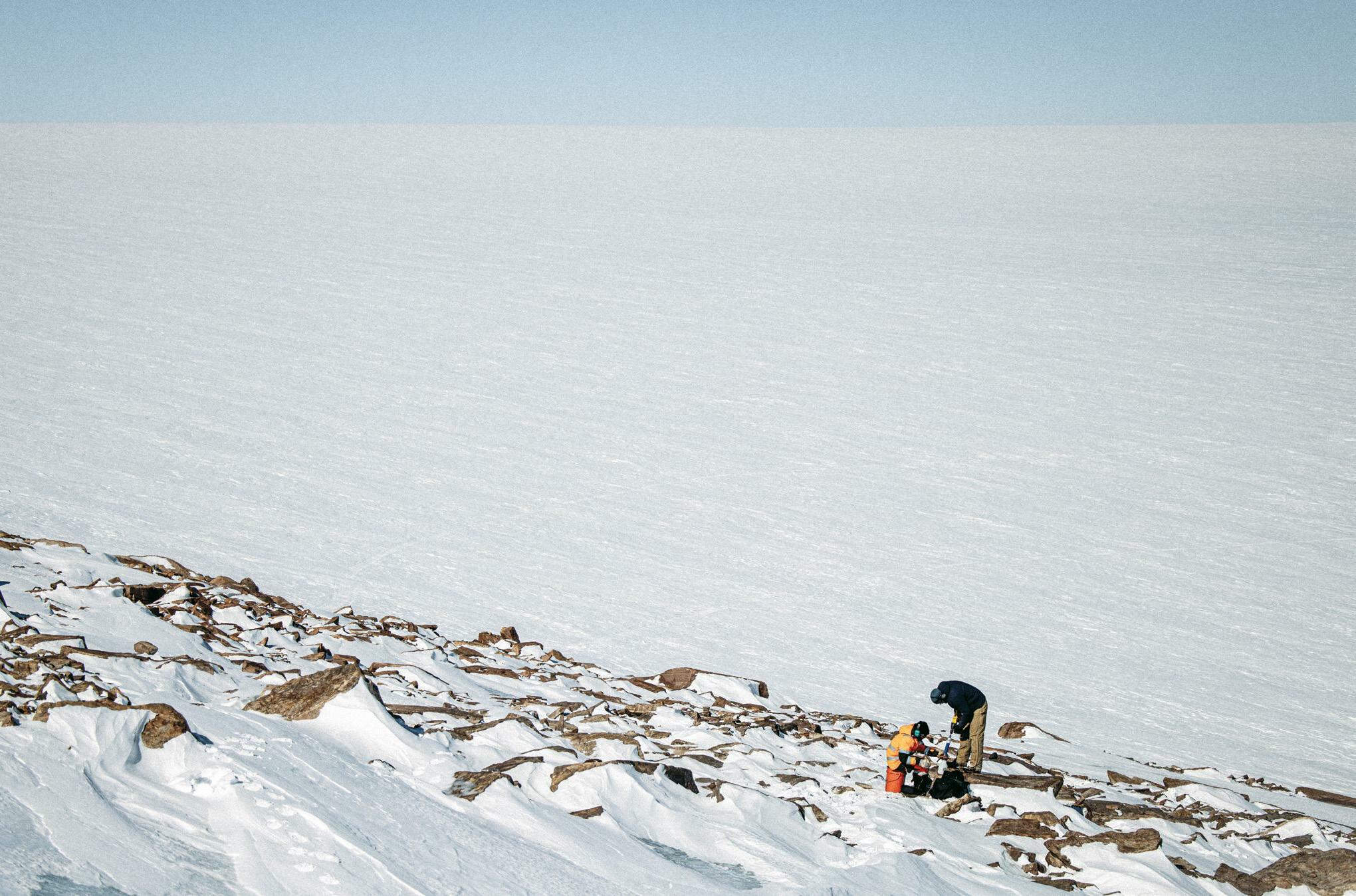
INSIDE A TENT FASTENED TO THE SURFACE of Greenland's ice sheet, the members of the GreenDrill expedition huddled around a drilling rig. The machine whined and shook as it spun. For days the drillers had been inching through ancient, solid ice to reach the rock below.
Outside, the sun burned down through a cloudless sky. The wind, having tumbled down 4,000 feet of elevation from the domed summit of the ice sheet hundreds of miles to the west, charged over the surface in wavelike pulses. The tent shuddered like some mad bouncy house at the end of the world. The nine members of the expedition—ice and rock engineers, scientists, polar-survival specialists—knew they should be close to bedrock. But Forest Harmon, the driller working the handwheel, said he still couldn't feel the core break—the moment when the metal catcher inside the drill head separates the bedrock core from its earthly tomb.
The GreenDrill site sat on the frozen edge of the Northeast Greenland Ice Stream, or NEGIS, a massive, moving tongue of ice that drains 12 to 16 percent of the ice sheet into the ocean. Upended and laid atop the contiguous U.S., it would look like a flowing mountain range more than a mile and half tall at its highest point and 20 to 30 miles across, extending from Boston to Washington, D.C. If the entire Greenland ice sheet melted, global sea levels would rise by about 24 feet. The NEGIS is how a good deal of that planet-altering flood would enter the sea.
The sheet won't melt all at once, of course, but scientists are increasingly concerned by signs of accelerating ice-sheet retreat. A recent report showed that it has been losing mass every year for the past 27 years. Another study found that nearly every Greenlandic glacier has thinned or retreated in the past few decades. The NEGIS itself has extensively sped up and thinned over the past decade.

यह कहानी Scientific American के July/August 2025 संस्करण से ली गई है।
हजारों चुनिंदा प्रीमियम कहानियों और 10,000 से अधिक पत्रिकाओं और समाचार पत्रों तक पहुंचने के लिए मैगज़्टर गोल्ड की सदस्यता लें।
क्या आप पहले से ही ग्राहक हैं? साइन इन करें
Scientific American से और कहानियाँ

Scientific American
The Quiet Math Problem That Runs the Planet
How Diffie-Hellman key exchange secures everything from your text messages to government secrets

7 mins
May 2026

Scientific American
The Fog of Science
Did an adversary just invent a world-changing weapon, or are they making it up? DARPA is building an AI to instantly call their bluff
4 mins
May 2026

Scientific American
The Hubble Space Telescope Is Still Awesome
Hubble is going strong despite its decades in space and next-generation successors
4 mins
May 2026

Scientific American
Meet America's Native Bees
Scientists estimate there are about 4,000 species of native bees in the U.S.
5 mins
May 2026

Scientific American
The Chemistry of Desire
Inside the secretive laboratories where scientists build novel molecules to make luxury fragrance feel like pure emotion
5 mins
May 2026
Scientific American
Scanning the Stone
As ore gets harder to find, the mining industry is turning to subatomic-particle sensors to push deep underground
8 mins
May 2026

Scientific American
YOUR HEART IN FLAMES
Inflammation may be the true cause of cardiovascular diseaseand there's a drug to treat it
13 mins
May 2026

Scientific American
Ancient Lexicon
Stone Age art may reveal a 40,000-year-old precursor to writing
2 mins
May 2026

Scientific American
Thermal Breakthrough
A new super heat conductor challenges fundamental physics
2 mins
May 2026

Scientific American
How to Vacation in Space
Planned orbital hotels promise luxury, but can they deliver?
4 mins
May 2026
Listen
Translate
Change font size