
Passez à l'illimité avec Magzter GOLD
Obtenez un accès illimité à plus de 9 000 magazines, journaux et articles Premium pour seulement
GREENLAND'S FROZEN SECRET
Scientific American
|July/August 2025
The collapse of the world's second-largest ice sheet would drown cities worldwide. Is that ice more vulnerable than we know?
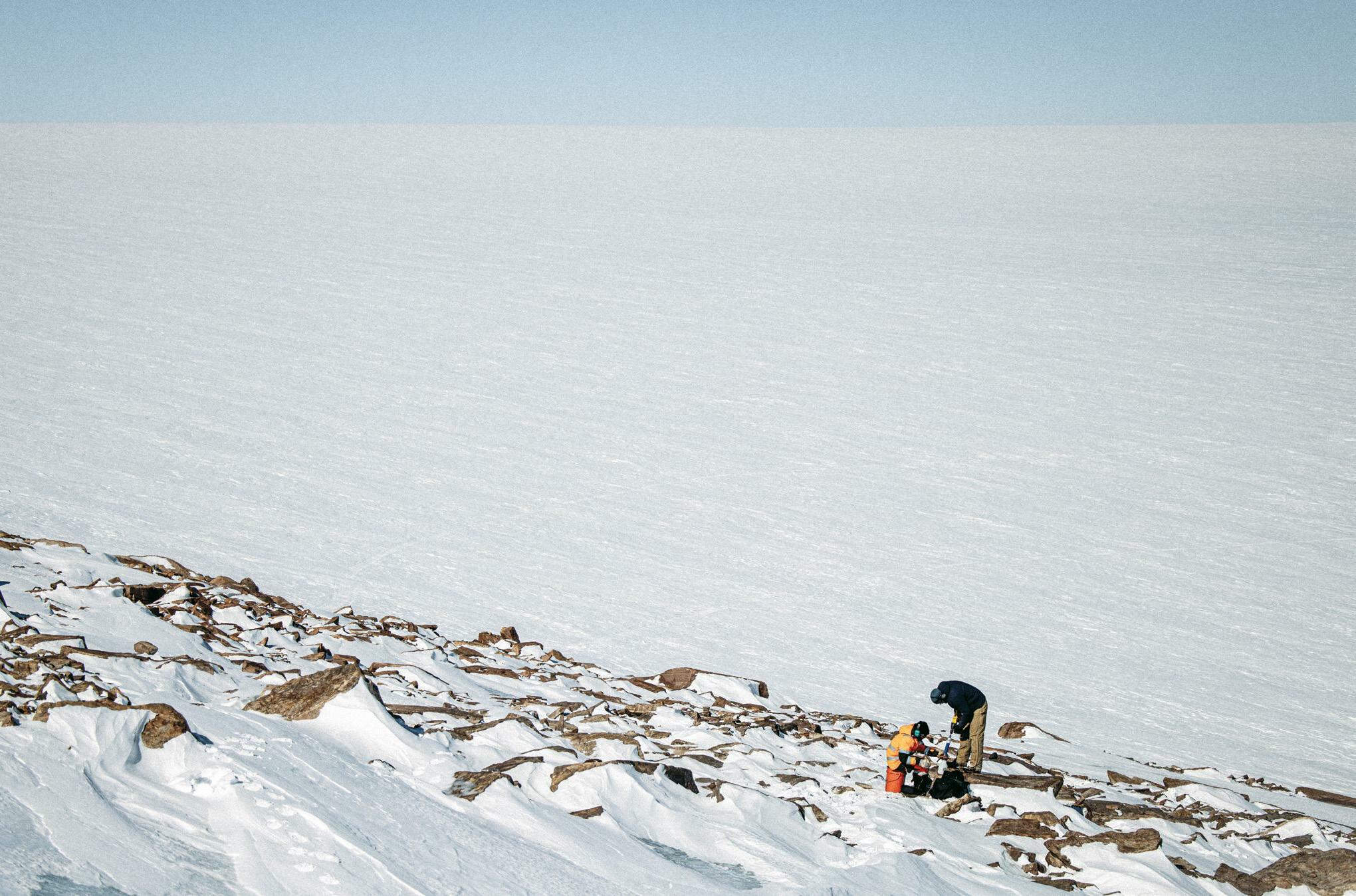
INSIDE A TENT FASTENED TO THE SURFACE of Greenland's ice sheet, the members of the GreenDrill expedition huddled around a drilling rig. The machine whined and shook as it spun. For days the drillers had been inching through ancient, solid ice to reach the rock below.
Outside, the sun burned down through a cloudless sky. The wind, having tumbled down 4,000 feet of elevation from the domed summit of the ice sheet hundreds of miles to the west, charged over the surface in wavelike pulses. The tent shuddered like some mad bouncy house at the end of the world. The nine members of the expedition—ice and rock engineers, scientists, polar-survival specialists—knew they should be close to bedrock. But Forest Harmon, the driller working the handwheel, said he still couldn't feel the core break—the moment when the metal catcher inside the drill head separates the bedrock core from its earthly tomb.
The GreenDrill site sat on the frozen edge of the Northeast Greenland Ice Stream, or NEGIS, a massive, moving tongue of ice that drains 12 to 16 percent of the ice sheet into the ocean. Upended and laid atop the contiguous U.S., it would look like a flowing mountain range more than a mile and half tall at its highest point and 20 to 30 miles across, extending from Boston to Washington, D.C. If the entire Greenland ice sheet melted, global sea levels would rise by about 24 feet. The NEGIS is how a good deal of that planet-altering flood would enter the sea.
The sheet won't melt all at once, of course, but scientists are increasingly concerned by signs of accelerating ice-sheet retreat. A recent report showed that it has been losing mass every year for the past 27 years. Another study found that nearly every Greenlandic glacier has thinned or retreated in the past few decades. The NEGIS itself has extensively sped up and thinned over the past decade.

Cette histoire est tirée de l'édition July/August 2025 de Scientific American.
Abonnez-vous à Magzter GOLD pour accéder à des milliers d'histoires premium sélectionnées et à plus de 9 000 magazines et journaux.
Déjà abonné ? Se connecter
PLUS D'HISTOIRES DE Scientific American

Scientific American
Probiotic Hope and Hype
Despite their popularity, supplements with billions of \"good\" microbes help only a few illnesses, research shows

3 mins
January 2026

Scientific American
Mondays Really Are More Stressful
The start of the workweek can be a biologically measurable stressor, with consequences for long-term health that can stretch into retirement
4 mins
January 2026

Scientific American
Tiny Display
An e-paper breakthrough brings extremely high-resolution color
2 mins
January 2026

Scientific American
Fine-Feathered Snack
A bat's tracker documents a dramatic midair hunt
2 mins
January 2026

Scientific American
OUR ROBOTIC PICTURE
Will mechanical helpers ever be commonplace at home, at work and beyond?
11 mins
January 2026

Scientific American
"Use Your Words" Can Be Good for Kids' Health
Writing or expressing feelings can help adults mentally and physically. Kids are no different
5 mins
January 2026

Scientific American
Distant Diplomacy
Unrelated species “talk” and understand one another to avoid threats
2 mins
January 2026

Scientific American
Behind the Nobel
A 2025 winner reflects on the mysterious T cells that won him the prize
5 mins
January 2026

Scientific American
A Suite of Killers
Heart ailments, kidney diseases and type 2 diabetes actually may be part of just one condition. It's called CKM syndrome
10 mins
January 2026

Scientific American
Static Launch
Tiny worms leap toward their fruit fly hosts with an electric “tractor beam”
3 mins
January 2026
Listen
Translate
Change font size