
मैगज़्टर गोल्ड के साथ असीमित हो जाओ
10,000 से अधिक पत्रिकाओं, समाचार पत्रों और प्रीमियम कहानियों तक असीमित पहुंच प्राप्त करें सिर्फ
कोशिश गोल्ड - मुक्त
'Window to avoid worst climate scenarios is rapidly shutting'
Down To Earth
|August 16, 2025
In 2023, scientists for the first time quantified nine planetary boundaries—aspects that affect the functioning of Earth systems, including climate change, ocean acidification and land-system change—and concluded that six of them have already been transgressed. This assessment is based on a framework put forth in 2009 by a team led by JOHAN ROCKSTRÖM, now director at Potsdam Institute for Climate Impact Research and professor of earth system science at the University of Potsdam, Germany. All the boundaries are under strain due to global warming, bringing us closer to irreversible climate tipping points, Rockström tells SHAGUN. Excerpts:

Global temperatures have been rising steadily, driven by human activity. How have natural systems responded?
Warming has been largely linear so far. The rise in temperature is already translating to more frequent and intense droughts, floods, heatwaves, wildfires, disease patterns and stronger, human-reinforced storms. This forms the basis for declaring a climate crisis. Now in that journey, the planet itself is governed by biological, chemical and physical processes that have been dampening the impact of this stress. For instance, the oceans absorb about 90 per cent of the excess heat generated by fossil fuel burning and around 25 per cent of the carbon dioxide. Forests and other terrestrial ecosystems take up another 25 per cent. Even the melting of ice in the Arctic, Antarctic and Himalayan glaciers consumes about 4 per cent of that heat. In fact, only about 1 per cent of the heat we produce remains in the atmosphere, which is driving the climate crisis. The key concern is, what happens if the planet is no longer dampening and reducing the impacts of climate change, but rather self-enforcing them—releasing more methane, nitrous oxide, carbon from trees and soils, or heat from oceans. This would be the “tipping point”, or the point at which we cross the critical threshold from where the planet shifts from helping to stabilise the climate to actually reinforcing the warming trend.
The Greenland ice sheet, the Atlantic Meridional Overturning Circulation (AMOC) and the Amazon rainforest currently play roles that help cool the planet. But if these systems cross a tipping point, their internal feedbacks reverse— instead of absorbing carbon or heat, they start emitting carbon or releasing heat, accelerating climate change.
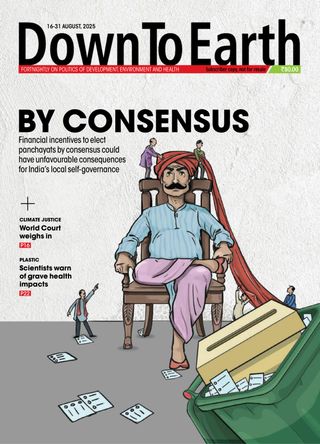

यह कहानी Down To Earth के August 16, 2025 संस्करण से ली गई है।
हजारों चुनिंदा प्रीमियम कहानियों और 10,000 से अधिक पत्रिकाओं और समाचार पत्रों तक पहुंचने के लिए मैगज़्टर गोल्ड की सदस्यता लें।
क्या आप पहले से ही ग्राहक हैं? साइन इन करें
Down To Earth से और कहानियाँ

Down To Earth
GREAT NICOBAR DILEMMA
In the fragile ecosystem of Nicobar, strategic development must align with constitutional commitment to protect environment, indigenous dignity

3 mins
March 16, 2026

Down To Earth
CATCH BY THE ROOTS
Sabai grass could be a game-changer for the marginalised economies of West Bengal's dry uplands. All it needs is an efficient market strategy
4 mins
March 16, 2026

Down To Earth
POWERING TRANSITION
India's renewable ambitions are rising rapidly, with half of its installed power capacity now coming from non-fossil sources. Yet the gap between capacity and generation remains wide. The experiences of two pioneering states, Karnataka and Tamil Nadu, which together generate over a fifth of the country's renewable energy, offer crucial lessons for accelerating the transition, reports PUJA DAS from Bengaluru, Chennai, Mumbai and New Delhi
16 mins
March 16, 2026

Down To Earth
At core of survival
Water scarcity defines life in a village inside Sariska Tiger Reserve's critical habitat, as debates over its relocation drag on
5 mins
March 16, 2026

Down To Earth
What's on your plate
An upcoming digital tool can help people learn about the origin of their meals and make climate-positive food choices
2 mins
March 16, 2026

Down To Earth
'Bad environment can never be good economics'
The Supreme Court of India and even the high courts were once very active and took a proactive role in protecting the environment; unfortunately, that is no longer true
4 mins
March 16, 2026
Down To Earth
Things fall apart
IN THE past year, the world has counted more missiles and bombs than hours.
2 mins
March 16, 2026

Down To Earth
Universities in crisis, innovation is stifled
Political control and skewed policies have led to unrest in academia, stifling creativity and meaningful research
4 mins
March 16, 2026

Down To Earth
SPARK IN THE GAME
The Reserve Bank of India's restored recognition of Default Loss Guarantees re-enables credit flow into last-mile electric mobility
3 mins
March 16, 2026

Down To Earth
Ushering in new eras
An appraisal of the state of biodiversity conservation, pollution reduction and climate adaptation regimes in India
3 mins
March 16, 2026
Listen
Translate
Change font size