कोशिश गोल्ड - मुक्त
Blind spots
Down To Earth
|August 01, 2025
Climate models still struggle to keep up with rapid changes in the polar regions
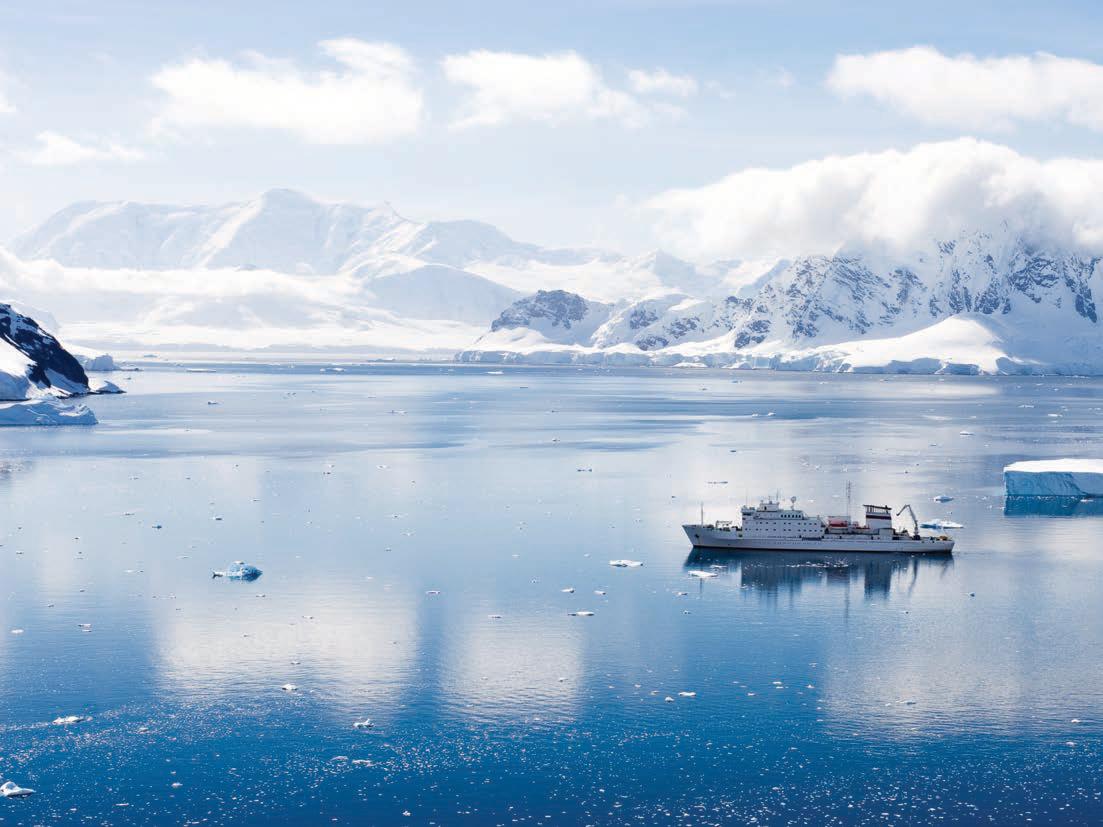
NOT ALL models are perfect. This is particularly true for those trying to simulate climate scenarios for the polar regions, where accessing reliable and exhaustive data is difficult due to remote locations, harsh weather conditions and the dynamics of sea ice. Recent studies show that this chronic lack of data and imperfect climate models could be masking the unexpected ways in which global warming is altering the polar regions that modulate the global climate system.
One critical region where climate models are falling short is the Southern Ocean, which encircles Antarctica. Across its large expanse of uninterrupted water, winds pick up speed and waves gather energy. Scientists estimate that the Southern Ocean experiences the strongest winds and largest waves on Earth, which facilitate the exchange of heat and gas, including carbon dioxide (CO₂), between the air and sea. As a result, it has the capacity to store and release more heat than anywhere else on Earth. Southern Ocean is also home to the largest current in the world ocean, whose depth and breadth result in a massive transport of water, circulating heat, oxygen, CO₂ and nutrients from the tropics around Antarctica. Scientists at University of Melbourne in Australia have dubbed the Southern Ocean as the “engine room” for the planet’s climate and weather systems, and say that any changes here can send a ripple through the globe.

यह कहानी Down To Earth के August 01, 2025 संस्करण से ली गई है।
हजारों चुनिंदा प्रीमियम कहानियों और 10,000 से अधिक पत्रिकाओं और समाचार पत्रों तक पहुंचने के लिए मैगज़्टर गोल्ड की सदस्यता लें।
क्या आप पहले से ही ग्राहक हैं? साइन इन करें
Down To Earth से और कहानियाँ

Down To Earth
GREAT NICOBAR DILEMMA
In the fragile ecosystem of Nicobar, strategic development must align with constitutional commitment to protect environment, indigenous dignity

3 mins
March 16, 2026
Down To Earth
CATCH BY THE ROOTS
Sabai grass could be a game-changer for the marginalised economies of West Bengal's dry uplands. All it needs is an efficient market strategy
4 mins
March 16, 2026

Down To Earth
POWERING TRANSITION
India's renewable ambitions are rising rapidly, with half of its installed power capacity now coming from non-fossil sources. Yet the gap between capacity and generation remains wide. The experiences of two pioneering states, Karnataka and Tamil Nadu, which together generate over a fifth of the country's renewable energy, offer crucial lessons for accelerating the transition, reports PUJA DAS from Bengaluru, Chennai, Mumbai and New Delhi
16 mins
March 16, 2026
Down To Earth
At core of survival
Water scarcity defines life in a village inside Sariska Tiger Reserve's critical habitat, as debates over its relocation drag on
5 mins
March 16, 2026

Down To Earth
What's on your plate
An upcoming digital tool can help people learn about the origin of their meals and make climate-positive food choices
2 mins
March 16, 2026

Down To Earth
'Bad environment can never be good economics'
The Supreme Court of India and even the high courts were once very active and took a proactive role in protecting the environment; unfortunately, that is no longer true
4 mins
March 16, 2026
Down To Earth
Things fall apart
IN THE past year, the world has counted more missiles and bombs than hours.
2 mins
March 16, 2026

Down To Earth
Universities in crisis, innovation is stifled
Political control and skewed policies have led to unrest in academia, stifling creativity and meaningful research
4 mins
March 16, 2026

Down To Earth
SPARK IN THE GAME
The Reserve Bank of India's restored recognition of Default Loss Guarantees re-enables credit flow into last-mile electric mobility
3 mins
March 16, 2026

Down To Earth
Ushering in new eras
An appraisal of the state of biodiversity conservation, pollution reduction and climate adaptation regimes in India
3 mins
March 16, 2026
Listen
Translate
Change font size