
Passez à l'illimité avec Magzter GOLD
Obtenez un accès illimité à plus de 9 000 magazines, journaux et articles Premium pour seulement
Baby you can drive my car(tridge)
Stereophile
|December 2025
While I was coming to grips with this month's review subject, the idler drive Garrard 301 Advanced, I began to think about the various methods that have been used to spin turntable platters over the years. Since the transition a century ago from windup clockwork to electric motors, there have basically been three ways to spin a turntable platter: idler drive, belt drive, and direct drive. True, there have also been a few designs that go their own unique ways, such as the rare, water-driven Oasis made by David Gillespie of Saturn Audio in the late 1970s and the gear-driven H.H. Scott 710 I once owned and foolishly sold. But almost everything made since the 1950s uses one of the three main drive systems. Even the Omega Drive system, which was used by Wilson Benesch on their extraordinary GMT One turntable, is at its core a direct drive design.
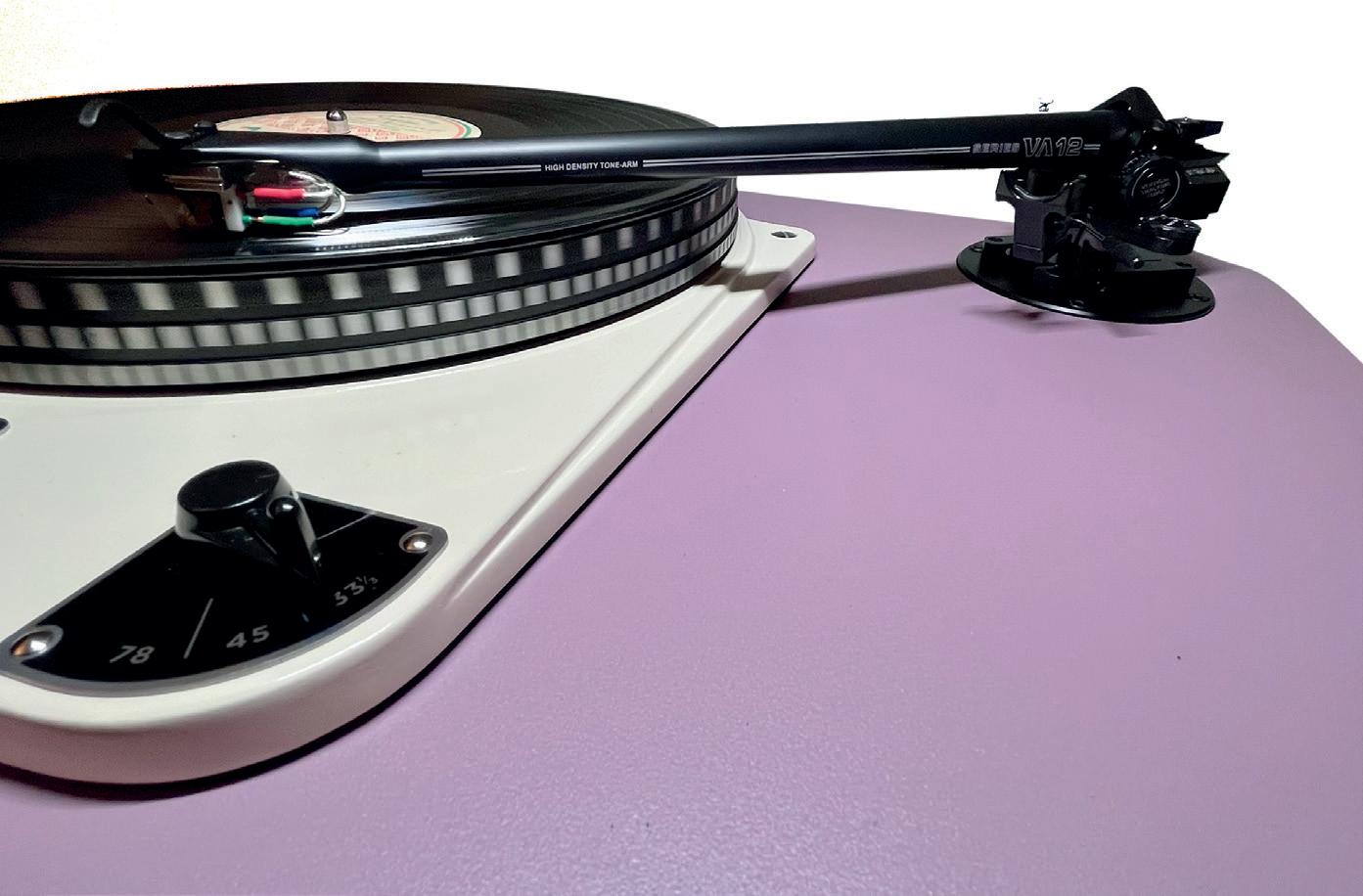
For a long time, I had the mistaken belief that pretty much every turntable made before the mid-1950s used an idler wheel to drive the platter. While that's mostly true, some professional turntables well before that time could be accurately described as direct drive, coming more than 30 years before the Technics SP-10 was introduced in 1970. These professional transcription turntables were used mostly by radio stations and other professionals and came in a waist-high metal cabinet that probably weighed more than the radio-station engineer who operated it. One of the most popular of these was the RCA 70-D transcription turntable. Its massive 16" platter was connected by a long metal rod to a grapefruit-sized motor at the bottom of the cabinet. Motor noise and rumble breakthrough could be an issue, but because they were playing mono records, the cartridges had little sensitivity to the mostly vertical vibrations.
When stereo records arrived, in 1958, those vertical vibrations became a big problem, because the new stereo cartridges measured both vertical and lateral movement to create a stereo signal. Belt-drive turntables isolated the motor from the platter, so they quickly became the standard.
While the first belt-drive turntable was one of those big transcription jobs with a 16" platter—it was called the Components Corporation Model 70, introduced in 1954—it was the 1961 Acoustic Research AR that set the path for consumers. The budget-priced AR with its belt drive and three-point spring suspension became a legend, and even 20 years later, when I was in college, I knew several students who had brought their parents' old AR with them for their dorm systems.

Cette histoire est tirée de l'édition December 2025 de Stereophile.
Abonnez-vous à Magzter GOLD pour accéder à des milliers d'histoires premium sélectionnées et à plus de 9 000 magazines et journaux.
Déjà abonné ? Se connecter
PLUS D'HISTOIRES DE Stereophile

Stereophile
Buzz Me In
If you like 1970s rock music, particularly hard rock music, something you love was recorded or mixed in a Record Plant studio.

3 mins
January 2026

Stereophile
NuPrime MCX-800AD
IMMERSIVE AUDIO PROCESSOR
11 mins
January 2026
Stereophile
Shanachie Records
The term 'sales' is an anachronism. Today, it's about streaming and ancillary income.\"
3 mins
January 2026
Stereophile
Advance Paris X-CD9
CD PLAYER
11 mins
January 2026
Stereophile
T+A Symphonia for phono; a new NAD M10
Out of the box, the T+A Symphonia streaming integrated amplifier Rogier van Bakel reviewed in the November 2025 issue¹ has two pairs of single-ended analog line inputs.
20 mins
January 2026

Stereophile
Why the Music We Love Feels Different Now
There's a scene in the 2002 movie The Pianist in which Adrien Brody's character, the Polish-Jewish pianist Władysław Szpilman, is hiding in the ruins of a Warsaw villa.
3 mins
January 2026

Stereophile
A tale of two Walters
Acommon theme in this space in Stereophile is the need to reach new audiences and generate broader interest in the hi-fi hobby.
3 mins
January 2026
Stereophile
Eversolo Play CD Edition
ALL-IN-ONE STREAMING PLAYER
12 mins
January 2026

Stereophile
Timeless flights
How many adventurous rock’n’roll bands forged in the late-’60s/early-’70s would have been left by the wayside—or relegated to languish in perpetual cutout-bin purgatory—had it not been for the wide-open programming M.O. of stereo-loving FM radio stations? The Moody Blues could very easily have been one of those sidelined, notched-cover footnotes, but they altered their gameplan when guitarist/vocalist Justin Hayward and bassist/vocalist John Lodge joined the fold a few years after the chart success of “Go Now” in 1964.¹
3 mins
January 2026
Stereophile
You still believe in me
One of my foundational memories of becoming an audiophile was waiting to listen to a pair of speakers at Sound by Singer in Manhattan.
12 mins
January 2026
Listen
Translate
Change font size