
Mit Magzter GOLD unbegrenztes Potenzial nutzen
Erhalten Sie unbegrenzten Zugriff auf über 9.000 Zeitschriften, Zeitungen und Premium-Artikel für nur
Versuchen GOLD - Frei
Baby you can drive my car(tridge)
Stereophile
|December 2025
While I was coming to grips with this month's review subject, the idler drive Garrard 301 Advanced, I began to think about the various methods that have been used to spin turntable platters over the years. Since the transition a century ago from windup clockwork to electric motors, there have basically been three ways to spin a turntable platter: idler drive, belt drive, and direct drive. True, there have also been a few designs that go their own unique ways, such as the rare, water-driven Oasis made by David Gillespie of Saturn Audio in the late 1970s and the gear-driven H.H. Scott 710 I once owned and foolishly sold. But almost everything made since the 1950s uses one of the three main drive systems. Even the Omega Drive system, which was used by Wilson Benesch on their extraordinary GMT One turntable, is at its core a direct drive design.
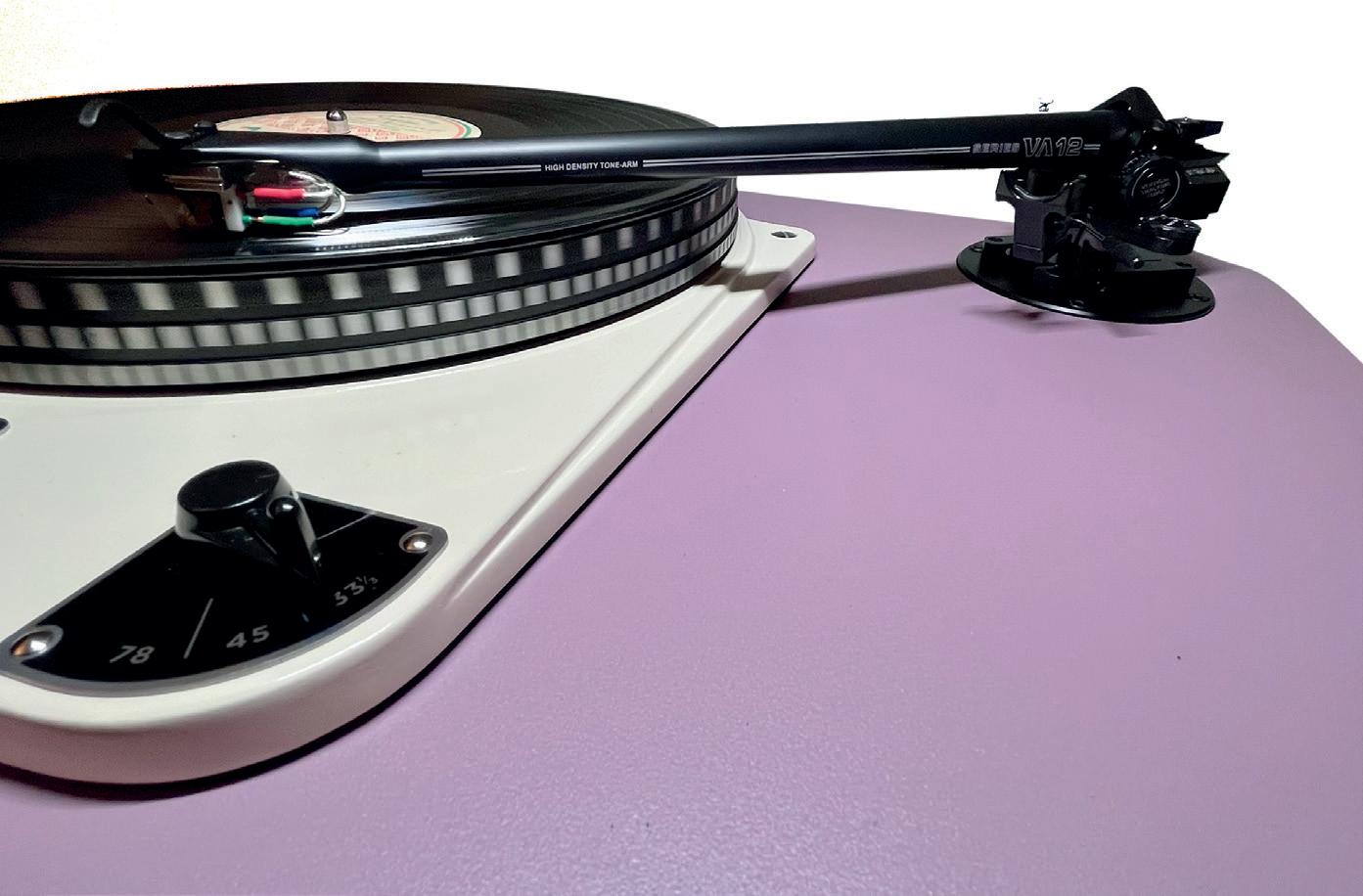
For a long time, I had the mistaken belief that pretty much every turntable made before the mid-1950s used an idler wheel to drive the platter. While that's mostly true, some professional turntables well before that time could be accurately described as direct drive, coming more than 30 years before the Technics SP-10 was introduced in 1970. These professional transcription turntables were used mostly by radio stations and other professionals and came in a waist-high metal cabinet that probably weighed more than the radio-station engineer who operated it. One of the most popular of these was the RCA 70-D transcription turntable. Its massive 16" platter was connected by a long metal rod to a grapefruit-sized motor at the bottom of the cabinet. Motor noise and rumble breakthrough could be an issue, but because they were playing mono records, the cartridges had little sensitivity to the mostly vertical vibrations.
When stereo records arrived, in 1958, those vertical vibrations became a big problem, because the new stereo cartridges measured both vertical and lateral movement to create a stereo signal. Belt-drive turntables isolated the motor from the platter, so they quickly became the standard.
While the first belt-drive turntable was one of those big transcription jobs with a 16" platter—it was called the Components Corporation Model 70, introduced in 1954—it was the 1961 Acoustic Research AR that set the path for consumers. The budget-priced AR with its belt drive and three-point spring suspension became a legend, and even 20 years later, when I was in college, I knew several students who had brought their parents' old AR with them for their dorm systems.


Diese Geschichte stammt aus der December 2025-Ausgabe von Stereophile.
Abonnieren Sie Magzter GOLD, um auf Tausende kuratierter Premium-Geschichten und über 9.000 Zeitschriften und Zeitungen zuzugreifen.
Sie sind bereits Abonnent? Anmelden
WEITERE GESCHICHTEN VON Stereophile

Stereophile
The Rolling Stones v3.0
In the Rolling Stones' long history, the Mick Taylor era was a peak, if not the peak. Taylor, who replaced cofounder Brian Jones in the late 1960s, proved a great musical foil for Keith Richards. He was a technical wizard on the guitar; those fluid higher-octaves riffs and runs were the perfect counterpoint to Richards's jabbing and stabbing and growling style. At heart, he was a bluesman, so a great fit for a band named after a Muddy Waters tune. The run of albums from Let It Bleed through It's Only Rock 'n Roll took the Stones' music in new directions and set the standard for tight, fast, and loose arena rock circa the early 1970s.

3 mins
March 2026

Stereophile
Bob Dylan Through the Open Window
Columbia Legacy has released Vol.18 of the Bob Dylan Bootleg Series. Through the Open Window covers the years 1956–1963. The collection is available as three physical sets: two-CD or four-LP “Highlights” versions that contain 42 tracks, and an eight-CD “Deluxe Edition Box Set” that contains 139 tracks and has a running time of 8 hours, 59 minutes. The “Highlights” package is available streaming at 24/192, but the other 97 tracks are only available in the big box. That big box also includes a 124-page hardback book containing full credits, 100 photos, and liner notes—really a substantial monograph—by Sean Wilentz, professor of American History at Princeton University and author of the book Bob Dylan in America.
7 mins
March 2026
Stereophile
Technics SL-50C
Every first love leaves a strong impression. Hopefully it’s a good one.
15 mins
March 2026

Stereophile
The passing of two Americana greats
Just before Christmas 2025, American music suffered two irreplaceable losses with the passings of Raul Malo (December 8) and Joe Ely (December 15). While a lot of musicians exist on the artistic and commercial fringes, Malo and Ely were foundational artists, gifted creators and performers who refused to be confined by artistic boundaries. Though not without their struggles, each eventually found widespread respect and success. Each leaves behind a significant body of wonderful recordings.
3 mins
March 2026
Stereophile
HI-FI as ART
Since founding Ojas in the 1990s and applying the name to his audio components, Devon Turnbull has mined a young audience that the traditional hi-fi industry has struggled to reach.
14 mins
March 2026
Stereophile
Burmester 232
My first response, upon being offered for review the new Burmester 232 Classic Line modular class-AB dual mono integrated amplifier ($25,000), was apprehension—but not because of the product itself, and certainly not because of the Burmester brand. My first response, upon being offered for review the new Burmester 232 Classic Line modular class-AB dual mono integrated amplifier ($25,000), was apprehension—but not because of the product itself, and certainly not because of the Burmester brand.
23 mins
March 2026

Stereophile
Kind of a 'pinch me' situation
In these days of industry transformation, acquiring a brick-and-mortar hi-fi store is not for the faint of heart. That's just what 41-year-old Brandon Bartee did in August 2025. Bartee acquired Audio Concepts from Mark Ashworth, who was celebrating the store’s 40th anniversary, all 40 years under his ownership. Ashworth has been consulting for the store since the acquisition and will continue to do so for another few more months. Audio Concepts has been in the same location in North Dallas, near Preston Hollow, an affluent neighborhood about six miles north of downtown, for 37 of its 40 years. The store has four isolated demo rooms and a few other listening areas.
3 mins
March 2026

Stereophile
Collecting used records. And cleaning them
I own a lot of records. Way too many if we're being honest. It's hard for me to come up with an accurate count, and I'm not even remotely organized enough to have a formal inventory, but if I had to make a guesstimate based on linear feet I figure I must have around 10,000. About 10 years ago, I started to recognize that I owned far more records than I could ever hope to listen to, even once, in my remaining time on the planet, and since that realization my record purchasing rate has slowed to a trickle. These days, my worst weakness kicks in when I'm visiting my friend of over 45 years, Alan B out in L.A. Our idea of great social interaction is to head out and visit some of the record stores near his home in Pasadena, such as Amoeba and Freakbeat Records. Ten years ago on these trips, I would pick up enough records over a weekend to fill three big boxes that I would then ship back home to New York, using the US Postal Service's bargain Media Mail service. Times have changed, and on my most recent visit I came home with just a dozen or so new acquisitions, few enough to easily slip into my suitcase.
11 mins
March 2026

Stereophile
Steve played it
Legendary Stax guitarist/producer Steve Cropper hated when deejays talked over song intros. He decided to do something about it for the countless hit singles cut at the label's Memphis studio in the 1960s. As a result of his efforts, Cropper—who passed away on December 3, 2025, at age 84—became known as “The Intro Guy,” a sobriquet he was proud to honor.
3 mins
March 2026
Stereophile
New digs
It's difficult to put a positive spin on moving. A recent survey ranked it as life's most stressful event, ahead of divorce, losing a job, or becoming a parent. Forty-two percent of respondents said it brought them to tears. Thirteen percent said it was worse than a week in jail.
11 mins
March 2026
Listen
Translate
Change font size