Intentar ORO - Gratis
OUR ROBOTIC FUTURE
Scientific American
|January 2026
Will mechanical helpers ever be commonplace at home, at work and beyond?
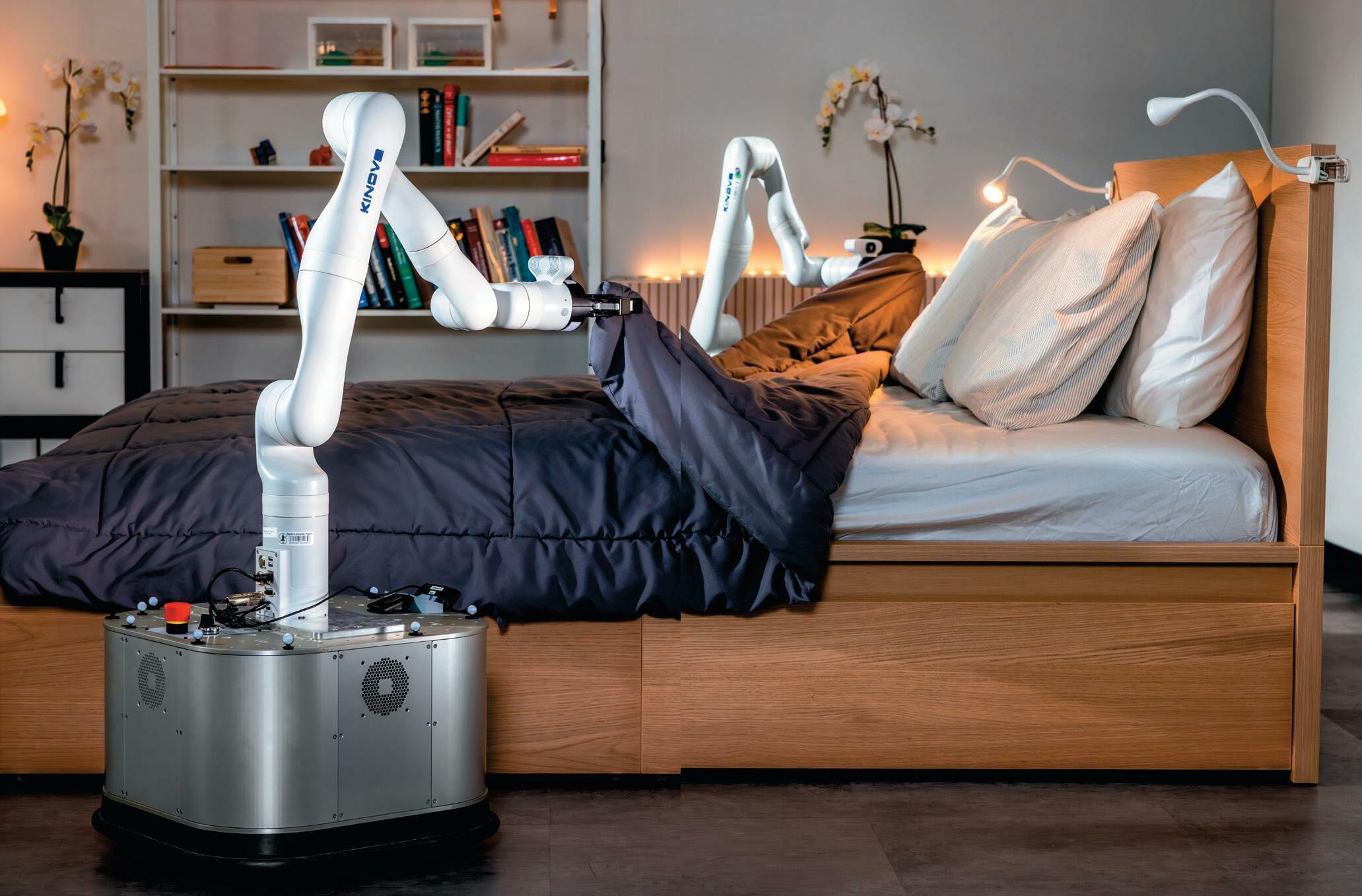
Bed making is one household task that could eventually be outsourced to robots such as TidyBot, a project led by Stanford University computer scientist Jeannette Bohg.
IN THE FUTURE, A CAREGIVING MACHINE MIGHT GENTLY LIFT AN ELDERLY PERSON out of bed in the morning and help them get dressed. A cleaning bot could trundle through a child's room, picking up scattered objects, depositing toys on shelves and tucking away dirty laundry. And in a factory, mechanical hands may assemble a next-generation smartphone from its first fragile component to the finishing touch.
These are glimpses of a possible time when humans and robots will live and work side by side. Some of these machines already exist as prototypes, and some are still theoretical. In situations where people experience friction, inconvenience or wasted effort, engineers see opportunity—for robots to perform chores, do tasks we are unable to do or go places where we cannot.
Realizing such a future poses immense difficulties, however, not the least of which is us. Human beings are wild and unpredictable. Robots, beholden as they are to the rules of their programming, do not handle chaos well. Any robot collaborating or even coexisting with humans must be flexible. It must navigate messes and handle sudden changes in the environment. It must operate safely around excitable small children or delicate older people. Its limbs or manipulators must be sturdy, dexterous and attached to a stable body chassis that provides a source of power. And to truly become a part of our daily lives, these mechanical helpers will need to be affordable. All told, it's a steep challenge.
Ben Guarino is a freelance journalist with a soft spot for big ideas and tiny critters. He was formerly an associate technology editor at Scientific American.

Esta historia es de la edición January 2026 de Scientific American.
Suscríbete a Magzter GOLD para acceder a miles de historias premium seleccionadas y a más de 9000 revistas y periódicos.
¿Ya eres suscriptor? Iniciar sesión
MÁS HISTORIAS DE Scientific American

Scientific American
Dirty Little Secrets
Extremophile molds are invading art museums and devouring their collections. Stigma and climate change have fueled their spread

16 mins
February 2026
Scientific American
Archaeology Is Reviving the Smell of History
How reconstructing long-lost smells connects us to the past
6 mins
February 2026

Scientific American
Heal Injuries Faster
Toss out the old advice that rest is the best recovery strategy
4 mins
February 2026

Scientific American
Can a Time Capsule Outlast Geology?
A ridiculous but instructive thought experiment involving deep time, plate tectonics, erosion and the slow death of the sun
17 mins
February 2026
Scientific American
Fiery Amoeba
A newfound organism thrives in record-breaking heat
2 mins
February 2026
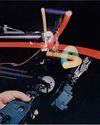
Scientific American
50, 100 & 150 Years
GIANT ATOMS
3 mins
February 2026
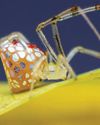
Scientific American
Nature's Tile Shop
Life keeps evolving these geometric patterns
2 mins
February 2026
Scientific American
Battle of the Breeds
A large dataset shows that some dog stereotypes are based in reality, and others might be unfair characterizations
1 min
February 2026

Scientific American
The Milky Way's Disk Keeps Getting Weirder
The disk of our galaxy is not flat but warped and waving
5 mins
February 2026
Scientific American
A Winning Loser
If the cards shown here are rearranged to form four new poker hands of five cards each, what is the low- est possible winning or tying hand?
1 min
February 2026
Listen
Translate
Change font size