
Vuélvete ilimitado con Magzter GOLD
Obtenga acceso ilimitado a más de 9000 revistas, periódicos e historias Premium por solo
Intentar ORO - Gratis
Collision Course
Scientific American
|February 2026
The ancient moon- forming planet Theia probably came from the inner solar system
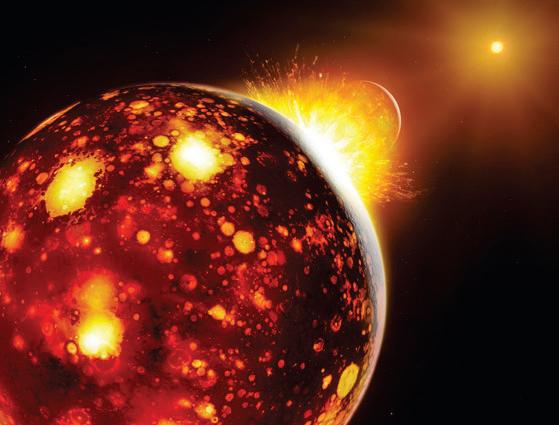
Artist's impression of the planet Theia colliding with ancient Earth to create the moon
ROUGHLY FOUR AND A HALF billion years ago the planet Theia slammed into Earth, destroying itself, melting large portions of our planet's mantle and ejecting a huge debris disk that later pulled together to become the moon. Scientists have long wondered about both the composition and the origin of Theia. Now they have evidence that it formed very close to home.
The original giant-impact model of the moon's formation, proposed in the 1970s, predicted that the moon was made mostly of material from the colliding object. This scenario implied there should be differences between the chemical compositions of the moon and Earth, but research has found that the two are nearly identical—far more similar than two independent planetary bodies should be. A study published recently in Science took a close look at other things Theia gave us besides the moon: additional molybdenum and iron left behind on Earth from the collision.

Esta historia es de la edición February 2026 de Scientific American.
Suscríbete a Magzter GOLD para acceder a miles de historias premium seleccionadas y a más de 9000 revistas y periódicos.
¿Ya eres suscriptor? Iniciar sesión
MÁS HISTORIAS DE Scientific American

Scientific American
Earthquake Life
Yellowstone quakes spark bursts of microbial growth underground

2 mins
March 2026
Scientific American
Sailing the Sun
By designing vertical panels that move in a gale, two Swedish inventors are unlocking a solar future for the windswept north
9 mins
March 2026
Scientific American
Covered in Bees
Ancient bees burrowed deep into discarded mammal jawbones
2 mins
March 2026
Scientific American
Fire Starters
Ancient humans were making fire 350,000 years earlier than thought
3 mins
March 2026
Scientific American
Relativity Revealed
Physicists have observed a bizarre prediction of special relativity for the first time
8 mins
March 2026

Scientific American
Everything You Wanted to Know about Polyamory (but Were Afraid to Ask
The practice is not a faddish excuse to sleep around, research shows. And it has deep roots in American culture
14 mins
March 2026

Scientific American
Let the Rivers Run
An investigation into the rights of nature
4 mins
March 2026

Scientific American
Hidden Proof
\"Effective zero knowledge\" beats long-standing cryptographic impossibilities
2 mins
March 2026

Scientific American
The Universe's Weirdest Optical Illusions
Sometimes the farther away an object is, the bigger it seems to be
4 mins
March 2026

Scientific American
Living in the COPILOT SOCIETY
The promise and peril of artificial intelligence everywhere
2 mins
March 2026
Listen
Translate
Change font size