
Vuélvete ilimitado con Magzter GOLD
Obtenga acceso ilimitado a más de 9000 revistas, periódicos e historias Premium por solo
Intentar ORO - Gratis
THE EYES THAT WATCH THE SKY
BBC Science Focus
|April 2024
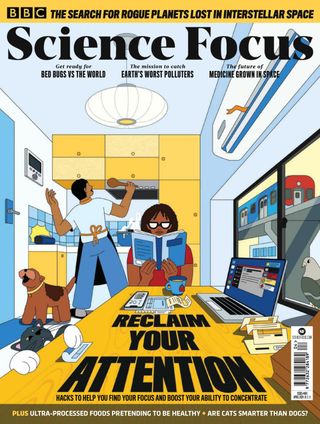
When it launches in 2026, the Copernicus programme's Anthropogenic Carbon Dioxide Monitoring satellite will give us a new window on to Earth's atmosphere... And how we're altering it

It's a rather delicious irony that one of the most valuable things to come out of the space programme wasn't the ability to look into the deepest regions of the Universe, but to look back at Earth; to see our world as a beautiful disc of white clouds, blue oceans and multicoloured continents.
Since Sputnik, the first artificial satellite, was launched more than 70 years ago, an armada of Earth-observation spacecraft has been put into orbit. Together with more than a century and a half of consistent Earth-based weather measurements, the data these satellites have gathered has allowed us to develop a much better understanding of our planet's climate and our effects upon it.
As is now well known, Earth's climate is changing, with average global temperatures increasing. This occurs because of the industrial and domestic burning of fossil fuels, which releases carbon dioxide (CO2) into the atmosphere, where it traps heat. We rely on this 'greenhouse effect' to make the planet habitable, but in recent decades so much CO₂ has been released by humans that we've thrown Earth's natural balance off-kilter.
In December 2015, 196 Parties at the UN Climate Change Conference (COP21) in Paris, France, agreed to a legally binding international treaty on climate change. This treaty's goal is to hold global temperatures to below an increase of 2°C. To do this, countries are required to report how much anthropogenic (man-made) CO₂ they emit and, starting this year, they must also report on the actions they're taking to reduce these emissions.
This will allow us to do a global carbon 'stocktake' and, from that, recommend further actions that ́need to be taken on a country-by-country basis. At present, countries calculate their carbon emissions based on statistical and economic factors, such as how much fuel is being imported or produced in the country. The assumption is then that this fuel is used within the country and produces its waste CO2.

Esta historia es de la edición April 2024 de BBC Science Focus.
Suscríbete a Magzter GOLD para acceder a miles de historias premium seleccionadas y a más de 9000 revistas y periódicos.
¿Ya eres suscriptor? Iniciar sesión
MÁS HISTORIAS DE BBC Science Focus

BBC Science Focus
HOW FISH COULD SAVE MILLIONS OF PEOPLE'S SIGHT
There's nowhere near enough donors to meet the demand for corneal transplants. A pioneering treatment that relies on fish scales could change that

3 mins
May 2026

BBC Science Focus
Your Wi-Fi is lying to you
Wi-Fi 7's giant speed claims might look impressive, but the realities of our homes – and the laws of physics – mean that real-world performance will never get close
6 mins
May 2026

BBC Science Focus
WHICH ANIMAL IS MOST LIKELY TO ESCAPE FROM THE ZOO?
Have you heard the one about the monkey and the Yorkshire pudding?
2 mins
May 2026

BBC Science Focus
THE BLACK SERVAL
The black serval (Leptailurus serval) is an unusual, melanistic version of the African serval, a medium-sized wild cat that's native to Africa.
2 mins
May 2026
BBC Science Focus
Cryosleep vs hibernation: What's the difference?
When hibernating animals, such as hedgehogs and dormice, disappear for winter, they don't freeze like the Siberian salamander.
1 mins
May 2026
BBC Science Focus
Space brain
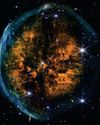
The greatest names in science are often said to be 'big-brained', but this cosmic wonder puts them all to shame. Nebula PMR 1 - otherwise known as the 'Exposed Cranium' nebula for its distinctive shape - measures around 3.2 light-years across.
1 min
May 2026

BBC Science Focus
Your most draining relationships are taking years off your life, study suggests
Difficult people don't just zap your energy - they may also accelerate your biological ageing
4 mins
May 2026

BBC Science Focus
DOES EARTH HAVE A HEARTBEAT?
Move over, Ringo Starr.
1 mins
May 2026
BBC Science Focus
WEIGHT-LOSS DRUGS FOR ALL?
The obesity crisis is ruining lives and costing governments trillions. But some healthcare experts think there's now a radical solution: roll out GLP-1 jabs to everyone who needs them for free. Could it work?
9 mins
May 2026
BBC Science Focus
HOW TO SEE VENUS ON APPROACH TO JUPITER
Venus has been slowly moving away from the Sun's glare over the past few weeks, heading into the evening twilight after sunset.
1 mins
May 2026
Listen
Translate
Change font size