
Vuélvete ilimitado con Magzter GOLD
Obtenga acceso ilimitado a más de 9000 revistas, periódicos e historias Premium por solo
Intentar ORO - Gratis
SET THE JUICE LOOSE
BBC Science Focus
|April 2023
This month, the JUICE mission blasts off on its eight-year voyage to Jupiter. Once there, it will peer at the planet's moons to find out if life could be lurking beneath their icy crusts...

The Earth has always been believed to be the gold standard for a habitable world. Lessons learnt from life on Earth have told us that if we want to seek life on other planets in the Solar System, we need to find three basic ingredients in the same place at the same time – liquid water, the chemical building blocks of life, and a source of energy. Previously, we thought that these could only be found within a narrow ring around the Sun called the ‘Goldilocks Zone’, or ‘Habitable Zone’. But we were wrong.
Images of Jupiter’s moons taken by the Voyager missions in 1979 and the Galileo spacecraft between 1995 and 2003 completely reshaped our view of the Solar System.
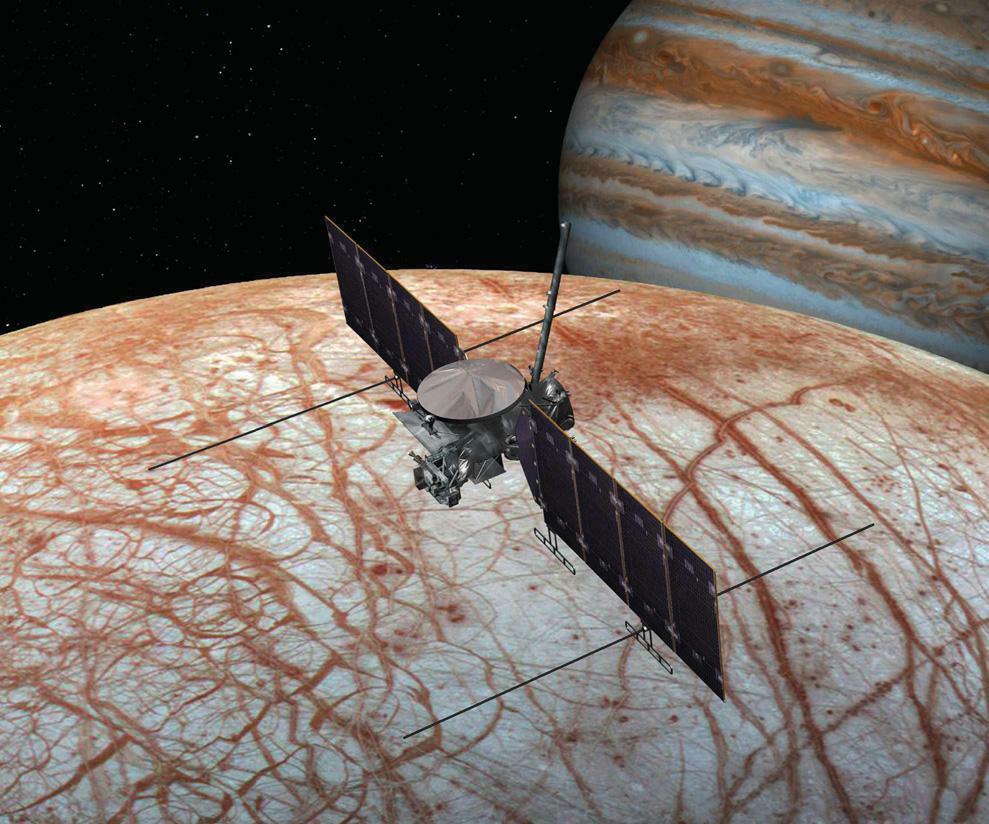
They exposed evidence for liquid water in the outer reaches of our planetary neighbourhood, far from where we thought it should be able to exist. Today, we know that the fourth largest moon of Jupiter, Europa, contains more water than all of Earth’s oceans combined. It turns out that Jupiter, despite being outside our Solar System’s traditional habitable zone, has created a habitable zone all of its own, driven not by the Sun’s warmth – sunlight at Jupiter is 30 times dimmer than at Earth – but by the effects of its incredibly powerful gravity. Given these new ‘cooler’ habitable options, in April this year the JUpiter ICy moons Explorer (JUICE) mission will be sent to Jupiter’s moons to help astrobiologists understand how habitable worlds have emerged in the outer Solar System.


Esta historia es de la edición April 2023 de BBC Science Focus.
Suscríbete a Magzter GOLD para acceder a miles de historias premium seleccionadas y a más de 9000 revistas y periódicos.
¿Ya eres suscriptor? Iniciar sesión
MÁS HISTORIAS DE BBC Science Focus
BBC Science Focus
World's biggest cobweb is home to 100,000 spiders
Spiders don't normally create such large colonies, so there's no need to worry about finding one in your basement

1 min
February 2026
BBC Science Focus
A dementia vaccine could be gamechanging – and available already
Getting vaccinated against shingles could protect you from getting dementia, or slow the progression of the disease
1 mins
February 2026

BBC Science Focus
DATA IN SPACE
An unusual spacecraft reached orbit in November 2025, one that might herald the dawn of a new era.
7 mins
February 2026
BBC Science Focus
Climate change is already shrinking your salary
No matter where you live, a new study has found warmer temperatures are picking your pocket
4 mins
February 2026

BBC Science Focus
A MENTAL HEALTH GLOW-UP
Forget fine lines. Could Botox give you an unexpected mental health tweakment?
3 mins
February 2026
BBC Science Focus
Most people with high cholesterol gene don't know they have it
Standard testing struggles to detect the condition
1 mins
February 2026

BBC Science Focus
HOW CAN I BOOST MY IQ?
If you're serious about getting smarter, it's time to ditch the brain-training apps
4 mins
February 2026

BBC Science Focus
Humans are absolutely terrible at reading dogs' emotions
Think you can tell how our furry friends are feeling? Think again
1 mins
February 2026

BBC Science Focus
HOW TO TEACH AI RIGHT FROM WRONG
If we want to get good responses from AI, we may need to see what it does when we ask it to be evil
3 mins
February 2026

BBC Science Focus
What Australia's social media ban could really mean for under-16s
Many people think social media is bad for our kids. Australia is trying to prove it
5 mins
February 2026
Translate
Change font size