
Vuélvete ilimitado con Magzter GOLD
Obtenga acceso ilimitado a más de 9000 revistas, periódicos e historias Premium por solo
Intentar ORO - Gratis
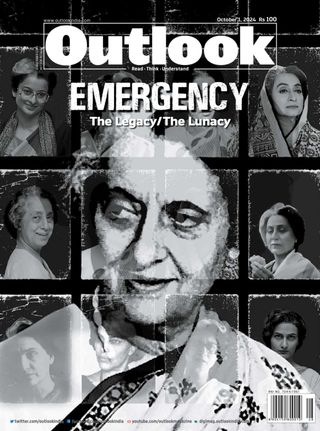
'Emergency' Takeaways
Outlook
|October 01, 2024
In a democracy, no ruler can be granted a carte blanche, like it happened during the Emergency, but the fact remains that we also learnt some valuable lessons during this period
EVEN before a holier-than-thou Narendra Modi government declared June 25 as 'Samvidhaan Hatya Diwas' to mark the imposition of the Emergency by the Indira Gandhi government on that day in 1975, there has been total unanimity that it was a rotten enterprise.
If there were any differences among scholars and partisans, these were to do with what was the dark side and what were the darker aspects of the Emergency. It is mostly agreed upon that the dark side included the suspension of fundamental rights, press censorship, the arrest of Opposition leaders, etc., whereas the darker side had to club the extraconstitutional power exercised by Sanjay Gandhi and his goonish aides. As it happens in all political debates over history, the villains are easily identified as are the heroes.
But even after nearly 50 years, we are nowhere near any understanding of the nature of the breakdown of normal politics that led to that midnight denouement on June 25, 1975.
It is helpful to keep in mind that the "JP Movement" was the first instance of mass mobilisation aimed at a regime change. Prior to the 1974-75 invocation of street power, the Indian State had faced only limited mass agitation. Early in the life of free India, there was the Vishal Andhra agitation; then the demand for bifurcation of Bombay between Gujarat and Maharashtra; and, later, the anti-Hindi agitation in south India. Each of these mass eruptions could be successfully dealt with because each was based on a clear-cut demand that could be conceded. The JP Movement, on the other hand, was expressly seeking a "total revolution".

Esta historia es de la edición October 01, 2024 de Outlook.
Suscríbete a Magzter GOLD para acceder a miles de historias premium seleccionadas y a más de 9000 revistas y periódicos.
¿Ya eres suscriptor? Iniciar sesión
MÁS HISTORIAS DE Outlook

Outlook
'Why GDP Growth Doesn't Always Translate Into Votes'
The recent election results have once again shown that economic growth alone does not guarantee electoral victory.

3 mins
June 06, 2026

Outlook
Lights, Camera, Othering
The establishment of Israel has been accompanied by a national cinema devoted to negating and erasing the Palestinian Other
5 mins
June 06, 2026

Outlook
Goodbye to All That
Booker-winning British author Julian Barnes' Departure(s) is a unique hybrid work: playful, philosophical, whimsical
4 mins
June 06, 2026

Outlook
Collapse of Trust
As the NEET-UG 2026 paper leak forced the cancellation of India’s biggest medical entrance exam, more than 22 lakh aspirants find themselves trapped in uncertainty
11 mins
June 06, 2026

Outlook
NO LONGER A TWELFTH MAN
Bihar cricket, which has languished in the shadows for long, is all set to improve its strike rate, thanks to Vaibhav Sooryavanshi, the new Bihari kid on the block
5 mins
June 06, 2026

Outlook
BLAZE OF GLORY
The challenges of being a celebrity cricketer at a young age can be tough to handle
5 mins
June 06, 2026

Outlook
THE SWASHBUCKLERS
A new generation of fearless stars is emerging and finding its feet at the very top of an extremely competitive cricketing environment
5 mins
June 06, 2026

Outlook
THE TEEN TORNAD
At the age of 15, Vaibhav Sooryavanshi is already a cricketing legend
10 mins
June 06, 2026

Outlook
A Journey to Remember
The prerecorded message crackled over the din in the compartment: ‘Welcome to the Shatabdi Express.
4 mins
June 06, 2026

Outlook
Crossing Borders
Ruth Martin is the translator of German-Iranian author Shida Bazyar’s novel The Nights are Quiet in Tehran (originally written in German), which has been shortlisted for the 2026 International Booker Prize.
4 mins
June 06, 2026
Listen
Translate
Change font size