
Vuélvete ilimitado con Magzter GOLD
Obtenga acceso ilimitado a más de 9000 revistas, periódicos e historias Premium por solo
Intentar ORO - Gratis
Nifty 50 Equal Weight Index funds: How are they different from Nifty 50 and should you invest in them?
Investors India
|January 2024
In a game of chess, every piece, from pawn to queen, has unique abilities and can move in a specific way.

However, a chess player has to frame an overall broad strategy, fit each piece within that, and, as a team, make the best of the unique abilities of each piece. Similarly, in investing, you have to frame an overall investment strategy, let each component contribute with its unique capabilities, and earn meaningful risk-adjusted returns at the portfolio level. The Nifty 50 Equal Weight Index funds can be best suited for such an investment strategy. In this article, we will understand the Nifty 50 equal weight index, the index funds based on it, how they differ from Nifty 50 market capitalisation index funds, performance comparison, and whether one should invest in it.
What is the Nifty 50 Equal Weight Index, and how is it different from the Nifty 50 Index?
The Nifty 50 Equal Weight Index is an alternative weighing index derived from the parent Nifty 50 Index. It has all the 50 constituents of its parent. However, the major difference is with regard to the weightage of each company and the sectoral concentration. The Nifty 50 Equal Weight Index assigns an equal weightage of 2% to each of the 50 companies, whereas the weights of Nifty 50 Index companies are based on their market capitalisation.
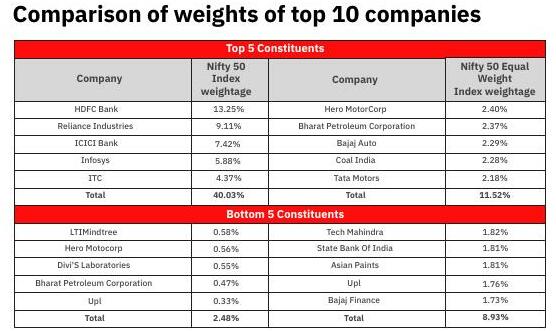
Note: The weightage of Nifty 50 Index constituents and Nifty 50 Equal Weight Index constituents is as of 30th November 2023


Esta historia es de la edición January 2024 de Investors India.
Suscríbete a Magzter GOLD para acceder a miles de historias premium seleccionadas y a más de 9000 revistas y periódicos.
¿Ya eres suscriptor? Iniciar sesión
MÁS HISTORIAS DE Investors India

Investors India
Strong Fundamentals Shield India During Geopolitical Turmoil Amid War
Macroeconomic indicators reflect the resilience of the Indian economy despite ongoing geopolitical tensions. Inflation has eased to low levels, GDP growth continues to remain above 7 percent, and the current account deficit is contained below 1 percent.

1 mins
April 2026

Investors India
Why Investment Product Design Matters in Volatile Times
Periods of geopolitical uncertainty often test investor confidence and increase market volatility.
3 mins
April 2026

Investors India
Match target maturity date with your horizon when investing in a life cycle mutual fund
The Securities and Exchange Board of India’s (Sebi) introduction of life cycle funds gives investors a new route to goal-based investing through a preset framework rather than repeated portfolio decisions.
6 mins
April 2026

Investors India
What mutual fund investors should focus on during market turmoil
It has been a rough few weeks for Indian mutual fund investors
5 mins
April 2026

Investors India
ASK THE EXPERT
Dear Prantik, closing your PPF account to shift the funds to an equity mutual fund portfolio is not a good idea.
3 mins
April 2026

Investors India
Why Real Estate is India's Favourite Asset Class for Investment
In India, real estate has long transcended its identity as a basic necessity to become a financial cornerstone, serving as a store of value, a symbol of achievement, and a source of long-term security.
5 mins
April 2026

Investors India
Walking - The Cure-all Exercise
Walking is one of the simplest, easiest and safest exercises for anyone.
6 mins
April 2026
Investors India
INSURANCE NEWS
In a recent Rajya Sabha session, finance minister Nirmala Sitharaman said both private and public insurance companies are tightly regulated and face action when they violate rules.
1 mins
April 2026

Investors India
SEBI's new mutual fund rules explained: Life Cycle Funds introduced; who are they for?
Mutual funds have become a popular investment vehicle and have rewarded investors over last several years.
3 mins
April 2026

Investors India
FY27 Budget—Focus on Manufacturing, Employment and Economic Security
We found the FY27 union budget forward looking and strategic, one that is aimed at sustaining growth, generating employment and building economic resiliency, keeping in mind the changing geopolitical context in terms of ongoing trade fragmentation and supply-chain reorganization.
5 mins
March 2026
Translate
Change font size