Intentar ORO - Gratis
LUDDITE LESSONS
The New Yorker
|April 21, 2025
The weavers lost the fight to save their livelihoods. As A.I. looms, can we do better?
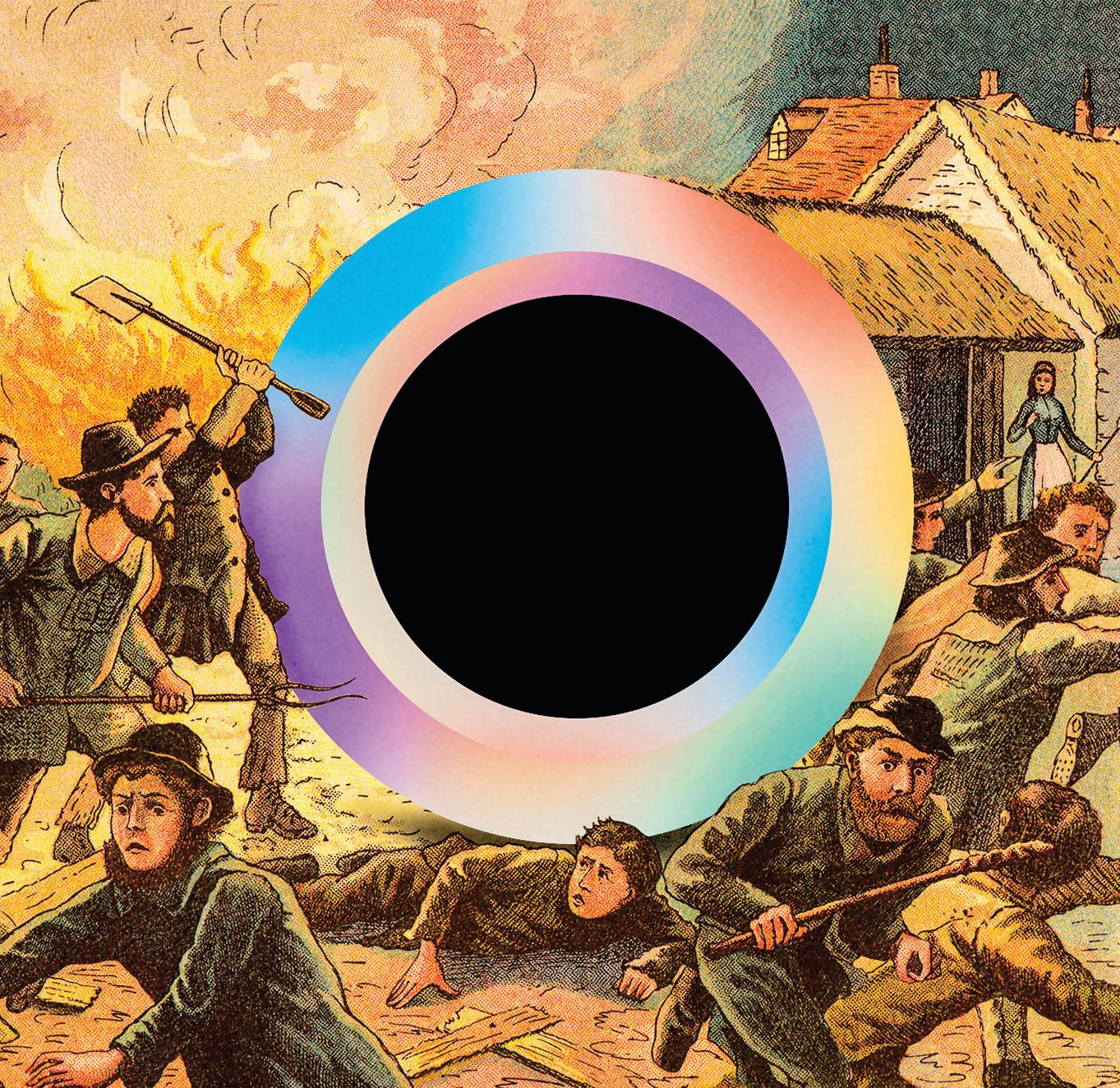
The challenge is to make A.I. work for us, rather than the other way around.
In the early hours of April 12, 1812, a crowd of men approached Rawfolds Mill, a four-story stone building on the banks of the River Spen, in West Yorkshire. This was Brontë country—a landscape of bleak moors, steep valleys, and small towns nestled in the hollows. The men, who'd assembled on the moors hours earlier, were armed with muskets, sticks, hatchets, and heavy blacksmith's hammers. When they reached the mill, those at the front broke windows to gain entry, and some fired shots into the darkened factory. But the mill's owner, William Cartwright, had been preparing for trouble.
During the previous twelve months, a wave of attacks had swept through textile factories across central and northern England. The unrest began in Nottinghamshire, where stocking knitters stormed their employers' premises and destroyed newfangled knitting frames, which they blamed for undercutting wages and reducing them to penury. These attacks spread to Lancashire, the heart of textile manufacturing, and to Yorkshire, where mill owners had begun mechanizing the ancient craft of “dressing” woollen cloth—raising the nap and cutting it into finished pieces.
For centuries, the “shearers” or “croppers” who practiced this craft had formed something like an artisanal priesthood, raising the nap with the heads of teasel plants and finishing the cloth with handheld shears in a ritual of skill passed from father to son. Now came the machines—the gig mills with their cold metal rollers and the shear-ing frames that needed just one man turning a crank, like an organ grinder playing a funeral march for an entire way of life.

Esta historia es de la edición April 21, 2025 de The New Yorker.
Suscríbete a Magzter GOLD para acceder a miles de historias premium seleccionadas y a más de 9000 revistas y periódicos.
¿Ya eres suscriptor? Iniciar sesión
MÁS HISTORIAS DE The New Yorker
The New Yorker
CONTRIBUTORS
Eliza Griswold (\"Young Americans,\" p. 12) is a contributing writer.

1 mins
June 29, 2026

The New Yorker
THE READERS
Early in my treatment, we decided that you wouldn't read my work.
24 mins
June 29, 2026

The New Yorker
URBAN LEGEND
Closing out a crime trilogy about a changing New York, Colson Whitehead excavates his own foundations.
33 mins
June 29, 2026
The New Yorker
ABOUT TOWN
POST-ROCK | Last year, the Chicago instrumental post-rock band Tortoise returned with \"Touch,\" its first album in nearly a decade, the further explorations of an inquisitive nature.
3 mins
June 29, 2026

The New Yorker
GOINGS ON JUNE 24-30, 2026
What we're watching, listening to, and doing this week.
1 min
June 29, 2026
The New Yorker
LONGING FOR ITHACA
There’s a reason Homer’s homecoming epic has long defeated the directors.
16 mins
June 29, 2026

The New Yorker
HOT PURSUIT
The repo man coming for your ride.
35 mins
June 29, 2026

The New Yorker
WILD THINGS
Why do animals have sex, anyway?
14 mins
June 29, 2026

The New Yorker
PRICKLY PAIRS - “The Invite.”
“The Invite” begins with an aphorism: “One should always be in love.
6 mins
June 29, 2026
The New Yorker
BRAVE NEW WORLD DEPT.INSTANCING
Wednesday evenings at Hex&Co., board-game café and bar in Morningside Heights, are dedicated to \"RPG Encounters,\" in which fans of role-playing games gather to create collaborative stories over espresso drinks.
3 mins
June 29, 2026
Listen
Translate
Change font size