Intentar ORO - Gratis
Do You Know What's Crawling On Your Cattle?
Successful Farming
|July 2025
The Asian longhorned tick spreads theileriosis, a disease caused by a parasite that feeds off cattle’s red and white blood cells.
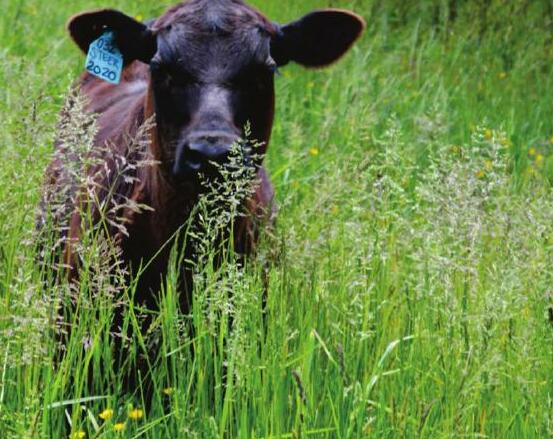
Eastern Virginia cattle producer Steve Hopkins knows his 300 Angus and SimAngus cows will encounter a pest or two while out on their lush summer pastures. But in 2018 the pests his cows were hosting were worse than he could have imagined.
That year, Riverview Farms Cattle lost seven cows. A year later, the farm lost two out of 22 bred cows Hopkins had recently purchased.
At first, Hopkins suspected it was anaplasmosis, a common tick-borne disease. But when he treated the cattle for it, they didn’t respond to the antibiotics. A call to his veterinarian and one blood test later, Hopkins would learn that 95% of his herd was infected with Theileria orientalis Ikeda, which causes theileriosis.
“Once you have the first wave, it gets better. All those that made it through are now resistant,” Hopkins says.
A Deadly Pest
Theileriosis is a disease caused by a blood-borne parasite that feeds off cattle’s red and white blood cells. The disease is spread by the Asian longhorned tick, an invasive species from northeast Asia. USDA discovered the tick in 2017 on sheep in New Jersey.
Since then, the tick has spread to 17 states: Arkansas, Connecticut, Delaware, Georgia, Kentucky, Maryland, Missouri, New Jersey, New York, North Carolina, Ohio, Pennsylvania, Rhode Island, South Carolina, Tennessee, Virginia, and West Virginia. In 2022, the tick was on two breeding bulls that fell ill and died in Kentucky, according to the state’s department of agriculture. The University of Missouri also found the tick in a pasture in Linn County, Missouri.
“This is troubling because this tick is spreading quickly and efficiently throughout the United States,” says Lindsay Fry, a USDA veterinary medical officer.
Unlike the common deer and cattle fever ticks, Asian longhorned females are parthenogenetic, which means a female doesn’t need a male to reproduce.


Esta historia es de la edición July 2025 de Successful Farming.
Suscríbete a Magzter GOLD para acceder a miles de historias premium seleccionadas y a más de 9000 revistas y periódicos.
¿Ya eres suscriptor? Iniciar sesión
MÁS HISTORIAS DE Successful Farming

Successful Farming
When Fire Backfires
Controlled burns and field fires are part of farm life. But when flames or smoke drift beyond your fence line, you could be on the hook for major damages.

4 mins
March 2026

Successful Farming
Planter Calibration Sets Yield Potential
Preparing, calibrating, and verifying planter performance help ensure uniform emergence.
4 mins
March 2026
Successful Farming
all around THE FARM
I built this rolling cart out of two Harbor Freight scissor-lift transmission jacks.
1 mins
March 2026
Successful Farming
Pickup Box Power Utility Center
An easy-access portable energy source serves multiple functions.
1 mins
March 2026

Successful Farming
6 Tips for a Tighter Calving Window
Experts say a shorter calving season can optimize your barn’s productivity and your checkbook.
4 mins
March 2026

Successful Farming
Are We Too Young for an Estate Plan?
Problem: A young couple with children doesn’t have an estate plan, but their assets may change with future inheritance and acquisitions.
2 mins
March 2026

Successful Farming
New Holland PowerStar Electro Command Tractors
High-power machines feature utility size.
2 mins
March 2026

Successful Farming
Claas Jaguar 1000 Forage Harvester for Wide Crop Flow
The 1000 series is launching with four new models.
2 mins
March 2026

Successful Farming
Mark Crave
At this Wisconsin dairy, sustainability and family farming go hand in hand, from milking 2,300 cows to powering the farm with manure.
3 mins
March 2026

Successful Farming
Insuring Against Fire
Being fully covered in case of fire is critical after a disaster.
3 mins
March 2026
Listen
Translate
Change font size