Intentar ORO - Gratis
Why Territorial Managers Stifle Innovation and What to Do About It
MIT Sloan Management Review
|Summer 2024
Managers who feel insecure about their status tend not to encourage novel ideas from their employees. Fostering their identification with the organization can change this behavior.

Dilip has been working hard on a game-changing idea for a new product. But when he excitedly approaches his boss to share it and get approval for further development and testing, his proposal is quickly rejected. Instead of offering constructive feedback on how to make the idea workable, his boss vaguely refers to a lack of budget and discourages Dilip from pursuing any further ideas.
Sound familiar? Sadly, such scenarios are all too common in many organizations.
Employee creativity and innovation are critical to the success of organizations today. However, when employees do generate novel ideas, they often fail to receive encouragement or see their ideas materialize. Managers are a significant contributor to this phenomenon; even when they profess to value creativity, they routinely reject innovative ideas proposed by employees, preventing their implementation. Why do managers say no to ideas that could benefit their companies and even themselves?
Researchers have so far focused on personality factors, managers’ economic mindsets, or managers’ general aversion to uncertainty as explanations for this stifling of employee ideas. For example, one study has suggested that because managers are always focused on the financial consequences of their decisions, they reject novel ideas whose financial outcomes cannot be reliably forecast. However, as we discuss in our paper in Organization Science, there are deeper reasons for such rejection, rooted in managers’ self-interests, underlying fears, and insecurities.
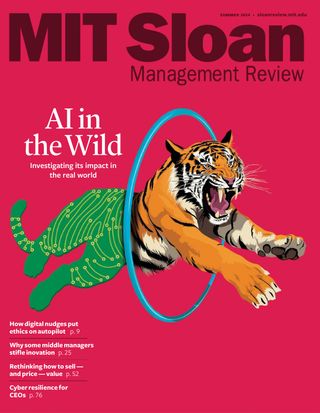

Esta historia es de la edición Summer 2024 de MIT Sloan Management Review.
Suscríbete a Magzter GOLD para acceder a miles de historias premium seleccionadas y a más de 9000 revistas y periódicos.
¿Ya eres suscriptor? Iniciar sesión
MÁS HISTORIAS DE MIT Sloan Management Review

MIT Sloan Management Review
Assess What Is Certain in a Sea of Unknowns
Understanding what won't change clarifies what might — and strengthens decision-making in volatile times.

13 mins
winter 2026

MIT Sloan Management Review
Ask Sanyin: Why Is It So Hard to Pull the Plug on a Project?
We're finding it difficult to wind down projects that no longer serve our priorities.
2 mins
winter 2026

MIT Sloan Management Review
Integrate Sustainability and Innovation to Find New Opportunities
Five common innovation practices can help leaders pursue sustainability as a growth strategy.
12 mins
winter 2026

MIT Sloan Management Review
The Case for Quiet Corporate Activism
Leaders concerned that they will be penalized for championing sustainability and diversity can still sustain their commitments.
11 mins
winter 2026

MIT Sloan Management Review
The Perils of Algorithmic Pricing
Some revenue management systems based on algorithms may lead to unintended collusion and antitrust violations.
9 mins
winter 2026

MIT Sloan Management Review
Broadening Future Perspectives at the Bank of England
Leaders at the U.K’s central bank sought to broaden their thinking about future risks and opportunities. Here’s how they built longer-term horizon-scanning capabilities and what they learned along the way.
9 mins
winter 2026

MIT Sloan Management Review
How Nesting Changes Platform Strategy
Should your platform host another platform — or be hosted by one? Here's how to think through the choices.
14 mins
winter 2026
MIT Sloan Management Review
Are You an Authentic Leader or an Authentic Jerk?
Leaders who are true to their values can inspire trust and respect, but not if \"being yourself\" becomes the problem.
13 mins
winter 2026

MIT Sloan Management Review
How to Make Scenario Planning Stick
Developing future scenarios can deepen leaders’ strategic insights. Establishing scenario planning as an ongoing capability and reaping its full benefits require linking it to other processes.
16 mins
winter 2026

MIT Sloan Management Review
A Faster Way to Build Future Scenarios
This streamlined approach to scenario planning incorporates AI and helps managers navigate future uncertainties more efficiently.
13 mins
winter 2026
Listen
Translate
Change font size