
Vuélvete ilimitado con Magzter GOLD
Obtenga acceso ilimitado a más de 9000 revistas, periódicos e historias Premium por solo
Intentar ORO - Gratis
Unfair Trade Laws Can Put A Spanner In Our Quest For A Circular Economy
Down To Earth
|June 16, 2019
USED Recycle and reuse of products make great economic and environmental sense. But will circular economy benefit the world at a time when economic giants like the US are using trade sanctions to bully Rwanda, which has banned used clothing? India too is at the risk of becoming the rich world's dumpyard

AN UNEASY silence has enveloped over the once-vibrant Kimironko market in Rwanda's capital town, Kigali. Sitting in a dim corner, Emmanuel Harindin-Tiwari listens intently as the other stallholders discuss an incident on the border that now threatens political and social stability in East Africa. On May 24, the Rwandan security force gunned down two people, including a Ugandan national, for trying to smuggle used clothes into the country. Those were hand-me-downs from people living some tens of thousands of kilometers away across the North Atlantic Ocean, or beyond the Mediterranean Sea, which get sold across Africa as cheap garments and are the primary source of clothing across the continent.
But the Rwandan government does not want its citizens to sift through piles of cast-offs from wealthier nations. In its attempt to shed the "third world" label and "restore" people's dignity, the government has been aggressively regulating the entry of used clothes and footwear into the country. Since 2016-17, it has progressively increased taxes on this merchandise, first from the US $0.20 to $2.50 per kg and then to $4 in the next financial year. Tariff on used footwear has also jumped from $0.20 to $5. Simultaneously, the government has heightened surveillance along the country's porous borders with Uganda and the Democratic Republic of Congo, which is among the top importers of used clothing in Africa. This has unnerved many of the 22,000 Rwandans engaged in the trade—right from wholesalers, retailers and vendors to those involved in washing, repairing and restyling products to fit the body shapes and sizes of Africans.
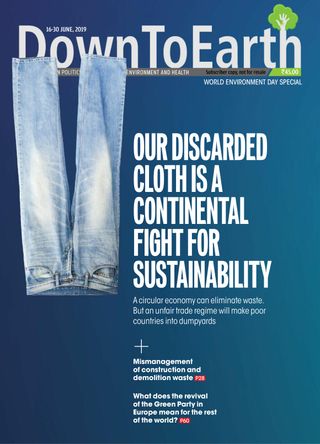

Esta historia es de la edición June 16, 2019 de Down To Earth.
Suscríbete a Magzter GOLD para acceder a miles de historias premium seleccionadas y a más de 9000 revistas y periódicos.
¿Ya eres suscriptor? Iniciar sesión
MÁS HISTORIAS DE Down To Earth

Down To Earth
MILES TO GO
As impacts of climate change accelerate, climate finance remains trapped in incrementalism

6 mins
April 16, 2026

Down To Earth
Hope for revival of the great Indian bustard
The birth of a great Indian bustard chick in the Kutch region of Gujarat has created history in the world of conservation, reviving hope.
2 mins
April 16, 2026
Down To Earth
IN MAHUA TERRITORY
Once mahua starts to flower, every thing else takes a back seat for tribal communities in forests of central India
6 mins
April 16, 2026

Down To Earth
CAUGHT IN THE ENERGY GAP
Kitchens across rural India reflect a peculiar reality: energy is within reach but affordability remains a concern. PUJA DAS travels across 15 villages in Madhya Pradesh, Chhattisgarh and Uttar Pradesh to investigate why rural households still rely on traditional fuels like firewood, dung cakes and crop residue that pose a health risk, and why their energy bills are rising.
12 mins
April 16, 2026
Down To Earth
Lake or wetland?
While villages around Almora's Tadag Tal want the seasonal lake to be developed into a perennial waterbody, experts say the area is a wetland and should not be disturbed
5 mins
April 16, 2026

Down To Earth
World far from curbing maternal deaths
INDIA HAS cut its maternal mortality ratio (MMR) by 80 per cent since 1990, according to a recent analysis published in The Lancet.
1 min
April 16, 2026
Down To Earth
Energy in times of war
THE DISASTROUS US-Israel war against Iran has disrupted energy supply across the world. Governments in both rich and poor countries are warning their people of dire times ahead, unlike anything seen before by this generation: acute energy scarcity, rationing and even the prospect of cars and aeroplanes running out of fuel. The question is what will the future energy map look like?
3 mins
April 16, 2026
Down To Earth
Unfinished business
Land consolidation is globally considered a critical component of land reforms and holds the key to improve agrarian productivity. But it is yet to be undertaken in meaningful ways in most parts of the country, reports
6 mins
April 16, 2026

Down To Earth
Roots of revival
Chhattisgarh's Baiga community mounts conservation efforts to keep alive a traditional art form at risk of vanishing due to ecological changes
2 mins
April 16, 2026
Down To Earth
A mass human capital loss
ADULT HEIGHT across countries, including India, is no longer increasing.
2 mins
April 16, 2026
Translate
Change font size