
Gå ubegrenset med Magzter GOLD
Få ubegrenset tilgang til over 9000 magasiner, aviser og premiumhistorier for bare
Unfair Trade Laws Can Put A Spanner In Our Quest For A Circular Economy
Down To Earth
|June 16, 2019
USED Recycle and reuse of products make great economic and environmental sense. But will circular economy benefit the world at a time when economic giants like the US are using trade sanctions to bully Rwanda, which has banned used clothing? India too is at the risk of becoming the rich world's dumpyard

AN UNEASY silence has enveloped over the once-vibrant Kimironko market in Rwanda's capital town, Kigali. Sitting in a dim corner, Emmanuel Harindin-Tiwari listens intently as the other stallholders discuss an incident on the border that now threatens political and social stability in East Africa. On May 24, the Rwandan security force gunned down two people, including a Ugandan national, for trying to smuggle used clothes into the country. Those were hand-me-downs from people living some tens of thousands of kilometers away across the North Atlantic Ocean, or beyond the Mediterranean Sea, which get sold across Africa as cheap garments and are the primary source of clothing across the continent.
But the Rwandan government does not want its citizens to sift through piles of cast-offs from wealthier nations. In its attempt to shed the "third world" label and "restore" people's dignity, the government has been aggressively regulating the entry of used clothes and footwear into the country. Since 2016-17, it has progressively increased taxes on this merchandise, first from the US $0.20 to $2.50 per kg and then to $4 in the next financial year. Tariff on used footwear has also jumped from $0.20 to $5. Simultaneously, the government has heightened surveillance along the country's porous borders with Uganda and the Democratic Republic of Congo, which is among the top importers of used clothing in Africa. This has unnerved many of the 22,000 Rwandans engaged in the trade—right from wholesalers, retailers and vendors to those involved in washing, repairing and restyling products to fit the body shapes and sizes of Africans.
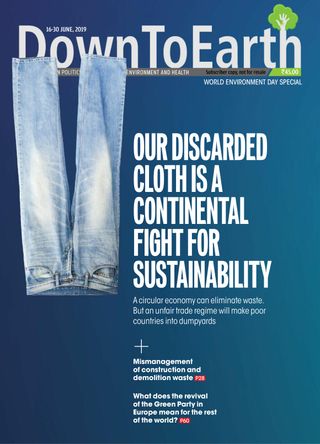

Denne historien er fra June 16, 2019-utgaven av Down To Earth.
Abonner på Magzter GOLD for å få tilgang til tusenvis av kuraterte premiumhistorier og over 9000 magasiner og aviser.
Allerede abonnent? Logg på
FLERE HISTORIER FRA Down To Earth
Down To Earth
KING OF BIRDS
Revered for centuries, western tragopan now needs protection as its forests shrink, human pressures mount

3 mins
December 16, 2025

Down To Earth
WHISKERS ALL AQUIVER
Climate change threatens creatures that have weathered extreme environments for thousands of years
2 mins
December 16, 2025

Down To Earth
GOLDEN SPIRIT
Survival of the shy primate is closely tied to the health of Western Ghats
3 mins
December 16, 2025

Down To Earth
RINGED EYES IN THE CANOPY
Rapid habitat destruction forces arboreal langur to alter habits
2 mins
December 16, 2025

Down To Earth
HANGING BY THE CLIFF
The Himalaya's rarest wild goat is on the brink of local extinction
2 mins
December 16, 2025

Down To Earth
ANGEL OF THE BEAS
Conservation reserves, citizen science, and habitat protection give the Indus River dolphin a fighting chance in India
2 mins
December 16, 2025

Down To Earth
UNDER MOONLIT SCRUB
Survival of this hidden guardian tells us whether our scrublands still breathe
2 mins
December 16, 2025

Down To Earth
SYMBOL OF SILENT VALLEY
Lion-tailed macaque remains vulnerable despite past victories
2 mins
December 16, 2025

Down To Earth
THE APE IN OUR STORIES
India's only non-human ape species is a cultural icon threatened by forest fragmentation
2 mins
December 16, 2025

Down To Earth
SENTINEL OF THE HIGH COLD DESERT
The bird's evocative call may not continue to roll across the cold desert valley for long
3 mins
December 16, 2025
Translate
Change font size