Intentar ORO - Gratis
Picture Imperfect
Down To Earth
|September 01, 2019
It’s difficult to ignore how desertification is expanding in areas that are on the front line of climate change
-

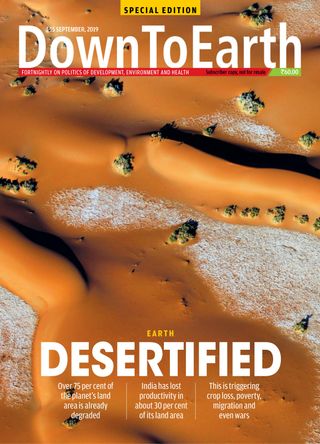
A THIRD OF the Earth’s total landmass has become a victim of desertification, threatening the livelihood of a billion people in over 100 countries. The Intergovernmental Panel on Climate Change (IPCC), the global body for assessing the state of climate change and its impacts, released its 1,500-page report on August 8, echoing the United Nations Convention to Combat Desertification’s finding. IPCC sounded a clear warning for the world: adopt sustainable land management practices or face the consequences of land degradation, climate change, and desertification.
It's Special Report on Climate Change defines desertification as land degradation occurring in drylands—arid, semi-arid and dry sub-humid areas. And the way we use land is rapidly turning large tracts dry. Three-quarters of the Earth’s ice-free land is already under stress.
Nearly 50 million hectares (ha) of forest land have been acquired since 2000, mostly for agriculture, in Sub-Saharan Africa, Southeast Asia, Eastern Europe, and Latin America. As natural grasslands have been replaced with pasturelands, forests with cropland, and wetlands have dried up, greenhouse gases (GHG) in the environment have peaked. During 2007-2016, human activities added 13 percent carbon dioxide (CO 2), 44 percent methane and 82 percent of nitrous oxide to the environment. This was largely due to deforestation, wood harvesting, and agricultural practices. In most regions, global warming due to GHG accelerated desertification and land degradation. Since 1961, the world has lost 11-14 percent of its biodiversity due to land-use changes. These have had drastic social and environmental impacts, yet there is no sign of stagnation in land acquisitions in the foreseeable future.

Esta historia es de la edición September 01, 2019 de Down To Earth.
Suscríbete a Magzter GOLD para acceder a miles de historias premium seleccionadas y a más de 9000 revistas y periódicos.
¿Ya eres suscriptor? Iniciar sesión
MÁS HISTORIAS DE Down To Earth

Down To Earth
THE GREAT PIVOT
China's moves to transition to clean energy offer critical lessons to India

4 mins
March 01, 2026

Down To Earth
COAL V CORRIDOR
A proposal to mine coal along a corridor that links two tiger reserves in central India is a step away from getting final clearance. The move could affect movement and genetic diversity of tiger populations in the region
8 mins
March 01, 2026

Down To Earth
India's challenging AI predicament
Hobbled by lack of innovation and AI skills in its crucial technology sector, India is focusing on a ruinous plan to host data centres
4 mins
March 01, 2026
Down To Earth
China to implement zero tariffs across Africa
CHINA ON February 14 announced that it will implement zero tariffs for imports from all the 53 African nations it has diplomatic relations with, starting from May 1.
1 min
March 01, 2026
Down To Earth
Poverty, sans the threshold
MEASUREMENT OF poverty is a fundamental exercise, needed to direct development programmes.
2 mins
March 01, 2026

Down To Earth
A bridge across forever
For two decades, a Chhattisgarh village remains stuck in a loop of building temporary river crossings to access markets and sell forest produce
4 mins
March 01, 2026
Down To Earth
Liveable cities need a new model
CRY FOR my Delhi. This is my city—my family records many generations who have lived here.
3 mins
March 01, 2026

Down To Earth
Real impacts of the changing seasons
This refers to the article \"1,500 days, and an alarm for new climate\" (1-15 December, 2025).
1 mins
March 01, 2026

Down To Earth
‘It’s a systematic effort by US to dismantle climate policy’
The US, the world's largest historical emitter of greenhouse gases, has overturned its “endangerment finding”, the legal foundation for regulating emissions under the Clean Air Act since 2009.
4 mins
March 01, 2026
Down To Earth
Amazon turned carbon source in 2023 drought
EXTREME DROUGHT and a prolonged heatwave in 2023 pushed parts of the Amazon rainforest from acting as a carbon sink to becoming a carbon source for three months, according to a February 13 study published in the journal AGU Advances of the American Geophysical Union.
1 min
March 01, 2026
Translate
Change font size