कोशिश गोल्ड - मुक्त
Picture Imperfect
Down To Earth
|September 01, 2019
It’s difficult to ignore how desertification is expanding in areas that are on the front line of climate change
-

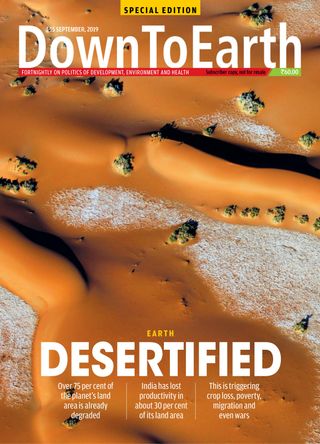
A THIRD OF the Earth’s total landmass has become a victim of desertification, threatening the livelihood of a billion people in over 100 countries. The Intergovernmental Panel on Climate Change (IPCC), the global body for assessing the state of climate change and its impacts, released its 1,500-page report on August 8, echoing the United Nations Convention to Combat Desertification’s finding. IPCC sounded a clear warning for the world: adopt sustainable land management practices or face the consequences of land degradation, climate change, and desertification.
It's Special Report on Climate Change defines desertification as land degradation occurring in drylands—arid, semi-arid and dry sub-humid areas. And the way we use land is rapidly turning large tracts dry. Three-quarters of the Earth’s ice-free land is already under stress.
Nearly 50 million hectares (ha) of forest land have been acquired since 2000, mostly for agriculture, in Sub-Saharan Africa, Southeast Asia, Eastern Europe, and Latin America. As natural grasslands have been replaced with pasturelands, forests with cropland, and wetlands have dried up, greenhouse gases (GHG) in the environment have peaked. During 2007-2016, human activities added 13 percent carbon dioxide (CO 2), 44 percent methane and 82 percent of nitrous oxide to the environment. This was largely due to deforestation, wood harvesting, and agricultural practices. In most regions, global warming due to GHG accelerated desertification and land degradation. Since 1961, the world has lost 11-14 percent of its biodiversity due to land-use changes. These have had drastic social and environmental impacts, yet there is no sign of stagnation in land acquisitions in the foreseeable future.

यह कहानी Down To Earth के September 01, 2019 संस्करण से ली गई है।
हजारों चुनिंदा प्रीमियम कहानियों और 10,000 से अधिक पत्रिकाओं और समाचार पत्रों तक पहुंचने के लिए मैगज़्टर गोल्ड की सदस्यता लें।
क्या आप पहले से ही ग्राहक हैं? साइन इन करें
Down To Earth से और कहानियाँ
Down To Earth
Popular distrust
THE WORLD seems to be going through a period of stasis despite facing an unfathomable polycrisis.

2 mins
February 01, 2026
Down To Earth
CONSERVE OR PERISH
Periyar Tiger Reserve has rewritten Indian conservation by turning poachers into protectors and conflict into coexistence
5 mins
February 01, 2026

Down To Earth
'Rivers need to run free'
From Tibet to West Bengal, the Brahmaputra is the pulse of communities and ecosystems along its course. But what are the risks the river faces through human interventions, particularly dams, discusses journalist, author and filmmaker SANJOY HAZARIKA in his new book, River Traveller.
4 mins
February 01, 2026

Down To Earth
India is facing up to its innovation lag
There are signs now that India is acknowledging the superior strides made by China in a frontier technology like Al
4 mins
February 01, 2026

Down To Earth
Competing concerns
What are the repercussions of the EU-Mercosur pact that have made European farmers protest against the free trade agreement?
4 mins
February 01, 2026

Down To Earth
From fryer to flight
Sustainable fuel made from used cooking oil can play a pivotal role in helping India achieve its aviation emission reduction goals. Measures to collect this oil must be revamped
4 mins
February 01, 2026

Down To Earth
ACCESS OPEN
An amendment to India's nodal forest conservation law opens up forests across India to commercial exploitation by the paper industry
6 mins
February 01, 2026
Down To Earth
DRINK FROM TAP CAN BE A REALITY
As cities across India struggle to supply safe piped water, Odisha offers a success story
2 mins
February 01, 2026

Down To Earth
GREAT DRYING
The Earth is hotter than at any point in the past 100,000 years, with 2023-25 becoming the warmest three-year period on record and also breaching the 1.5°C threshold for the first time. One fallout is dwindling freshwater.
22 mins
February 01, 2026

Down To Earth
Green redemption
Restoration of grasslands of Kerala's Pampadum Shola National Park, once dominated by invasive Australian wattles, see a return of streams and native species
1 mins
February 01, 2026
Translate
Change font size