
Vuélvete ilimitado con Magzter GOLD
Obtenga acceso ilimitado a más de 9000 revistas, periódicos e historias Premium por solo
Intentar ORO - Gratis
Water, Water, Everywhere?
BBC Sky at Night Magazine
|December 2023
Penny Wozniakiewicz investigates why astronomers are so concerned with finding water in the Solar System, and why it is vital to our exploration of space

Staring up at the Moon with the naked eye, we can forgive early astronomers for assuming the dark patches spread out over its surface were seas - or 'maria' as they were named, after the Latin word for seas. Informed by centuries of ever-improving observations and over 60 years of space exploration, we now know the maria are not seas but rather vast expanses of volcanic basalt that erupted over the lunar surface several billion years ago.
The Moon is in fact very dry: more so than any desert on Earth. Yet despite that, on 23 August 2023 the Indian Space Research Organisation's Chandrayaan-3 mission successfully deployed its lander and rover near the lunar south pole in search of water.
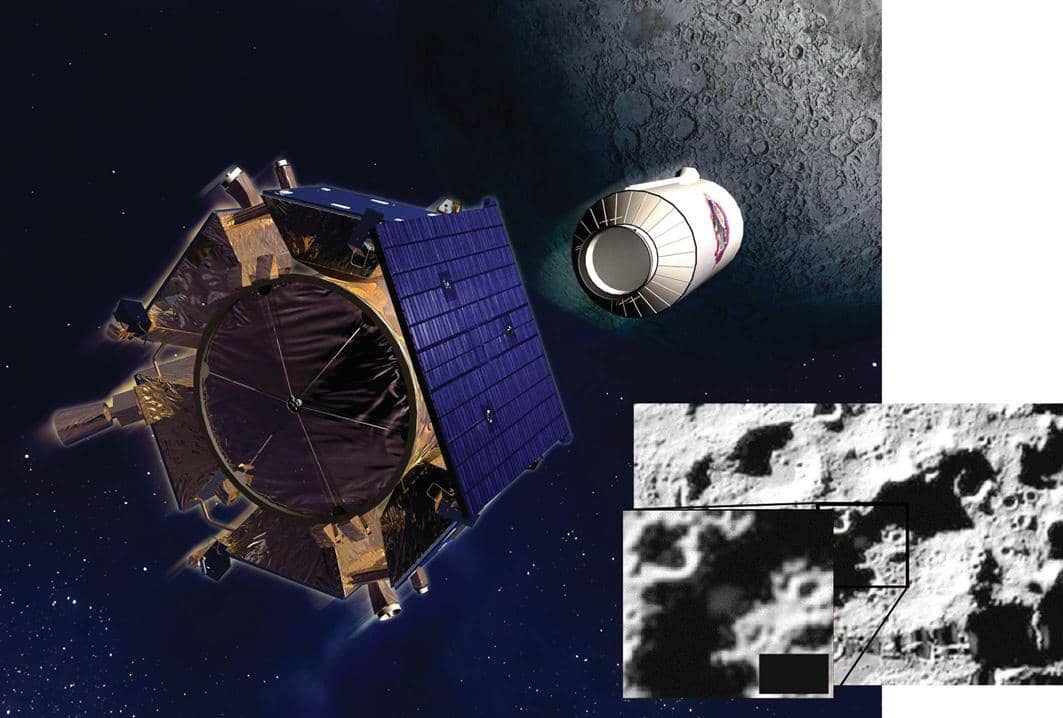
So why search for water in such a dry location? Although there is no liquid water on the Moon, water is present in the form of ice trapped between grains in the lunar soil and incorporated into minerals and glassy beads produced by impacts. The potential for such hidden water was first suggested by remote observations of the surface, and later confirmed by NASA's LCROSS mission, which in 2009 fired an empty rocket stage into a crater on the lunar surface and identified ice in the plume of material flung up from the crash site. Further observations of the surface by the likes of the NASA and German Aerospace Center's SOFIA telescope have since suggested the south polar region of the Moon in particular may host far more water than we ever imagined. As much as 100-400mg of water (about one raindrop) may be present in each kilo of soil.
While this may seem a small amount, it has prompted several space agencies to propose lunar surface missions and instruments to find and characterise lunar water over the next decade.
PROSPECTing for water

Esta historia es de la edición December 2023 de BBC Sky at Night Magazine.
Suscríbete a Magzter GOLD para acceder a miles de historias premium seleccionadas y a más de 9000 revistas y periódicos.
¿Ya eres suscriptor? Iniciar sesión
MÁS HISTORIAS DE BBC Sky at Night Magazine

BBC Sky at Night Magazine
Crush: Close Encounters with Gravity
Gravity is something that we're all innately familiar with. It keeps our feet on the ground, fights against a rocket trying to leave Earth and governs the movement of the planets and stars.

1 mins
April 2026

BBC Sky at Night Magazine
Exploring the Universe
There's no shortage of children's books about astronomy.
2 mins
April 2026
BBC Sky at Night Magazine
Make your Milky Way images pop
Simple, free processing techniques using FastStone Image Viewer
3 mins
April 2026

BBC Sky at Night Magazine
Nightfaring: In Search of the Disappearing Darkness
This book is a manifesto for dark skies, written as a travel memoir.
1 mins
April 2026
BBC Sky at Night Magazine
Flying saucers- The making of a modern myth
Our obsession with UFOs goes back further than you might think. Robert Pateman traces how early science fiction, dubious sightings and an alien-mad media led to the 1950s saucer fever
9 mins
April 2026
BBC Sky at Night Magazine
STAR OF THE MONTH
Alphecca, the brightest jewel in the Crown
1 min
April 2026

BBC Sky at Night Magazine
How to use a planisphere
Navigate the sky with the original stargazer's tool. No batteries, apps or Wi-Fi required!
3 mins
April 2026
BBC Sky at Night Magazine
Why rockets don't launch straight up
For a rocket to get its payload into space, it has to follow a curved path. But what would happen if it didn't?
2 mins
April 2026

BBC Sky at Night Magazine
Q&A WITH A DARK MATTER SPECIALIST
Dark matter makes up 27 per cent of all matter in the Universe. So why is it so hard to find? Meet one of the people making a map that leads us to it
3 mins
April 2026

BBC Sky at Night Magazine
Why I want to put a hotel on the Moon
Bored of the beach? Sick of city breaks? Step this way. Space entrepreneur Skyler Chan explains how he'll build a holiday destination on the Moon by 2030
2 mins
April 2026
Translate
Change font size