
Vuélvete ilimitado con Magzter GOLD
Obtenga acceso ilimitado a más de 9000 revistas, periódicos e historias Premium por solo
Intentar ORO - Gratis
Waking up WEBB
BBC Sky at Night Magazine
|March 2022
The James Webb Space Telescope's launch and deployment was a storming success, but why haven't we seen the first pictures yet? Govert Schilling has the answer

After 25 years and over 10 billion US dollars, on Christmas Day 2021, the James Webb Space Telescope (JWST) was finally launched into space by a European Ariane 5 rocket. With its 6.5-metre primary mirror and its tennis-court-sized sunshield, Webb had to be folded up to fit in the rocket's fairing, only to be deployed step by step in the first two weeks of its mission (see box, 'Unfolding the telescope', on p36). However, the successor to the Hubble Space Telescope won't take its first images of the Universe before late June or early July 2022, which begs the question - why?
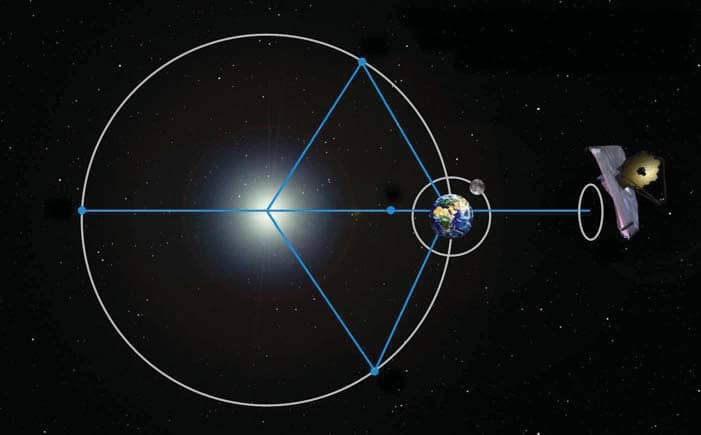
It seems like an excessively long wait, especially since JWST arrived in its final orbit on 24 January. A total of three mid-course correction manoeuvres successfully placed the huge space telescope in a slow looping orbit around the second Lagrange point (L2), a stable gravitational point some 1.5 million kilometres behind Earth as seen from the Sun. "But a lot more needs to be done before we can start science operations," says Mark McCaughrean, the Senior Advisor for Science and Exploration at ESA (the European Space Agency), NASA's main partner in the programme.
For one, the telescope and its sensitive instruments, which left the French Guianalaunch platform at tropical temperatures, have to cool down to 230°C below zero.

Esta historia es de la edición March 2022 de BBC Sky at Night Magazine.
Suscríbete a Magzter GOLD para acceder a miles de historias premium seleccionadas y a más de 9000 revistas y periódicos.
¿Ya eres suscriptor? Iniciar sesión
MÁS HISTORIAS DE BBC Sky at Night Magazine
BBC Sky at Night Magazine
The Giant Leap: Why Space is the Next Frontier in the Evolution of Life
“Earth is the cradle of humanity, but one cannot live in the cradle forever,” wrote Konstantin Tsiolkovsky in 1911.

1 mins
February 2026
BBC Sky at Night Magazine
Tele Vue Nagler Type-7 series eyepieces
These premium optics were inspired by Apollo - and deliver a giant leap to your views
4 mins
February 2026
BBC Sky at Night Magazine
Once Upon a Time in Space
While the Space Race of the Cold War years was ultimately a geopolitical contest between the USA and the Soviet Union, the rivalry sparked rapid innovation and inspired multiple generations to look skyward.
1 mins
February 2026
BBC Sky at Night Magazine
The Multiverse: When One Universe Isn't Enough
The concept of a 'multiverse' – the idea that our Universe may be just one of many – is widespread in science fiction and a common thread of online discussions.
1 mins
February 2026
BBC Sky at Night Magazine
Q&A WITH A GAMMA RAY SPECIALIST
In 2025, astronomers detected a blast from space that lasted seven hours. Now they're uncovering the strange processes behind the exceptional outburst
3 mins
February 2026
BBC Sky at Night Magazine
Astronomy Photographer of the Year
The world-leading astrophotography competition returns. Could your image take the top prize of £10,000?
2 mins
February 2026
BBC Sky at Night Magazine
MOONWATCH
February's top lunar feature to observe
2 mins
February 2026
BBC Sky at Night Magazine
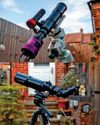
NOVAStar Scarlet A62Q 62mm f/8.4 quadruplet achromatic refractor
Well-built and capable, this beginner scope punches well above its bargain price
4 mins
February 2026
BBC Sky at Night Magazine
STAR OF THE MONTH
Rasalas, Leo the Lion's metal-rich crown
1 min
February 2026
BBC Sky at Night Magazine
Comet 24P/Schaumasse
Having reached perihelion on 8 January, comet 24P/ Schaumasse is now fading. Starting the month at a small-telescope-friendly mag. +10.5, it dims throughout February to below 12th magnitude.
1 min
February 2026
Translate
Change font size