कोशिश गोल्ड - मुक्त
Waking up WEBB
BBC Sky at Night Magazine
|March 2022
The James Webb Space Telescope's launch and deployment was a storming success, but why haven't we seen the first pictures yet? Govert Schilling has the answer

After 25 years and over 10 billion US dollars, on Christmas Day 2021, the James Webb Space Telescope (JWST) was finally launched into space by a European Ariane 5 rocket. With its 6.5-metre primary mirror and its tennis-court-sized sunshield, Webb had to be folded up to fit in the rocket's fairing, only to be deployed step by step in the first two weeks of its mission (see box, 'Unfolding the telescope', on p36). However, the successor to the Hubble Space Telescope won't take its first images of the Universe before late June or early July 2022, which begs the question - why?
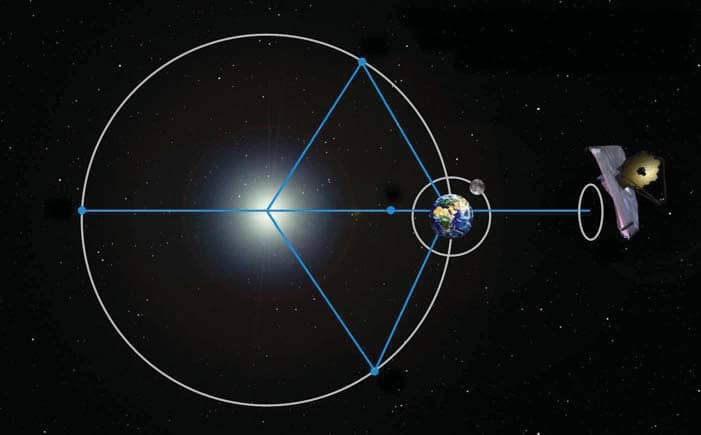
It seems like an excessively long wait, especially since JWST arrived in its final orbit on 24 January. A total of three mid-course correction manoeuvres successfully placed the huge space telescope in a slow looping orbit around the second Lagrange point (L2), a stable gravitational point some 1.5 million kilometres behind Earth as seen from the Sun. "But a lot more needs to be done before we can start science operations," says Mark McCaughrean, the Senior Advisor for Science and Exploration at ESA (the European Space Agency), NASA's main partner in the programme.
For one, the telescope and its sensitive instruments, which left the French Guianalaunch platform at tropical temperatures, have to cool down to 230°C below zero.

यह कहानी BBC Sky at Night Magazine के March 2022 संस्करण से ली गई है।
हजारों चुनिंदा प्रीमियम कहानियों और 10,000 से अधिक पत्रिकाओं और समाचार पत्रों तक पहुंचने के लिए मैगज़्टर गोल्ड की सदस्यता लें।
क्या आप पहले से ही ग्राहक हैं? साइन इन करें
BBC Sky at Night Magazine से और कहानियाँ

BBC Sky at Night Magazine
Crush: Close Encounters with Gravity
Gravity is something that we're all innately familiar with. It keeps our feet on the ground, fights against a rocket trying to leave Earth and governs the movement of the planets and stars.

1 mins
April 2026

BBC Sky at Night Magazine
Exploring the Universe
There's no shortage of children's books about astronomy.
2 mins
April 2026
BBC Sky at Night Magazine
Make your Milky Way images pop
Simple, free processing techniques using FastStone Image Viewer
3 mins
April 2026

BBC Sky at Night Magazine
Nightfaring: In Search of the Disappearing Darkness
This book is a manifesto for dark skies, written as a travel memoir.
1 mins
April 2026

BBC Sky at Night Magazine
Flying saucers- The making of a modern myth
Our obsession with UFOs goes back further than you might think. Robert Pateman traces how early science fiction, dubious sightings and an alien-mad media led to the 1950s saucer fever
9 mins
April 2026

BBC Sky at Night Magazine
STAR OF THE MONTH
Alphecca, the brightest jewel in the Crown
1 min
April 2026

BBC Sky at Night Magazine
How to use a planisphere
Navigate the sky with the original stargazer's tool. No batteries, apps or Wi-Fi required!
3 mins
April 2026
BBC Sky at Night Magazine
Why rockets don't launch straight up
For a rocket to get its payload into space, it has to follow a curved path. But what would happen if it didn't?
2 mins
April 2026

BBC Sky at Night Magazine
Q&A WITH A DARK MATTER SPECIALIST
Dark matter makes up 27 per cent of all matter in the Universe. So why is it so hard to find? Meet one of the people making a map that leads us to it
3 mins
April 2026

BBC Sky at Night Magazine
Why I want to put a hotel on the Moon
Bored of the beach? Sick of city breaks? Step this way. Space entrepreneur Skyler Chan explains how he'll build a holiday destination on the Moon by 2030
2 mins
April 2026
Translate
Change font size