Intentar ORO - Gratis
Time For More Of The Same
Outlook
|July 30, 2018
Don’t expect a radical India policy from likely PM Imran
-

PAKISTAN: 2008, 2013 and now 2018—another election, perhaps another government. But will things really change in the country domestically or in its external orientation? Or will khaki continue to be the colour of the country as it always has been, except for a brief opportunity after the decisive defeat of 1971, which a charismatic leader squandered, or a fleeting moment in 1998, which flattered only to deceive when a gentlemanly army chief, to the chagrin of his officers and troops, decided to follow the democratic principle and put in his papers?
The election campaign and process has been dark, vicious and violent. It has been symptomatic of the nature of Pakistani politics since the 2013 national elections, which witnessed Nawaz Sharif’s party, PML(N), sweep Punjab and consequently, given the province’s overwhelming weight in all aspects of Pakistan’s national life, comfortably form the federal government; Sharif became prime minister for the third time. The ZardariBhuttos remained confined to Sindh while Imran Khan did well to gain a majority in Khyber Pakhtunkhwa and also put up a better than expected show in Punjab.
Unreconciled with the results, Khan complained of widespread rigging by the PML(N). His party’s public agitations, including a lockdown of Islamabad in 2014, had the army’s tacit support. Its animus towards Sharif—rooted in the souring of their ties in the early 1990s and exacerbated by Pervez Musharraf’s coup—grew because of his desire to take control of the country’s India policy and pursue cases against Musharraf. The army got its chance in 2016 when the Panama Papers revealed that the Sharif family owned firms and property abroad.
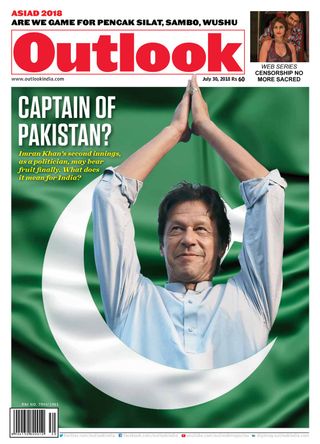

Esta historia es de la edición July 30, 2018 de Outlook.
Suscríbete a Magzter GOLD para acceder a miles de historias premium seleccionadas y a más de 9000 revistas y periódicos.
¿Ya eres suscriptor? Iniciar sesión
MÁS HISTORIAS DE Outlook
Outlook
Goapocalypse
THE mortal remains of an arterial road skims my home on its way to downtown Anjuna, once a quiet beach village 'discovered' by the hippies, explored by backpackers, only to be jackbooted by mass tourism and finally consumed by real estate sharks.

2 mins
January 21, 2026

Outlook
A Country Penned by Writers
TO enter the country of writers, one does not need any visa or passport; one can cross the borders anywhere at any time to land themselves in the country of writers.
8 mins
January 21, 2026
Outlook
Visualising Fictional Landscapes
The moment is suspended in the silence before the first mark is made.
1 mins
January 21, 2026
Outlook
Only the Upper, No Lower Caste in MALGUDI
EVERY English teacher would recognise the pleasures, the guilt and the conflict that is the world of teaching literature in a university.
5 mins
January 21, 2026
Outlook
The Labour of Historical Fiction
I don’t know if I can pinpoint when the idea to write fiction took root in my mind, but five years into working as an oral historian of the 1947 Partition, the landscape of what would become my first novel had grown too insistent to ignore.
6 mins
January 21, 2026
Outlook
Conjuring a Landscape
A novel rarely begins with a plot.
6 mins
January 21, 2026
Outlook
The City that Remembered Us...
IN the After-Nation, the greatest crime was remembering.
1 min
January 21, 2026
Outlook
Imagined Spaces
I was talking with the Kudiyattam artist Kapila Venu recently about the magic of eyes.
5 mins
January 21, 2026
Outlook
Known and Unknown
IN an era where the gaze upon landscape has commodified into picture postcards with pristine beauty—rolling hills, serene rivers, untouched forests—the true essence of the earth demands a radical shift.
2 mins
January 21, 2026

Outlook
A Dot in Soot
A splinter in the mouth. Like a dream. A forgotten dream.
2 mins
January 21, 2026
Translate
Change font size