
Gå ubegrenset med Magzter GOLD
Få ubegrenset tilgang til over 9000 magasiner, aviser og premiumhistorier for bare
Prøve GULL - Gratis
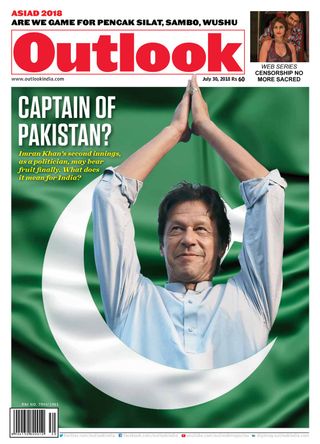
Time For More Of The Same
Outlook
|July 30, 2018
Don’t expect a radical India policy from likely PM Imran
-

PAKISTAN: 2008, 2013 and now 2018—another election, perhaps another government. But will things really change in the country domestically or in its external orientation? Or will khaki continue to be the colour of the country as it always has been, except for a brief opportunity after the decisive defeat of 1971, which a charismatic leader squandered, or a fleeting moment in 1998, which flattered only to deceive when a gentlemanly army chief, to the chagrin of his officers and troops, decided to follow the democratic principle and put in his papers?
The election campaign and process has been dark, vicious and violent. It has been symptomatic of the nature of Pakistani politics since the 2013 national elections, which witnessed Nawaz Sharif’s party, PML(N), sweep Punjab and consequently, given the province’s overwhelming weight in all aspects of Pakistan’s national life, comfortably form the federal government; Sharif became prime minister for the third time. The ZardariBhuttos remained confined to Sindh while Imran Khan did well to gain a majority in Khyber Pakhtunkhwa and also put up a better than expected show in Punjab.
Unreconciled with the results, Khan complained of widespread rigging by the PML(N). His party’s public agitations, including a lockdown of Islamabad in 2014, had the army’s tacit support. Its animus towards Sharif—rooted in the souring of their ties in the early 1990s and exacerbated by Pervez Musharraf’s coup—grew because of his desire to take control of the country’s India policy and pursue cases against Musharraf. The army got its chance in 2016 when the Panama Papers revealed that the Sharif family owned firms and property abroad.

Denne historien er fra July 30, 2018-utgaven av Outlook.
Abonner på Magzter GOLD for å få tilgang til tusenvis av kuraterte premiumhistorier og over 9000 magasiner og aviser.
Allerede abonnent? Logg på
FLERE HISTORIER FRA Outlook
Outlook
'Why GDP Growth Doesn't Always Translate Into Votes'
The recent election results have once again shown that economic growth alone does not guarantee electoral victory.

3 mins
June 06, 2026

Outlook
Lights, Camera, Othering
The establishment of Israel has been accompanied by a national cinema devoted to negating and erasing the Palestinian Other
5 mins
June 06, 2026

Outlook
Goodbye to All That
Booker-winning British author Julian Barnes' Departure(s) is a unique hybrid work: playful, philosophical, whimsical
4 mins
June 06, 2026
Outlook
Collapse of Trust
As the NEET-UG 2026 paper leak forced the cancellation of India’s biggest medical entrance exam, more than 22 lakh aspirants find themselves trapped in uncertainty
11 mins
June 06, 2026

Outlook
NO LONGER A TWELFTH MAN
Bihar cricket, which has languished in the shadows for long, is all set to improve its strike rate, thanks to Vaibhav Sooryavanshi, the new Bihari kid on the block
5 mins
June 06, 2026
Outlook
BLAZE OF GLORY
The challenges of being a celebrity cricketer at a young age can be tough to handle
5 mins
June 06, 2026

Outlook
THE SWASHBUCKLERS
A new generation of fearless stars is emerging and finding its feet at the very top of an extremely competitive cricketing environment
5 mins
June 06, 2026

Outlook
THE TEEN TORNAD
At the age of 15, Vaibhav Sooryavanshi is already a cricketing legend
10 mins
June 06, 2026
Outlook
A Journey to Remember
The prerecorded message crackled over the din in the compartment: ‘Welcome to the Shatabdi Express.
4 mins
June 06, 2026

Outlook
Crossing Borders
Ruth Martin is the translator of German-Iranian author Shida Bazyar’s novel The Nights are Quiet in Tehran (originally written in German), which has been shortlisted for the 2026 International Booker Prize.
4 mins
June 06, 2026
Translate
Change font size