
Go Unlimited with Magzter GOLD
Get unlimited access to 10,000+ magazines, newspapers and Premium stories for just
Try GOLD - Free
Navigating cloud security risks: Staying ahead of the curve
PCQuest
|Mar,2023
As businesses of all sizes move to the cloud, security risks are on the rise. With cybercrime increasing year after year, it is essential for organizations to stay ahead of emerging threats and navigate cloud security risks before they become a problem

As the world becomes more and more digitized, data privacy and confidentiality concerns are only going to become more prevalent. And with the recent rise in cloud computing, these concerns are only amplified. When you store data on a remote server (i.e. in the cloud), you are entrusting that data to the security of that server. And unfortunately, there have been a number of high-profile breaches of cloud security in recent years.
In 2011, for example, Sony's PlayStation Network was hacked, exposing the personal information of 77 million users. This is just one example of why data privacy and confidentiality are major concerns regarding cloud computing. When you store data remotely, you are essentially giving up control over who has access to that data. And if that data falls into the wrong hands, it could be used for identity theft, fraud, or other malicious activities.
Concerns around sensitive data have grown concurrently with the rise in cloud utilization. The SaaS solutions and expanding infrastructure unquestionably increased the services' accessibility. Nearly all solutions provide 99.97% uptime. However, are they also upholding security, confidentiality, and privacy requirements, which are crucial to the data you and your clients store?
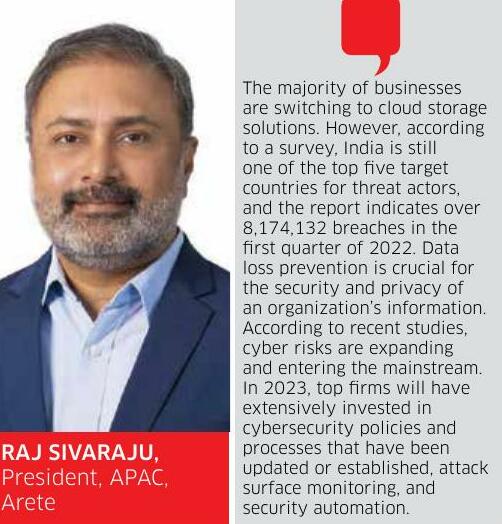
The majority of contemporary solutions have seen rapid feature evolution. These are created by entrepreneurs who are always competing with time to develop and release new features, enter the market first, and signup customers. Large-scale service providers like AWS, Azure, GCP, etc. are the foundation for these solutions.


This story is from the Mar,2023 edition of PCQuest.
Subscribe to Magzter GOLD to access thousands of curated premium stories, and 10,000+ magazines and newspapers.
Already a subscriber? Sign In
MORE STORIES FROM PCQuest

PCQuest
When Software Drives the Machine Need for Enterprise-Grade Software
Cars used to fail because of broken parts.Now they fail because of broken code. As vehicles become rolling computers, enterprise-grade software, ruthless testing, and fail-safe architecture decide one thing: whether a car keeps moving safely at 100 km/h

2 mins
March 2026

PCQuest
AI on the ground Practical use cases of AI in large enterprise operations
AI isn't a side project anymore, it's the quiet operator inside global giants. It reads invoices, senses machine fatigue, tailors every customer moment, flags risk in real time, and feeds leaders sharper instincts. Scale just got smarter
3 mins
March 2026

PCQuest
From AI experiments in 2025 to enterprise scale in 2026: Why data foundations will decide the winners
Everyone's betting big on Al, but most are burning cash instead of building value. The hidden culprit? Dirty data, clunky processes, and missing context. What if fixing your foundation, not your algorithms, was the real AI game-changer?
4 mins
March 2026

PCQuest
How automation at the periphery is accelerating digital transformation
Digital transformation is not tearing down the core anymore. It is happening at the edges. With AI and automation layered onto existing systems, companies are cutting costs, boosting productivity by up to 40%, and scaling smarter without risking operational chaos
2 mins
March 2026

PCQuest
When AI moves from chips to racks
AI performance is no longer just about faster chips. It is about how racks, power, networking, and orchestration work together. As agentic AI grows, infrastructure must become predictable, open, and built for scale from day one
4 mins
March 2026

PCQuest
Designing enterprise AI systems that stay fair
In 2026, bias is no longer treated as a communications issue or a public relations headache.
6 mins
March 2026

PCQuest
HALO smart sensor
What if bathrooms, locker rooms, and isolated spaces could become safer without adding cameras?
2 mins
March 2026

PCQuest
Building enterprise AI that doesn't discriminate
Bias in enterprise AI is not a side issue. It starts in data pipelines, training systems, product design, and engineering workflows. As AI scales, fairness, transparency, and accessibility are becoming core software requirements
4 mins
March 2026

PCQuest
Bias travels faster than code
Bias in enterprise AI is not a surface issue. It enters through data, features, model training, APIs, and UI logic, then spreads across the stack. The technical response is shifting from audits to architecture, observability, and deployment controls
6 mins
March 2026

PCQuest
How hospitals can use AI without risking patient data
With the fast pace of adoption of Artificial Intelligence (AI) and digital health systems in Indian hospitals, issues related to the security of patient data are also increasing at an equal rate.
2 mins
March 2026
Translate
Change font size