Try GOLD - Free
FOLLOWING THE RULES
Baseball America
|March - April 2025 (Double Issue)
MLB has tested the ABS challenge system for years, just as it did for every previous rule change
-
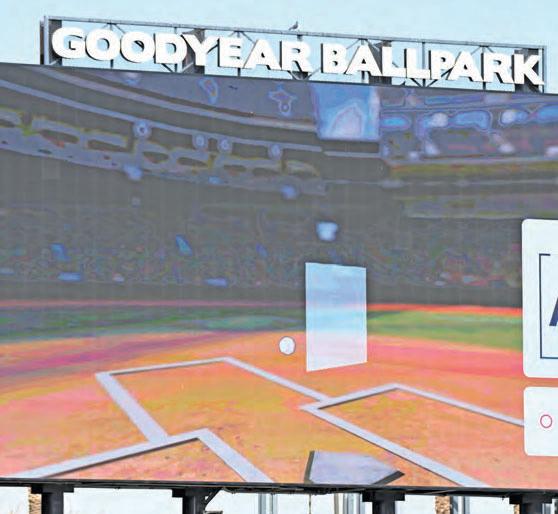
Spring training this year has given fans a reason to think about the strike zone in more detail than ever before. The experimental use of the automated ball-strike challenge system has led to a lot of fans wondering why the strike zone being used by robot umpires doesn't match the one they've seen in the rule book.
This is the part of baseball that has usually bubbled beneath the surface. You might know what should be a strike and what should be a ball. But if asked to define the two, things get complicated quickly.
If you have ever used the term "hollow beneath the kneecap," you've definitely read the official MLB rule book. If you've ever given thought to where the midpoint between the top of the shoulders and the top of the uniform pants truly resides, you've likely umpired games at some point.
But as MLB has edged closer and closer to bringing the ABS challenge system to regular season games, the success of that system has depended on putting that rulebook definition back on the bookshelf.
Whenever MLB has tried to match the rulebook definition of the strike zone in its many minor league, Arizona Fall League and Atlantic League experiments, it has done nothing but frustrate batters, pitchers, umpires and fans.
By being strict to the rules, the ABS zone seemed to be out of whack.
Only by being willing to be unconventional has MLB gotten to the point where the robo umps can call what we perceive as the conventional strike zone.
The strike zone is exceptionally complicated.
It has moved around from era to era, but anyone who watches a lot of baseball gets acclimated to the "normal" zone pretty quickly.
Now, that version of "normal" will change.
In the 1945 MLB rule book, the strike zone was defined as being "not lower than the batsman's knees, nor higher than his shoulder." Imagine a modern day batter getting called out on a fastball at collarbone height.
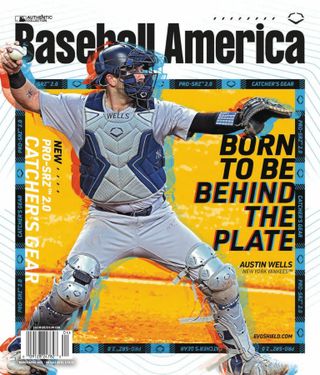

This story is from the March - April 2025 (Double Issue) edition of Baseball America.
Subscribe to Magzter GOLD to access thousands of curated premium stories, and 10,000+ magazines and newspapers.
Already a subscriber? Sign In
MORE STORIES FROM Baseball America

Baseball America
THE FASTER TRACK
In the 2020s, future big leaguers are spending less development time lin the minor leagues

7 mins
May / June 2026

Baseball America
SAVE OUR STARS
We propose one idea to help keep smaller-revenue clubs and their superstar players united up until free agency
4 mins
May / June 2026

Baseball America
MOTOWN'S NEWEST HIT SENSATION
Kevin McGonigle is a near-perfect hitting prospect
5 mins
May / June 2026

Baseball America
Six players who could be the No. 1 prospect in 2027
While Pirates shortstop Konnor Griffin ranks as the No. 1 prospect for 2026, we feel confident that, barring an unexpected injury, he won't be eligible for a repeat honor next year.
3 mins
May / June 2026
Baseball America
WILBUR WOOD DOMINATED THANKS TO KNUCKLEBALL
Knuckleballers are a special breed, but even among knuckleballers, Wilbur Wood was truly special.
1 mins
May / June 2026

Baseball America
POWER RANKING
Gone are the days when the American and National league were distinct entities.
22 mins
May / June 2026

Baseball America
MAZEROSKI WALKED OFF 1960 SERIES
If Bill Mazeroski had only that one moment, he would still be remembered forever.
1 min
May / June 2026

Baseball America
BREAKOUT PLAYERS
We choose 10 young players—five hitters and five pitchers—poised to break out in 2026
3 mins
May / June 2026

Baseball America
TERRANCE GORE SPED TO WORLD SERIES
Terrance Gore had the highest ratio of postseason success to regular season playing time in MLB history.
1 min
May / June 2026

Baseball America
KONNOR GRIFFIN'S SPEEDY ASCENT PLACES HIM IN RARE COMPANY
With top-of-the-scale speed, elite power and plus defense at multiple positions, Konnor Griffin is the best prospect in baseball.
3 mins
May / June 2026
Listen
Translate
Change font size