Try GOLD - Free
Tiny Display
Scientific American
|January 2026
An e-paper breakthrough brings extremely high-resolution color
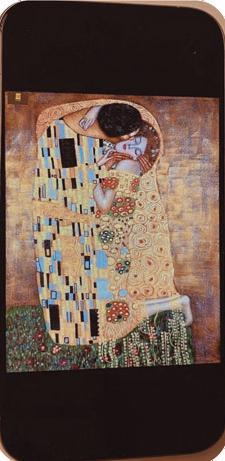
VISUAL DISPLAYS HAVE STEADILY gotten smaller and held closer to our eyes as our viewing habits have shifted from cinema screens to TVs to computers, smartphones and virtual reality. This shift has required higher image resolution (usually through increased pixel counts) to provide enough detail. Conventional light-emitting pixels work poorly below a certain size: brightness drops, and colors bleed. The same isn’t true for reflective displays such as those used in many e-readers, whose pixels reflect ambient light rather than emitting their own—but creating those pixels typically requires larger components.
A new reflective display could shatter those restrictions with resolutions beyond the limit of human perception. In a recent study in Nature, scientists describe a reflective retina e-paper that can display color video on screens smaller than two square millimeters across.
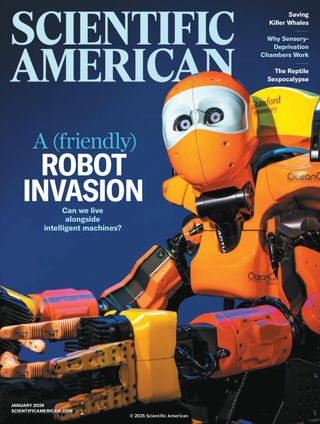

This story is from the January 2026 edition of Scientific American.
Subscribe to Magzter GOLD to access thousands of curated premium stories, and 10,000+ magazines and newspapers.
Already a subscriber? Sign In
MORE STORIES FROM Scientific American

Scientific American
Probiotic Hope and Hype
Despite their popularity, supplements with billions of \"good\" microbes help only a few illnesses, research shows

3 mins
January 2026

Scientific American
Mondays Really Are More Stressful
The start of the workweek can be a biologically measurable stressor, with consequences for long-term health that can stretch into retirement
4 mins
January 2026
Scientific American
Tiny Display
An e-paper breakthrough brings extremely high-resolution color
2 mins
January 2026

Scientific American
Fine-Feathered Snack
A bat's tracker documents a dramatic midair hunt
2 mins
January 2026

Scientific American
OUR ROBOTIC PICTURE
Will mechanical helpers ever be commonplace at home, at work and beyond?
11 mins
January 2026

Scientific American
"Use Your Words" Can Be Good for Kids' Health
Writing or expressing feelings can help adults mentally and physically. Kids are no different
5 mins
January 2026

Scientific American
Distant Diplomacy
Unrelated species “talk” and understand one another to avoid threats
2 mins
January 2026

Scientific American
Behind the Nobel
A 2025 winner reflects on the mysterious T cells that won him the prize
5 mins
January 2026

Scientific American
A Suite of Killers
Heart ailments, kidney diseases and type 2 diabetes actually may be part of just one condition. It's called CKM syndrome
10 mins
January 2026

Scientific American
Static Launch
Tiny worms leap toward their fruit fly hosts with an electric “tractor beam”
3 mins
January 2026
Listen
Translate
Change font size