Try GOLD - Free
Slime Attack
Scientific American
|July/August 2025
This creature's extraordinary goo could lead to recyclable bioplastics
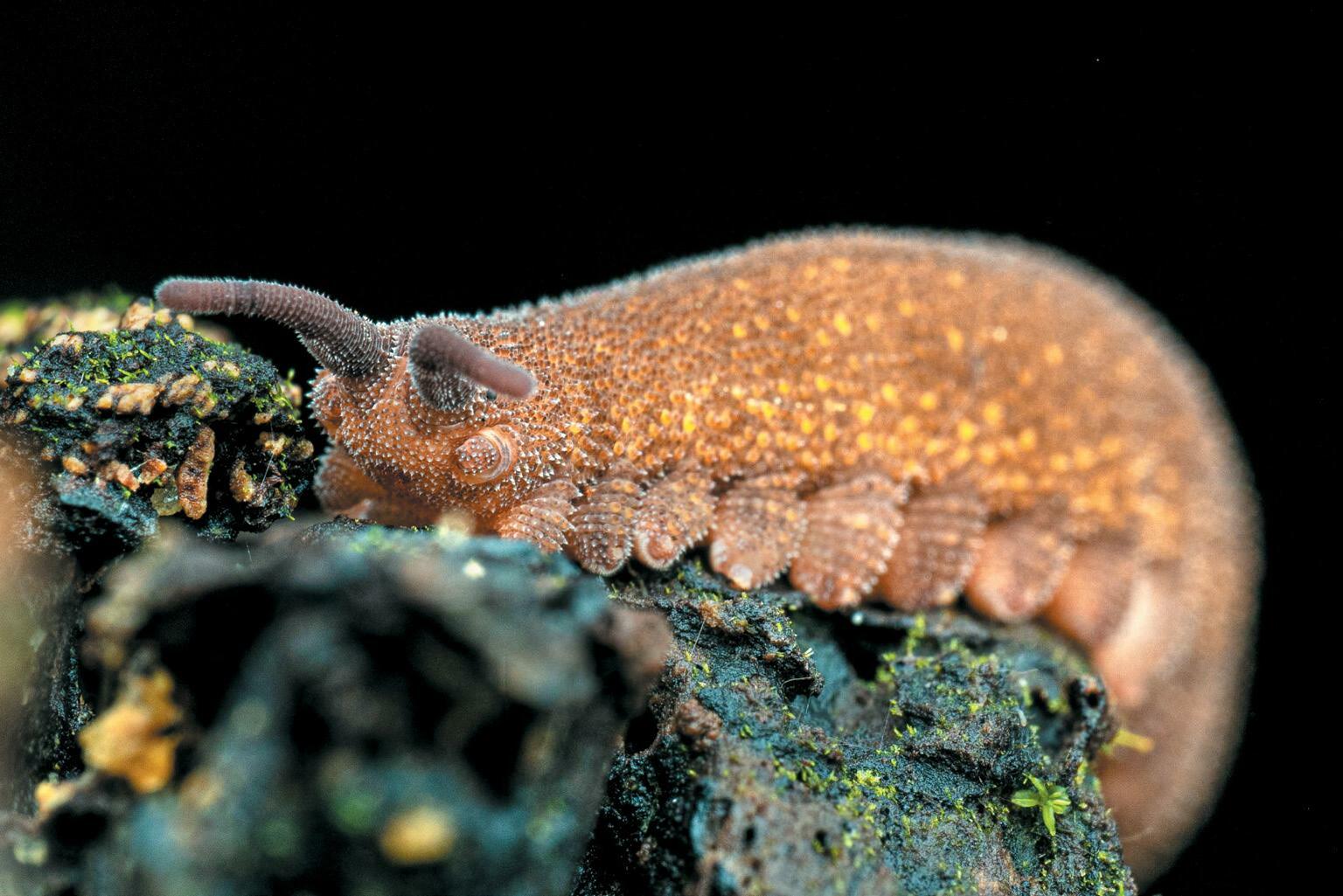
Velvet worms like this one "sneeze" out a sticky goo with intriguing properties.
THE VELVET WORM, a squishy little predator that looks like the stretch-limo version of a caterpillar, has a whimsical MO: it administers death by Silly String.
In the leaf litter of tropical and temperate forests around the world, velvet worms stalk the night on dozens of stubby legs. The pocket-size predator-whose species range from less than half an inch to eight inches longcan barely see, so it bumbles around, hoping to literally bump into an edible bug such as a cricket or a woodlouse.
When it finds one, the velvet worm uses nozzles on either side of its face to shoot jets of sticky slime at its victim.
"It happens so fast it's almost like they're sneezing," says Matthew Harrington, a biochemist at McGill University who has studied velvet worms for a decade.
At first, the goo is a watery liquid, but in midair it transforms into jellylike ropes that ensnare the unlucky creature and stick it to the ground. As the prey struggles, the slime forms fibrous threads, and within seconds the substance hardens into a glasslike solid.

This story is from the July/August 2025 edition of Scientific American.
Subscribe to Magzter GOLD to access thousands of curated premium stories, and 10,000+ magazines and newspapers.
Already a subscriber? Sign In
MORE STORIES FROM Scientific American

Scientific American
Dirty Little Secrets
Extremophile molds are invading art museums and devouring their collections. Stigma and climate change have fueled their spread

16 mins
February 2026

Scientific American
Archaeology Is Reviving the Smell of History
How reconstructing long-lost smells connects us to the past
6 mins
February 2026

Scientific American
Heal Injuries Faster
Toss out the old advice that rest is the best recovery strategy
4 mins
February 2026
Scientific American
Can a Time Capsule Outlast Geology?
A ridiculous but instructive thought experiment involving deep time, plate tectonics, erosion and the slow death of the sun
17 mins
February 2026
Scientific American
Fiery Amoeba
A newfound organism thrives in record-breaking heat
2 mins
February 2026
Scientific American
50, 100 & 150 Years
GIANT ATOMS
3 mins
February 2026
Scientific American
Nature's Tile Shop
Life keeps evolving these geometric patterns
2 mins
February 2026
Scientific American
Battle of the Breeds
A large dataset shows that some dog stereotypes are based in reality, and others might be unfair characterizations
1 min
February 2026
Scientific American
The Milky Way's Disk Keeps Getting Weirder
The disk of our galaxy is not flat but warped and waving
5 mins
February 2026
Scientific American
A Winning Loser
If the cards shown here are rearranged to form four new poker hands of five cards each, what is the low- est possible winning or tying hand?
1 min
February 2026
Listen
Translate
Change font size