Try GOLD - Free
Probiotic Hope and Hype
Scientific American
|January 2026
Despite their popularity, supplements with billions of "good" microbes help only a few illnesses, research shows
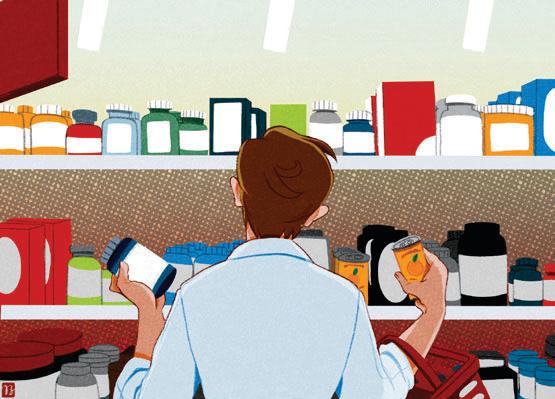
THERE ARE MICROBES living in medicine cabinets across the U.S., next to the aspirin and the Band-Aids. And people want them there. Indeed, consumers probably paid good money for them.
Probiotics are capsules or pills with live microorganisms—almost always bacteria or yeast—that are supposed to confer health benefits once people swallow them. Some of my friends, including a woman who was recently treated for cancer and a man with persistent digestive issues, bought the pills at the recommendation of doctors. Others, aware of a lot of new evidence about the ways microbes in our guts influence physical functioning, bought them on their own. Many hope the bacteria will improve their overall gut health, a desire reflected in bottle labels that say things like “improved digestion” and “clinically studied.”
But despite this popularity, evidence that probiotics help people is surprisingly limited. Medical organizations such as the American Gastroenterological Association (AGA) recommend only a few specific bacterial strains for a few well-defined conditions. “The average person likely doesn’t need probiotics and is unlikely to benefit from them for day-to-day use,” says gastroenterologist Omeed Alipour of the Santa Clara Health System in California, a spokesperson for the AGA.

This story is from the January 2026 edition of Scientific American.
Subscribe to Magzter GOLD to access thousands of curated premium stories, and 10,000+ magazines and newspapers.
Already a subscriber? Sign In
MORE STORIES FROM Scientific American

Scientific American
Probiotic Hope and Hype
Despite their popularity, supplements with billions of \"good\" microbes help only a few illnesses, research shows

3 mins
January 2026
Scientific American
Mondays Really Are More Stressful
The start of the workweek can be a biologically measurable stressor, with consequences for long-term health that can stretch into retirement
4 mins
January 2026
Scientific American
Tiny Display
An e-paper breakthrough brings extremely high-resolution color
2 mins
January 2026
Scientific American
Fine-Feathered Snack
A bat's tracker documents a dramatic midair hunt
2 mins
January 2026

Scientific American
OUR ROBOTIC PICTURE
Will mechanical helpers ever be commonplace at home, at work and beyond?
11 mins
January 2026

Scientific American
"Use Your Words" Can Be Good for Kids' Health
Writing or expressing feelings can help adults mentally and physically. Kids are no different
5 mins
January 2026

Scientific American
Distant Diplomacy
Unrelated species “talk” and understand one another to avoid threats
2 mins
January 2026
Scientific American
Behind the Nobel
A 2025 winner reflects on the mysterious T cells that won him the prize
5 mins
January 2026

Scientific American
A Suite of Killers
Heart ailments, kidney diseases and type 2 diabetes actually may be part of just one condition. It's called CKM syndrome
10 mins
January 2026
Scientific American
Static Launch
Tiny worms leap toward their fruit fly hosts with an electric “tractor beam”
3 mins
January 2026
Listen
Translate
Change font size