Try GOLD - Free
WHO SETS THE DOOMSDAY CLOCK?
Popular Mechanics US
|January / February 2026
In the shadow of my family's atomic legacy, I set out to understand the increasingly urgent debate about humanity's capacity to end itself and what it can teach us about living.

Set annually by scientists and policy experts, the Doomsday Clock is a graphic and metaphoric symbol of how close humanity is to self-destruction.
On a warm day in mid-July, a roomful of Nobel laureates and nuclear security experts, some 80 pairs of eyes, gaze out of the expansive windows of a 10th floor University of Chicago conference room, imagining their deaths by nuclear explosion.
A presenter directs the group's attention past the trees and gothic buildings of campus, over the apartment buildings in Hyde Park, and out to the Chicago skyline, hazy with wildfire smoke from Canada. He points out which neighborhoods would vanish in blasts of varying size, estimating casualties, injuries, and radiation effects.
What I know, what everyone there knows, is that if a nuclear bomb were to explode right then, right over us, it would be better to be inside that room, in the zone of vaporization, than in an outer ring of slow, painful death.
It's the opening session of the three-day 2025 Nobel Laureate Assembly for the Prevention of Nuclear War. The gathering is convened by scientists and nuclear security experts alarmed that a new arms race, eroding global cooperation, and the rise of artificial intelligence in warfare—among other factors—are pushing civilization closer to catastrophe. Timed to the 80th anniversary of the Trinity Test, the world's first nuclear explosion, the assembly aims to produce a declaration urging world leaders to reduce the nuclear threat.
The same urgency drives the Bulletin of Atomic Scientists and its iconic Doomsday Clock, the stark graphic that represents how close we are to self-annihilation. The clock is set yearly by the Bulletin's Science and Security Board chaired by Daniel Holz, PhD, a theoretical astrophysicist at the University of Chicago.
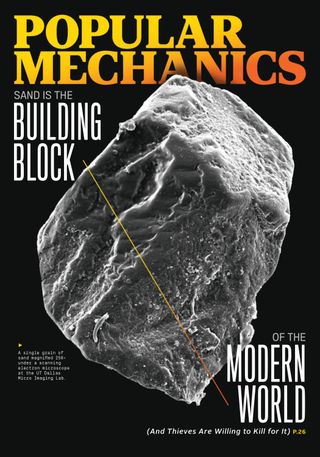

This story is from the January / February 2026 edition of Popular Mechanics US.
Subscribe to Magzter GOLD to access thousands of curated premium stories, and 10,000+ magazines and newspapers.
Already a subscriber? Sign In
MORE STORIES FROM Popular Mechanics US
Popular Mechanics US
HOW TO UNCLOG A SINK
IF YOUR SINK IS CLOGGED AND PLUNGING fails to clear the blockage, look to your P-trap (or simply, “trap”) before calling a plumber.

1 mins
January / February 2026

Popular Mechanics US
A WEIRD (AND FREE!) SOUND SYSTEM HACK
THERE ARE SO MANY VARIABLES TO how a room's dimensions, a building's construction, the placement of furniture, and the materials of that furniture affect the sound of speakers and subwoofers that there's no way to offer a one-size-fits-all, \"put it here\" maxim for the absolute best subwoofer sound quality.
1 mins
January / February 2026
Popular Mechanics US
The Fringes of Life
AT FIRST GLANCE, CREATING A DEFINItion of \"life\" seems simple.
2 mins
January / February 2026

Popular Mechanics US
THE SAND THIEVES
Sand is the hidden architecture of our modern world—but it's running out. Global mafias are stealing this precious resource from right beneath our feet, and they're willing to kill for it.
18 mins
January / February 2026

Popular Mechanics US
OPERATION PLUTO
THE ALLIES’ SECRET UNDERWATER WEAPON THAT HELPED DEFEAT THE NAZIS
13 mins
January / February 2026

Popular Mechanics US
5 WAYS TO KEEP YOUR GENERATOR IN WORKING ORDER
IF YOU HAVE A GAS GENERAtor, use ethanol-free gas treated with fuel stabilizer, and maintain a full tank when not in use; keep a gas can full of stabilized fuel on hand during peak disaster season.
1 min
January / February 2026

Popular Mechanics US
Minivans
MINIVANS ARE MAKING A COMEBACK, and that's kind of surprising, as they're some of the most polarizing vehicles on the road and have always been built with a function-over-form ethos.
1 mins
January / February 2026

Popular Mechanics US
3 WAYS TO FIND A STUD WITHOUT A STUD FINDER
There is a noticeably hollow sound when you knock on the space between the studs versus when you knock on drywall that has a stud behind it.
1 min
January / February 2026

Popular Mechanics US
A Cell-Sized Elephant
EVER SINCE THE POPULARITY OF 3D printing skyrocketed in the midaughts, people have been manufacturing everything from chocolate to rocket fuel-and that list now includes a microscopic elephant inside of a living cell. Technology has really leveled up since 2005.
1 mins
January / February 2026

Popular Mechanics US
WHO SETS THE DOOMSDAY CLOCK?
In the shadow of my family's atomic legacy, I set out to understand the increasingly urgent debate about humanity's capacity to end itself and what it can teach us about living.
21 mins
January / February 2026
Listen
Translate
Change font size