Try GOLD - Free
SCHOOL SCIENCE ESSENTIALS
How It Works UK
|Issue 203
Take a tour of a classroom laboratory and discover how your school's scientific instruments work

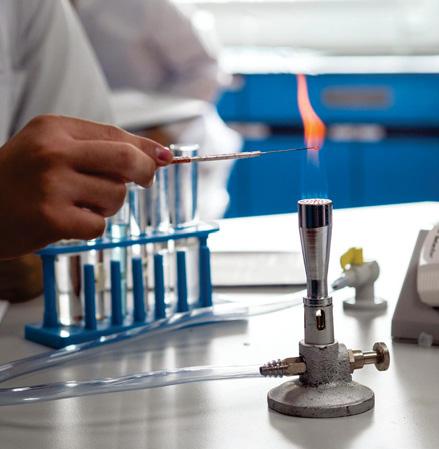
What would a school laboratory be without an iconic Bunsen burner? These experiment staples have been around since German chemist Robert Bunsen's pioneering invention in 1855. Fed up with choking on the soot that early laboratory burners released, Bunsen created a way to control the level of oxygen from the air that mixed with the gas fuel of the burner without producing soot.
His design looked similar to the modern-day instrument, including the chimney-like barrel and all-important adjustable air holes that control the intensity of the flame emitted by the burner. The more air that enters the burner, the hotter the flame is. The Bunsen burner allowed chemists to study the different colours of flames that could be produced by heating different elements. Along with another German chemist, Gustav Kirchhoff, Bunsen made many discoveries with his new burner, such as thallium's olive-green flame and indium's indigo hue.
 THE PH INSPECTOR
Since the 1300s, we've been using litmus paper to gauge the 'potential of hydrogen', or pH level, of solutions. As a chemical indicator, litmus is designed to change colour when exposed to either acidic, alkaline or neutral solutions. It does this by reacting to the presence of two different ions: acids hold positively charged hydrogen ions, whereas alkali solutions hold negatively charged hydroxide ions. When a solution is neutral, the positively and negatively charged ions balance each other out.
To make this chemical indicator, wood cellulose is infused with lichen, which contains compounds that react to the ions and change the colour of the paper. However, litmus paper can only indicate whether or not a solution is acidic or alkaline, and not to what degree.

This story is from the Issue 203 edition of How It Works UK.
Subscribe to Magzter GOLD to access thousands of curated premium stories, and 10,000+ magazines and newspapers.
Already a subscriber? Sign In
MORE STORIES FROM How It Works UK

How It Works UK
FORMULA FAST
YOUR ULTIMATE GUIDE TO FORMULA ONE RACING

1 mins
Issue 212

How It Works UK
MY LIFE AS AN ASTHMANAUT
A CHILDREN'S BOOK ABOUT ASTHMA
1 min
Issue 212

How It Works UK
LYDIA LOVES BUGS
A SHORT AND SWEET STORY OF AN ENTHUSIASTIC ENTOMOLOGIST
1 min
Issue 212

How It Works UK
INSIDE A DRONE
Drones aren't just for the military any more. These flying marvels are now taking over our lives
3 mins
Issue 212

How It Works UK
WE CAN HEAR WITHOUT EARS
AND OTHER THINGS YOU DIDN'T KNOW WE PLANTS COULD DO
1 min
Issue 212

How It Works UK
DO GEESE GET GOOSEBUMPS?
Many animals experience a similar reaction when they feel cold or scared
2 mins
Issue 212
How It Works UK
SUBMARINES WITHOUT SAILORS
Dive into the world of autonomous submarines and discover the mission that will see one sail around the world
4 mins
Issue 212
How It Works UK
WHAT HAPPENS INSIDE A COCOON?
How certain species of insects transform from crawling caterpillars to flying moths and butterflies
3 mins
Issue 212

How It Works UK
HOW THE ROSE LOST ITS SCENT
From floral to fragranceless, there's a biological reason behind a rose's missing odour today
3 mins
Issue 212
How It Works UK
How many insects have been discovered so far?
The total number of named species is around a million.
7 mins
Issue 212
Listen
Translate
Change font size