
Go Unlimited with Magzter GOLD
Get unlimited access to 10,000+ magazines, newspapers and Premium stories for just
Try GOLD - Free
Promising start
Down To Earth
|April 01, 2025
Sexed semen technology can revolutionise India's dairy sector. But its impact on biodiversity must not be ignored
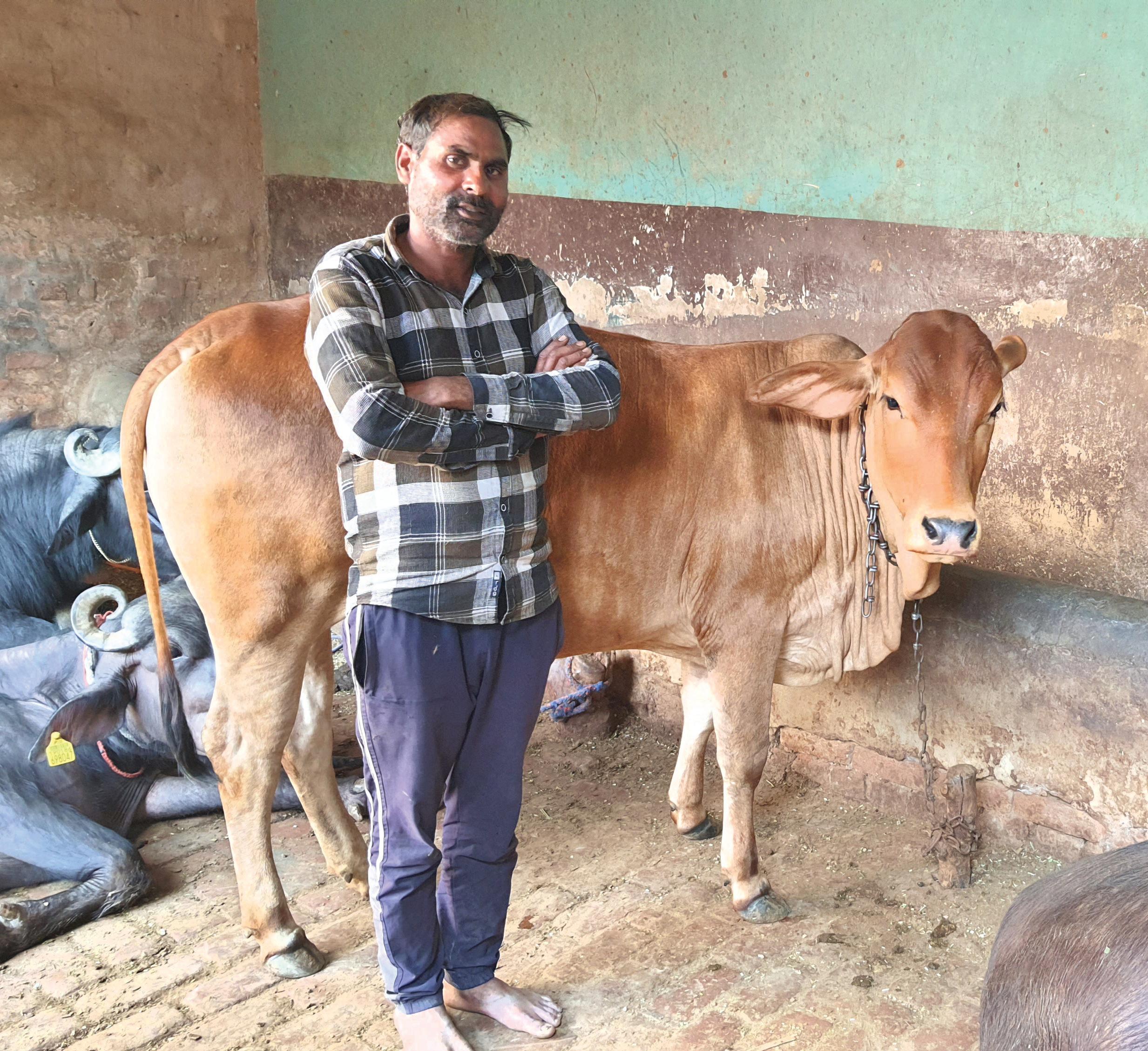
RAVINDRA MAWI'S eyes light up as he talks about Lakshmi. After all, the cow is more than just a source of milk for Mawi—she promises a prosperous future for the 36-year-old dairy farmer from Uttar Pradesh's Fatehpur Matnoura village, who now has access to the cutting-edge sexed semen technology that guarantees a 90 per cent chance of delivering female calf. On March 16, 2025, Lakshmi was artificially inseminated with sexed semen.
The technology is a beacon of hope for small farm households like Mawi's, whose economic well-being is determined by the productivity of livestock. While dairy cows yield a regular income through milk production, a male calf or bull is considered a burden since mechanisation has replaced draught power in agriculture. Farmers Down To Earth (DTE) spoke to in Uttar Pradesh say that the cost of rearing and maintaining a cattle ranges between ₹4,000 and ₹10,000 a month. So they usually abandon the bulls, though some keep the male buffaloes as they can be sold for slaughter. “Nobody wants a male. You would not find a bull in any home here,” says dairy farmer Bhim Dharamvir Singh of Fatehpur Matnoura village. Singh says the technology is a boon for farmers like him. In June last year, he got the artificial insemination of his cow done using sexed semen. The calf will be able to produce milk after two years, doubling his income.
Small wonder, then, that gender selection, which raises ethical concerns in human societies due to potential for disrupting natural sex ratios and causing societal imbalances and has been declared illegal in many countries including India, is now being touted as the cure to the stray cattle menace and to revolutionise India's milk production.

This story is from the April 01, 2025 edition of Down To Earth.
Subscribe to Magzter GOLD to access thousands of curated premium stories, and 10,000+ magazines and newspapers.
Already a subscriber? Sign In
MORE STORIES FROM Down To Earth

Down To Earth
GREAT NICOBAR DILEMMA
In the fragile ecosystem of Nicobar, strategic development must align with constitutional commitment to protect environment, indigenous dignity

3 mins
March 16, 2026
Down To Earth
CATCH BY THE ROOTS
Sabai grass could be a game-changer for the marginalised economies of West Bengal's dry uplands. All it needs is an efficient market strategy
4 mins
March 16, 2026

Down To Earth
POWERING TRANSITION
India's renewable ambitions are rising rapidly, with half of its installed power capacity now coming from non-fossil sources. Yet the gap between capacity and generation remains wide. The experiences of two pioneering states, Karnataka and Tamil Nadu, which together generate over a fifth of the country's renewable energy, offer crucial lessons for accelerating the transition, reports PUJA DAS from Bengaluru, Chennai, Mumbai and New Delhi
16 mins
March 16, 2026
Down To Earth
At core of survival
Water scarcity defines life in a village inside Sariska Tiger Reserve's critical habitat, as debates over its relocation drag on
5 mins
March 16, 2026

Down To Earth
What's on your plate
An upcoming digital tool can help people learn about the origin of their meals and make climate-positive food choices
2 mins
March 16, 2026

Down To Earth
'Bad environment can never be good economics'
The Supreme Court of India and even the high courts were once very active and took a proactive role in protecting the environment; unfortunately, that is no longer true
4 mins
March 16, 2026
Down To Earth
Things fall apart
IN THE past year, the world has counted more missiles and bombs than hours.
2 mins
March 16, 2026

Down To Earth
Universities in crisis, innovation is stifled
Political control and skewed policies have led to unrest in academia, stifling creativity and meaningful research
4 mins
March 16, 2026

Down To Earth
SPARK IN THE GAME
The Reserve Bank of India's restored recognition of Default Loss Guarantees re-enables credit flow into last-mile electric mobility
3 mins
March 16, 2026

Down To Earth
Ushering in new eras
An appraisal of the state of biodiversity conservation, pollution reduction and climate adaptation regimes in India
3 mins
March 16, 2026
Listen
Translate
Change font size