Try GOLD - Free
Fatal coincidence
Down To Earth
|April 16, 2023
Forest fire season in Uttarakhand coincides with flowering and breeding months of several vulnerable species, many of them native to Himalayas
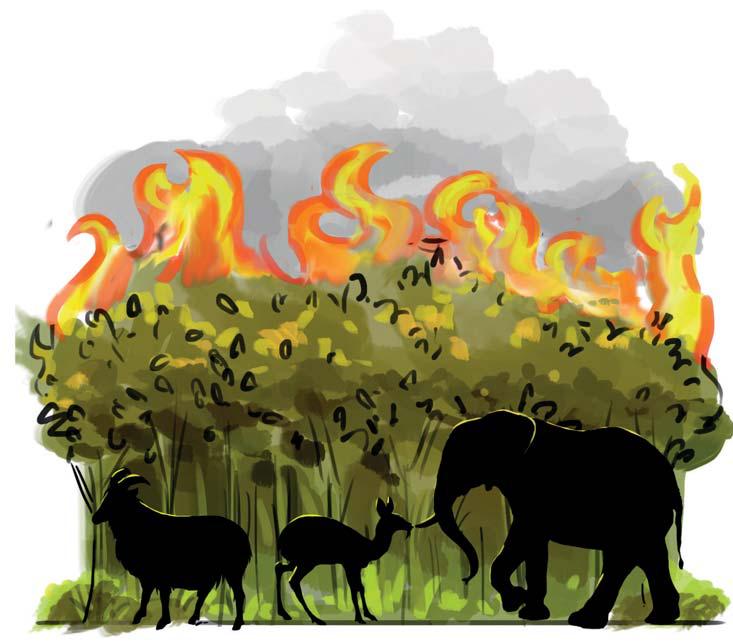
FOREST FIRES are becoming more frequent and fierce in Uttarakhand. Such regular burnings can be catastrophic for the state as well as the rich biodiversity it harbours. Uttarakhand is home to at least 102 species of mammals, 70 reptiles, 19 amphibians, and 124 species of fish. The state also boasts of 600 species of birds. The International Union for Conservation of Nature (IUCN) classifies 55 of the bird species as "threatened", of which six are critically endangered and four are endangered. Several mammalian fauna found in the state are also classified as endangered. The list includes the Asian elephant, tiger, Alpine musk deer, Himalayan musk deer, leopard, snow leopard, blue sheep, Himalayan Thar, leopard cat, Himalayan black bear, sloth bear and pangolin. With 7,000 species of plants, Uttarakhand contributes 31 per cent of the country's floral diversity. As many as 119 flowering plants are endemic to the state. The impact of recurrent forest fires in Uttarakhand is therefore not limited to the direct loss of trees and wildlife, their displacement and subsequent colonisation of unwanted species.
Forest fires can meddle with the life cycle of species and push many of the threatened and endemic species closer to extinction.
For instance, by destroying the leaves and foliage, a forest fire can significantly reduce the photosynthetic activity of surviving trees and thereby affect their growth. It can also damage the seed bank, both above and below the ground, and wipe out the seedlings and saplings growing on the forest floor. Species that are sparsely distributed and have small or patchy populations suffer the worst impacts as they lose their habitat, territories, shelter and food. The loss of keystone organisms in forest ecosystems, such as invertebrates, pollinators, and decomposers, can significantly slow the recovery rate of the forest.

This story is from the April 16, 2023 edition of Down To Earth.
Subscribe to Magzter GOLD to access thousands of curated premium stories, and 10,000+ magazines and newspapers.
Already a subscriber? Sign In
MORE STORIES FROM Down To Earth

Down To Earth
JINALI MODY - ENTREPRENEUR
In September 2025, UN Environment Programme announced Mumbai-based Jinali Mody, founder of material-science startup Banofi Leather, as a Young Champion of the Earth.

2 mins
January 01, 2026

Down To Earth
IT'S AN ENDLESS BATTLE
A decade spent tackling waste still feels vanishingly small
2 mins
January 01, 2026

Down To Earth
'NUMB, AND UNABLE TO ACT
As disasters grow more frequent, I find myself wondering how long I can continue living here, waiting for the next storm
2 mins
January 01, 2026

Down To Earth
SAJANA SAJEEVAN - CRICKETER
In April 2024, Sajana Sajeevan got her maiden call up to the national women's cricket team on the back of a 12-year domestic career that began in the paddy fields of Wayanad, Kerala.
4 mins
January 01, 2026

Down To Earth
NILA MADHAB PANDA - FILMMAKER
Few storytellers bring dramatic despair of ecological loss to the big screen like Nila Madhab Panda. The national-award winning filmmaker often makes nature his central character, be it in his 2017 film Kadvi Hawa or in the 2023 web series The Jengaburu Curse.
4 mins
January 01, 2026

Down To Earth
CHETAN SINGH SOLANKI: SCIENTIST | SOCIAL ENTREPRENEUR
For the past five years, Chetan Singh Solanki has been on a singular journey.
2 mins
January 01, 2026

Down To Earth
ʻLIVING SLOWLY, RELUCTANTLY
The pleasures and burdens of attempting a sustainable life in a fast-moving world
2 mins
January 01, 2026

Down To Earth
KIRAN RAO
Filmmaker and producer Kiran Rao has mastered the art of mainstreaming social commentary, as seen in her early films like Dhobi Ghat and more recently in Laapataa Ladies and Humans in the Loop.
4 mins
January 01, 2026

Down To Earth
I SEE THE RISE OF DEFENDERS
When a species disappears from a land, the loss extends far beyond the species itself.
2 mins
January 01, 2026

Down To Earth
MANISH MEHROTRA - CHEF | RESTAURATEUR
Manish Mehrotra is globally recognised for his innovative approach to preserving India's culinary heritage.
4 mins
January 01, 2026
Translate
Change font size