
Go Unlimited with Magzter GOLD
Get unlimited access to 10,000+ magazines, newspapers and Premium stories for just
BEYOND PETHA
Down To Earth
|August 16, 2025
Whether enjoyed as a sweet treat, refreshing juice or hearty vegetable dish, ash gourd offers a wealth of nutritional benefits
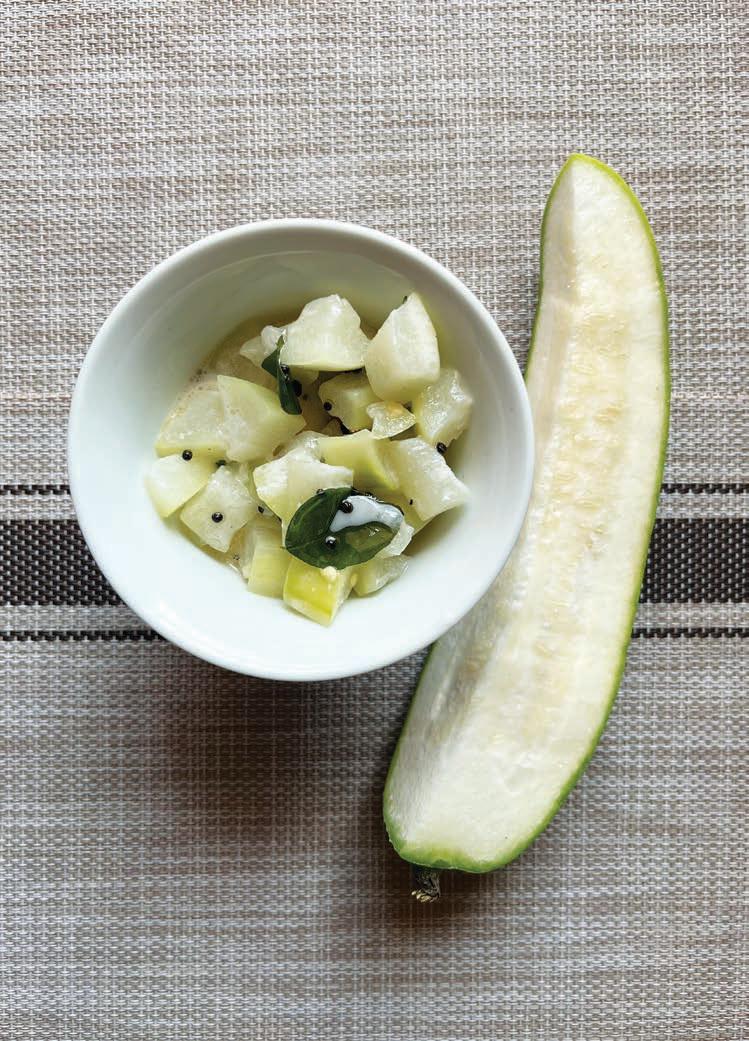
WHENEVER SOMEONE mentions ash gourd, an image of the translucent, sugary sweet petha—famously linked with Agra—comes to mind. It is so popular that the gourd, known as Benincasa hispida in scientific lexicon, is also called petha. However, over the past few years ash gourd has managed to change its image, and has now become popular among health enthusiasts too, who champion a raw juice made with the vegetable for daily detoxification and improved gut health.
But if neither the sweet nor the juice sound too tempting, one can always try the traditional ash gourd recipes that have been consumed by communities across the country for generations. The unripe vegetable, hairy on the outside, is prepared in a lightly spiced stir fry or cooked with coconut milk in Kerala and Andhra Pradesh.
In the Himalayan region, the gourd is used to prepare dry dumplings or vadis with pulses such as green gram, which can be used round the year. In Karnataka, traditional Udupi recipes use the gourd to make dishes like sambar, halwa and even chutney. In Maharashtra, it is used to prepare a sweet dish called kohalyachi vadee. And in West Bengal, the ash gourd is used in chalkumro'r bora, a fritter, and chal kumro ghonto, a dish of mixed vegetables that is also popular among health enthusiasts.
In whichever form one may like to consume it, the gourd can provide many health benefits. It is a good source of micronutrients such as calcium, iron and vitamins A and C.


This story is from the August 16, 2025 edition of Down To Earth.
Subscribe to Magzter GOLD to access thousands of curated premium stories, and 10,000+ magazines and newspapers.
Already a subscriber? Sign In
MORE STORIES FROM Down To Earth
Down To Earth
KING OF BIRDS
Revered for centuries, western tragopan now needs protection as its forests shrink, human pressures mount

3 mins
December 16, 2025
Down To Earth
WHISKERS ALL AQUIVER
Climate change threatens creatures that have weathered extreme environments for thousands of years
2 mins
December 16, 2025

Down To Earth
GOLDEN SPIRIT
Survival of the shy primate is closely tied to the health of Western Ghats
3 mins
December 16, 2025

Down To Earth
RINGED EYES IN THE CANOPY
Rapid habitat destruction forces arboreal langur to alter habits
2 mins
December 16, 2025

Down To Earth
HANGING BY THE CLIFF
The Himalaya's rarest wild goat is on the brink of local extinction
2 mins
December 16, 2025

Down To Earth
ANGEL OF THE BEAS
Conservation reserves, citizen science, and habitat protection give the Indus River dolphin a fighting chance in India
2 mins
December 16, 2025

Down To Earth
UNDER MOONLIT SCRUB
Survival of this hidden guardian tells us whether our scrublands still breathe
2 mins
December 16, 2025
Down To Earth
SYMBOL OF SILENT VALLEY
Lion-tailed macaque remains vulnerable despite past victories
2 mins
December 16, 2025

Down To Earth
THE APE IN OUR STORIES
India's only non-human ape species is a cultural icon threatened by forest fragmentation
2 mins
December 16, 2025

Down To Earth
SENTINEL OF THE HIGH COLD DESERT
The bird's evocative call may not continue to roll across the cold desert valley for long
3 mins
December 16, 2025
Listen
Translate
Change font size