Try GOLD - Free
A REGIME UPENDED
Down To Earth
|February 16, 2023
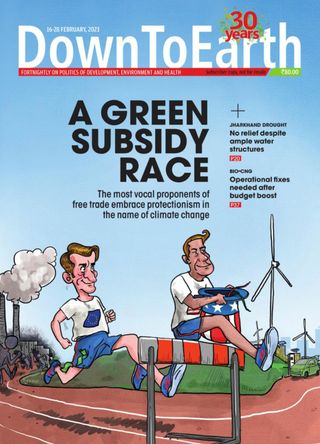
The US and EU have finally come on board on green industrial policy, but they are kicking away that ladder for other countries
-

THE CLIMATE-FOCUSSED trade measures introduced by the US and European countries in recent months mark a huge reversal of their approach to global trade governance. In the past three decades, these rich countries have often joined forces through the World Trade Organization (WTO) and tried to knock down trade barriers and encourage countries to treat one another's products equally to boost global commerce and, in their estimation, to bring about stability of the global economy.
To understand this dynamic, you have to view how the free trade regime came about, says Sunita Narain, director-general of the Centre for Science and Environment (CSE), Delhi. In the 1990s, the rich world found that it would be cheaper for its industries to set up shop in parts of the world, like in China, where labour was cheap, labour conditions were weak and environmental safeguards could be ignored. As a result, the rich world "exported" their emissions to the balance sheet of "other" countries and continued to consume goods at cheaper rates, while not reducing their domestic emissions, Narain explains.
According to Sanjay Reddy, chair of the Department of Economics at the New School for Social Research, US, measures like CBAM are being imposed in an already uneven context, due to the prior failure of rich countries to make good on their promises to make green technologies more accessible to developing countries through extending knowledge or providing financing. One way to implement such compensation would be, suggests Reddy, to operationalise cbam but to remit all of the taxes collected to exporting countries, which could then choose to transfer some of these funds to affected industries and firms as grants to aid in the implementation of clean technologies.

This story is from the February 16, 2023 edition of Down To Earth.
Subscribe to Magzter GOLD to access thousands of curated premium stories, and 10,000+ magazines and newspapers.
Already a subscriber? Sign In
MORE STORIES FROM Down To Earth
Down To Earth
Popular distrust
THE WORLD seems to be going through a period of stasis despite facing an unfathomable polycrisis.

2 mins
February 01, 2026
Down To Earth
CONSERVE OR PERISH
Periyar Tiger Reserve has rewritten Indian conservation by turning poachers into protectors and conflict into coexistence
5 mins
February 01, 2026

Down To Earth
'Rivers need to run free'
From Tibet to West Bengal, the Brahmaputra is the pulse of communities and ecosystems along its course. But what are the risks the river faces through human interventions, particularly dams, discusses journalist, author and filmmaker SANJOY HAZARIKA in his new book, River Traveller.
4 mins
February 01, 2026

Down To Earth
India is facing up to its innovation lag
There are signs now that India is acknowledging the superior strides made by China in a frontier technology like Al
4 mins
February 01, 2026

Down To Earth
Competing concerns
What are the repercussions of the EU-Mercosur pact that have made European farmers protest against the free trade agreement?
4 mins
February 01, 2026

Down To Earth
From fryer to flight
Sustainable fuel made from used cooking oil can play a pivotal role in helping India achieve its aviation emission reduction goals. Measures to collect this oil must be revamped
4 mins
February 01, 2026

Down To Earth
ACCESS OPEN
An amendment to India's nodal forest conservation law opens up forests across India to commercial exploitation by the paper industry
6 mins
February 01, 2026
Down To Earth
DRINK FROM TAP CAN BE A REALITY
As cities across India struggle to supply safe piped water, Odisha offers a success story
2 mins
February 01, 2026

Down To Earth
GREAT DRYING
The Earth is hotter than at any point in the past 100,000 years, with 2023-25 becoming the warmest three-year period on record and also breaching the 1.5°C threshold for the first time. One fallout is dwindling freshwater.
22 mins
February 01, 2026

Down To Earth
Green redemption
Restoration of grasslands of Kerala's Pampadum Shola National Park, once dominated by invasive Australian wattles, see a return of streams and native species
1 mins
February 01, 2026
Translate
Change font size