Try GOLD - Free
A DEVELOPING CRISIS
Down To Earth
|July 16, 2023
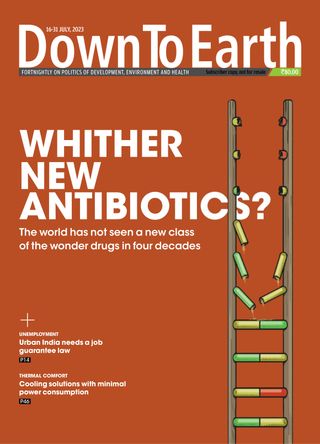
Most big pharmaceutical companies have all but quit research and development of new antibiotics since it is a low-return venture. Rapid rise of antimicrobial resistance means the old ammunition is misfiring. Without effective antibiotics, global healthcare will lose the treatment framework it stands on. A report by AMIT KHURANA, RAJESHWARI SINHA and GAURI ARORA on the precipitating global health crisis

I WOULD PRAY very hard," says V Ramasubramanian, when asked what if antibiotics failed to work one day. For the Chennai-based doctor who specialises in infectious diseases and tropical medicines, it is just impossible to contemplate a world without these wonder drugs that have revolutionised modern medicine since Alexander Fleming discovered the first of the kind, penicillin, in 1928. Today, antibiotics underpin much of the treatment we receive-be it for a small scrape or an organ transplant. Scientists estimate that by preventing people from dying of bacterial infections, antibiotics have helped increase life expectancy by 23 years. But the progress made over the last century is getting eroded.
Repeated exposure to antibiotics, due to unnecessary use, has prompted these single-cell pathogens to mutate and evolve their defence mechanisms to inactivate or evade the drugs. A May 2023 study by UK researchers has found that some bacteria adapt special pumps to flush antibiotics out of their cells. Then there are those resistant to multiple drugs. Last year, a report by medical journal The Lancet found that antibiotic resistance is now a leading cause of death worldwide. In 2019, antibiotic resistance was linked to 5 million deaths, with 1.3 million deaths directly attributed to it.
The real danger is that while bacteria are developing drug resistance at a disconcerting pace, not many antibiotics are in sight to replace the failing ammunitions. "We see bacteria that are resistant to almost all currently available antibiotics," Giorgia Sulis, assistant professor, School of Epidemiology and Public Health, University of Ottawa, Canada, who has worked extensively on tuberculosis (TB), tells

This story is from the July 16, 2023 edition of Down To Earth.
Subscribe to Magzter GOLD to access thousands of curated premium stories, and 10,000+ magazines and newspapers.
Already a subscriber? Sign In
MORE STORIES FROM Down To Earth
Down To Earth
MAJESTIC SARUS STAGES COMEBACK
Involvement of farmers in conservation helps the sarus crane population soar in eastern Uttar Pradesh over the past decade

5 mins
June 16, 2026

Down To Earth
Global resistance to AI data centres hardens
India must learn how to regulate environmentally disastrous data centres that guzzle more water and power than entire nations
4 mins
June 16, 2026

Down To Earth
SUMMER SMOG
Ground-level ozone is one of the national capital's least appreciated public health threat
1 mins
June 16, 2026

Down To Earth
A FOREST IN WAIT
For five decades, Abujhmad in Chhattisgarh was closed to the country. Now, as the region opens up, ANIL ASHWANI SHARMA travels to villages in its dense forests to see how isolation has impacted the people and development
6 mins
June 16, 2026

Down To Earth
DON'T WASTE THE FUTURE
Policymakers may need to focus less on expanding programmes and more on improving their effectiveness and reach, suggests the latest NFHS-6 data
3 mins
June 16, 2026
Down To Earth
NEED A FOREST TRIBUNAL
A tribunal will provide people a dedicated independent forum where they will have a statutory right to approach
2 mins
June 16, 2026
Down To Earth
Moment or movement
ONE DEFINITION of the word metamorphosis in the dictionary is “a striking alteration in appearance, character, or circumstances”.
2 mins
June 16, 2026

Down To Earth
El Niño, amplified
As a possible super El Niño looms in 2026, scientists warn of devastations that may extend into 2027
6 mins
June 16, 2026

Down To Earth
A mindless denial
District level bodies are increasingly refusing tribal population's rights over resources guaranteed by the forest rights Act
5 mins
June 16, 2026

Down To Earth
TOOR TOUR
What makes pigeon pea so ubiquitous across cuisines in India
4 mins
June 16, 2026
Translate
Change font size