
Go Unlimited with Magzter GOLD
Get unlimited access to 10,000+ magazines, newspapers and Premium stories for just
Build a zero-magnification finder
BBC Sky at Night Magazine
|February 2023
Make an illuminated aiming device you can use on any telescope
-

This month's project helps you aim your scope at a target in the night sky. It is called a zero-magnification finder because the view is the same size as seen with your naked eye. The finder projects a red circle onto the background sky and you move your telescope to align the centre of this circle with your target. Many stargazers use similar devices because they allow you to keep both eyes open and see a much larger area of sky, making it easier to jump to the target.
Our design has a red LED that illuminates the white interior of the front of the case. The LED is powered by a coin cell battery, via a switch on the back panel. The red light is reflected backwards through a clear glass screen, painted matt black except for a small ring in the centre. The light is then reflected upwards by a mirror mounted at 45° and through a lens, which produces a sharp image. This is reflected backwards again by a glass viewing screen, mounted at 45° in a hood. When the distant sky is viewed through this screen, the red circle is superimposed on it.
We sourced the components for this project imaginatively to keep the cost down. The LED, coin cell holder and switch are from an educational supplier. The clear glass was cut from an old picture frame, and we used the frame's thin MDF backing to make the case. The front surface mirror is a disposable dentist's mirror. We found these online, along with the lens, a Fresnel magnifier sheet.
Mounting matters


This story is from the February 2023 edition of BBC Sky at Night Magazine.
Subscribe to Magzter GOLD to access thousands of curated premium stories, and 10,000+ magazines and newspapers.
Already a subscriber? Sign In
MORE STORIES FROM BBC Sky at Night Magazine
BBC Sky at Night Magazine
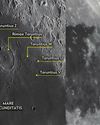
MOONWATCH
January's top lunar feature to observe

2 mins
January 2026
BBC Sky at Night Magazine
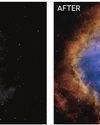
Speed up your processing workflow
How to use Photoshop's Actions tool to drastically cut your processing time
3 mins
January 2026
BBC Sky at Night Magazine
Chasing Canada's polar lights
With solar maximum peaking and a new Moon promising dark skies, Jamie Carter travels to Churchill, Manitoba to hunt the Northern Lights - and dodge polar bears – in Canada's far north
7 mins
January 2026
BBC Sky at Night Magazine
Beyond Pluto: The search for the hidden planets
Could one – or even two - undiscovered planets lurk at the edges of our Solar System? Nicky Jenner explores how close we are to finding the elusive 'Planet 9'
6 mins
January 2026
BBC Sky at Night Magazine
Jupiter moon events
Jupiter is a magnificent planet to observe.
2 mins
January 2026

BBC Sky at Night Magazine
What samples from space have taught us
Alastair Gunn explains what scientists have learnt in the 20 years since the first unmanned mission brought materials back from alien worlds
3 mins
January 2026
BBC Sky at Night Magazine
The Milky Way as you've never seen it before
This is the largest low-frequency radio colour image of our Galaxy ever assembled
1 min
January 2026
BBC Sky at Night Magazine
Merger of ‘impossibly' massive black holes explained
Scientists discover how enormous, fast-spinning black holes can exist after all
1 mins
January 2026
BBC Sky at Night Magazine
Lunar occultation of the Pleiades
BEST TIME TO SEE: 27 January from 20:30 UT
1 min
January 2026
BBC Sky at Night Magazine
The Universe's expansion may be slowing down
New study suggests current theories of dark energy could be wrong
1 mins
January 2026
Translate
Change font size