
Go Unlimited with Magzter GOLD
Get unlimited access to 10,000+ magazines, newspapers and Premium stories for just
A very British eclipse
BBC Sky at Night Magazine
|June 2024
In 1927, Britain experienced its first total solar eclipse since 1724. Mike Frost looks at how, like 8 April 2024's US spectacle, eclipse fever swept the nation
-
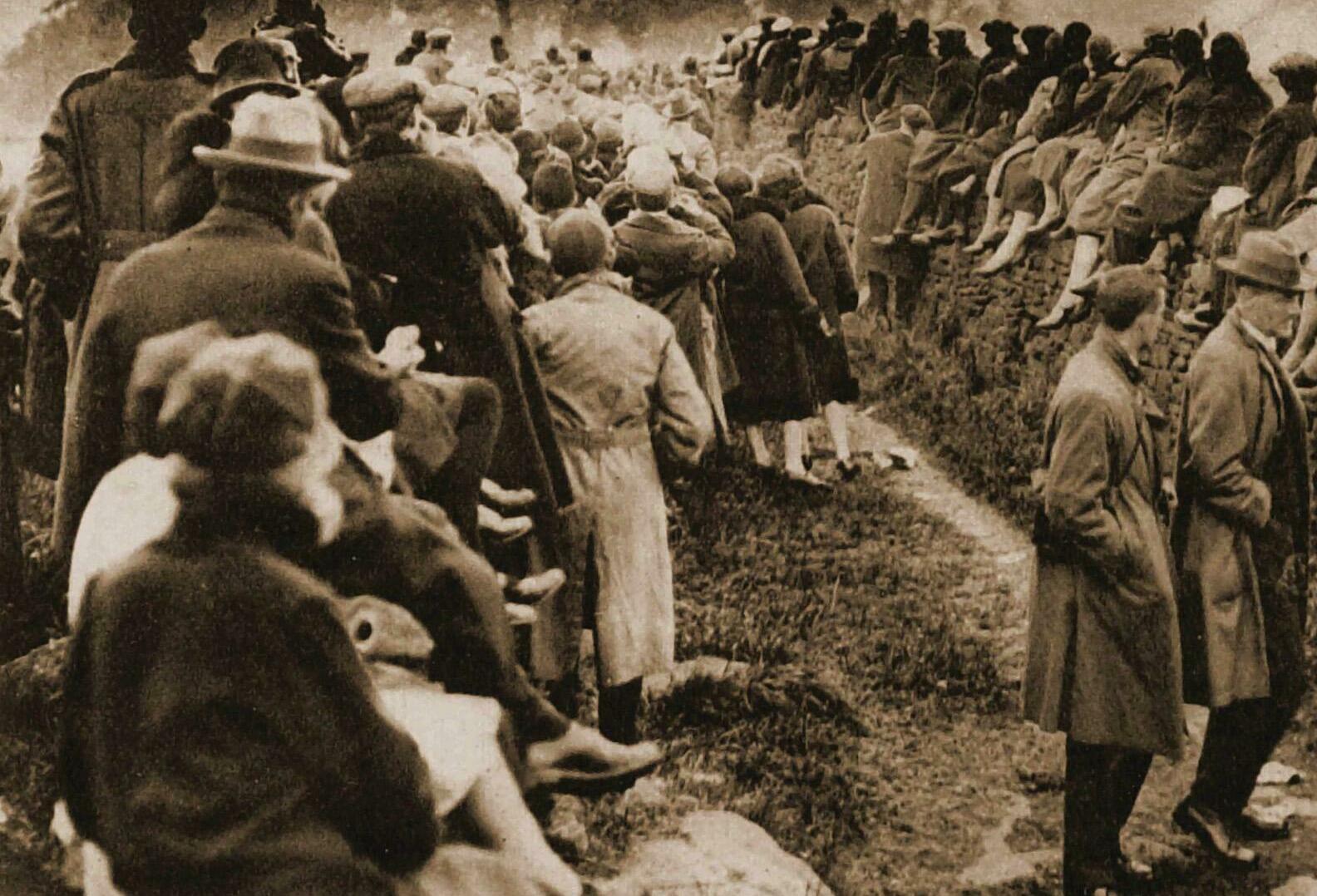
"At the back of us were great blue spaces in the clouds. But now the colour was going out. The clouds were turning pale; a reddish black colour. Down in the valley it was an extraordinary scrumble of red & black; there was the one light burning; all was cloud down there, & very beautiful, so delicately tinted. Nothing could be seen through the cloud. The 24 seconds were passing." Virginia Woolf, 'The Sun and the Fish', 1928
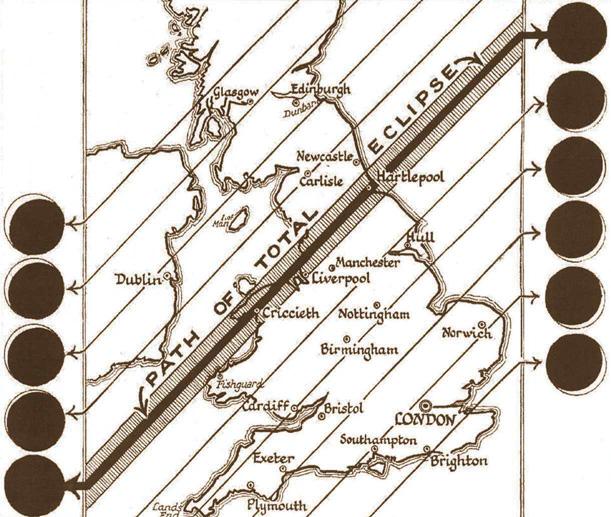
Early on the morning of 29 June 1927, the shadow of the Moon kissed the north of Wales and crossed the north of England. That day saw a total solar eclipse, the first in mainland Britain for over 200 years. The track of totality started at dawn to the southwest of Ireland, passed over the Lleyn Peninsula and Eryri (Snowdonia) in north Wales, before touching the English coast at Southport at 06:24 in the morning local time. Blackpool, Blackburn and Preston in Lancashire, Richmond and Middlesbrough in Yorkshire and Darlington in County Durham all saw total eclipses, as did parts of Liverpool and Durham. The track of totality left the English coast near Hartlepool and continued across the North Sea to Scandinavia and northern Russia. The whole of Britain saw at least a 90 per cent partial eclipse.
From the UK, it was a very short eclipse. Southport, on the centreline of totality, saw only 23 seconds of totality, Wales a second less, the east coast a second more. Yet, despite the short duration and the early time, a lot of people travelled to see it. Resorts such as Southport in Merseyside laid on "AllNight Festivities, including a special Open-Air Band Concert in the Municipal Gardens on June 29th at 3:30am". The newspapers estimated that a quarter of a million people were in the resort to see the eclipse.
British weather strikes

This story is from the June 2024 edition of BBC Sky at Night Magazine.
Subscribe to Magzter GOLD to access thousands of curated premium stories, and 10,000+ magazines and newspapers.
Already a subscriber? Sign In
MORE STORIES FROM BBC Sky at Night Magazine
BBC Sky at Night Magazine
MOONWATCH
January's top lunar feature to observe

2 mins
January 2026
BBC Sky at Night Magazine
Speed up your processing workflow
How to use Photoshop's Actions tool to drastically cut your processing time
3 mins
January 2026
BBC Sky at Night Magazine
Chasing Canada's polar lights
With solar maximum peaking and a new Moon promising dark skies, Jamie Carter travels to Churchill, Manitoba to hunt the Northern Lights - and dodge polar bears – in Canada's far north
7 mins
January 2026
BBC Sky at Night Magazine
Beyond Pluto: The search for the hidden planets
Could one – or even two - undiscovered planets lurk at the edges of our Solar System? Nicky Jenner explores how close we are to finding the elusive 'Planet 9'
6 mins
January 2026
BBC Sky at Night Magazine
Jupiter moon events
Jupiter is a magnificent planet to observe.
2 mins
January 2026
BBC Sky at Night Magazine
What samples from space have taught us
Alastair Gunn explains what scientists have learnt in the 20 years since the first unmanned mission brought materials back from alien worlds
3 mins
January 2026
BBC Sky at Night Magazine
The Milky Way as you've never seen it before
This is the largest low-frequency radio colour image of our Galaxy ever assembled
1 min
January 2026
BBC Sky at Night Magazine
Merger of ‘impossibly' massive black holes explained
Scientists discover how enormous, fast-spinning black holes can exist after all
1 mins
January 2026
BBC Sky at Night Magazine
Lunar occultation of the Pleiades
BEST TIME TO SEE: 27 January from 20:30 UT
1 min
January 2026
BBC Sky at Night Magazine
The Universe's expansion may be slowing down
New study suggests current theories of dark energy could be wrong
1 mins
January 2026
Listen
Translate
Change font size